
Korean Healthy Food: Korean Healing Foods and What Science Says
Korean home cooking centers on rice, soup and many small side dishes (banchan), most of them vegetables, plus tofu, fish and fermented foods such as kimchi. This World Healing Foods guide covers a Korean healthy food list and what research says. This page describes traditional foods and what research says about them. Foods support an overall healthy pattern; they do not treat any disease.
Food culture at a glance
A typical meal pairs mixed-grain rice and a soup or stew with several vegetable banchan. Many dishes, though, get their flavor from salty fermented pastes and sauces.
Top healing foods and what research says
| Food | What it offers | Evidence strength |
|---|---|---|
| Kimchi | fermented vegetables; may contain live microbes; salty (NIH NCCIH) | Limited (benefits strain-specific) |
| Namul (seasoned vegetables) | fiber-rich vegetables (Mayo Clinic) | Strong (vegetables) |
| Tofu (dubu) | soy protein may lower cholesterol slightly (NIH NCCIH) | Moderate |
| Doenjang (soybean paste) stew | fermented soy with vegetables; salty (Mayo Clinic) | Limited |
| Mackerel and other fish | EPA and DHA omega-3s (NIH ODS) | Strong (nutrient source) |
| Seaweed (gim, miyeok) | iodine-rich; too much is harmful (NIH ODS) | Strong for iodine |
| Mixed-grain rice (japgokbap) | whole grains such as barley (Mayo Clinic) | Strong (whole grains) |
| Ssam (lettuce wraps) | adds vegetables to every bite (WHO) | Strong (vegetables) |
| Garlic | supplements may lower cholesterol slightly (NIH NCCIH) | Limited (food amounts) |
| Green or barley tea | green tea linked to lower heart risk in Asian populations (NIH NCCIH) | Mixed |
Evidence notes
- Kimchi and fermented foods: fermented foods can contain live microbes, but NIH notes probiotic benefits are strain-specific and not established for most uses. (NIH NCCIH)
- Soy: soy protein in place of other proteins may lower cholesterol to a small extent. (NIH NCCIH)
- Fish: mackerel and other fatty fish provide EPA and DHA omega-3s. (NIH ODS)
- Garlic: Garlic supplements may lower total and LDL cholesterol to a small extent in people with high cholesterol; research has mostly tested supplements, not garlic in food. (NIH NCCIH)
Signature healthy dishes
- Bibimbap with lots of vegetables, an egg and a small amount of gochujang
- Doenjang jjigae (soybean paste stew) with tofu and vegetables, light on paste
- Grilled mackerel with mixed-grain rice and namul
- Miyeok guk (seaweed soup), low salt
- Ssam: lettuce wraps with grilled fish or tofu
Watch-outs: sodium
- Kimchi, gochujang and doenjang are salty and may add a lot of sodium. USDA data list about 750 mg of sodium in one cup (150 g) of kimchi (about 498 mg per 100 g; FDC ID 170392) (USDA FoodData Central). One brand of soybean paste (doenjang) lists about 580 mg in a 12-gram serving (about 4,830 mg per 100 g; FDC ID 391944) (USDA FoodData Central). One brand of gochujang sauce lists about 290 mg in a 2-tablespoon serving (FDC ID 2244609), and one brand of gochujang lists about 2,750 mg per 100 g (FDC ID 2410981) (USDA FoodData Central); values vary, so check labels.
- WHO advises adults keep sodium under 2,000 mg a day; high sodium raises blood pressure. (WHO)
- Seaweed is rich in iodine, and too much iodine can cause thyroid problems. (NIH ODS)
How to try it
- Serve kimchi as a small side rather than a main portion, and rinse or choose lower-salt versions
- Swap half the white rice for barley or mixed grains
- Fill half the table with namul and fresh vegetables
Related: fermented foods and the microbiome, fermented foods, high blood pressure Heal Story and kidney stones Heal Story.
Cooking for kids? See Japanese food for kids and healthy Chinese food for kids for East Asian kid-safe prep.
Cooking for kids? See healthy Korean food for kids.
Nearby cuisines: Japanese healing foods · Cantonese healing foods · Thai healing foods · World Healing Foods hub
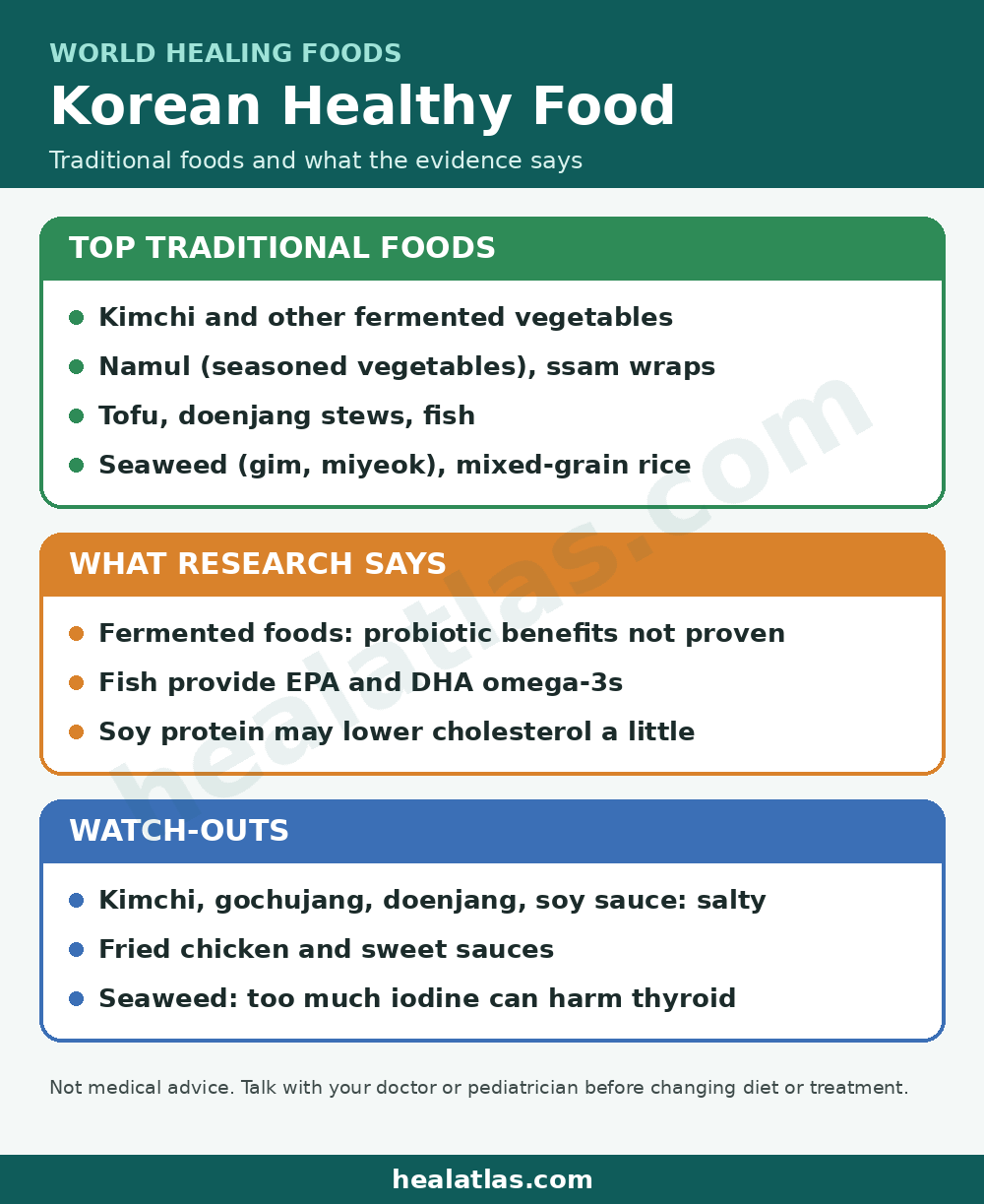
Infographic
Related on HealAtlas: World Healing Foods hub · Japanese healing foods · Fermented foods and gut health · High Blood Pressure Heal Story · Fermented foods
FAQ
Is Korean food healthy?
Many traditional meals can be: rice, soup and vegetable side dishes with tofu or fish may support a healthy diet. The main watch-out is sodium from kimchi, pastes and sauces. (WHO) (WHO)
Is kimchi good for gut health?
Kimchi is a fermented food that can contain live microbes, but NIH notes probiotic benefits depend on the strain and are not proven for most uses. It is also salty and may add a lot of sodium (USDA FoodData Central lists about 498 mg per 100 g), so keep portions small. (NIH NCCIH) (USDA FoodData Central)
What are the healthiest Korean dishes?
Vegetable-rich bibimbap, tofu and vegetable stews, grilled fish with mixed-grain rice, and namul are good choices, with sauces and pastes used lightly. (Mayo Clinic)
Is gochujang high in sodium?
It can be. One brand of gochujang sauce in USDA FoodData Central lists about 290 mg of sodium per 2-tablespoon serving, and one brand of gochujang lists about 2,750 mg per 100 g; values vary, so check labels. WHO recommends adults keep sodium under 2,000 mg a day. (USDA FoodData Central) (WHO)
Is seaweed soup (miyeokguk) good for you?
Seaweed such as miyeok is rich in iodine, which the body needs, but too much iodine may cause thyroid problems, so enjoy seaweed in normal food amounts. (NIH ODS)
Is tofu a healthy protein choice?
Tofu is made from soy, and NIH notes that eating soy protein in place of other proteins may lower cholesterol levels to a small extent. (NIH NCCIH)
How can I make Korean meals lower in sodium?
Use smaller amounts of kimchi, soy sauce, gochujang and doenjang, and fill up on namul and fresh vegetables. Mayo Clinic advises limiting salty condiments and using herbs and spices for flavor, which may support lower sodium intake. (Mayo Clinic)
Sources
- Mayo Clinic. Sodium: How to tame your salt habit. https://www.mayoclinic.org/healthy-lifestyle/nutrition-and-healthy-eating/in-depth/sodium/art-20045479 (accessed Oct 25, 2026)
- World Health Organization. Healthy diet fact sheet. https://www.who.int/news-room/fact-sheets/detail/healthy-diet (accessed Oct 25, 2026)
- USDA FoodData Central. Cabbage, kimchi, SR Legacy FDC ID 170392 (498 mg sodium per 100 g; 1 cup = 150 g). https://fdc.nal.usda.gov/food-search/?query=kimchi (accessed Oct 26, 2026)
- USDA FoodData Central. Gochujang sauce (branded), FDC ID 2244609 (about 290 mg sodium per 2 Tbsp serving), and Gochujang Korean fermented chili sauce (branded), FDC ID 2410981 (2,750 mg sodium per 100 g); values vary by brand. https://fdc.nal.usda.gov/food-search/?query=gochujang (accessed Oct 26, 2026)
- USDA FoodData Central. Soybean paste (branded), FDC ID 391944 (4,830 mg sodium per 100 g; serving 12 g); values vary by brand. https://fdc.nal.usda.gov/food-search/?query=soybean%20paste (accessed Oct 26, 2026)
- World Health Organization. Sodium reduction fact sheet. https://www.who.int/news-room/fact-sheets/detail/sodium-reduction (accessed Oct 25, 2026)
- Mayo Clinic. Dietary fiber: Essential for a healthy diet. https://www.mayoclinic.org/healthy-lifestyle/nutrition-and-healthy-eating/in-depth/fiber/art-20043983 (accessed Oct 25, 2026)
- Mayo Clinic. Whole grains: Hearty options for a healthy diet. https://www.mayoclinic.org/healthy-lifestyle/nutrition-and-healthy-eating/in-depth/whole-grains/art-20047826 (accessed Oct 25, 2026)
- NIH Office of Dietary Supplements. Omega-3 Fatty Acids: Fact Sheet for Consumers. https://ods.od.nih.gov/factsheets/Omega3FattyAcids-Consumer/ (accessed Oct 25, 2026)
- NIH Office of Dietary Supplements. Iodine: Fact Sheet for Consumers. https://ods.od.nih.gov/factsheets/Iodine-Consumer/ (accessed Oct 25, 2026)
- NCCIH (NIH). Probiotics: Usefulness and Safety. https://www.nccih.nih.gov/health/probiotics-usefulness-and-safety (accessed Oct 25, 2026)
- NCCIH (NIH). Green Tea: Usefulness and Safety. https://www.nccih.nih.gov/health/green-tea (accessed Oct 25, 2026)
- NCCIH (NIH). Soy: Usefulness and Safety. https://www.nccih.nih.gov/health/soy (accessed Oct 25, 2026)
- NCCIH (NIH). Garlic: Usefulness and Safety. https://www.nccih.nih.gov/health/garlic (accessed Oct 25, 2026)