
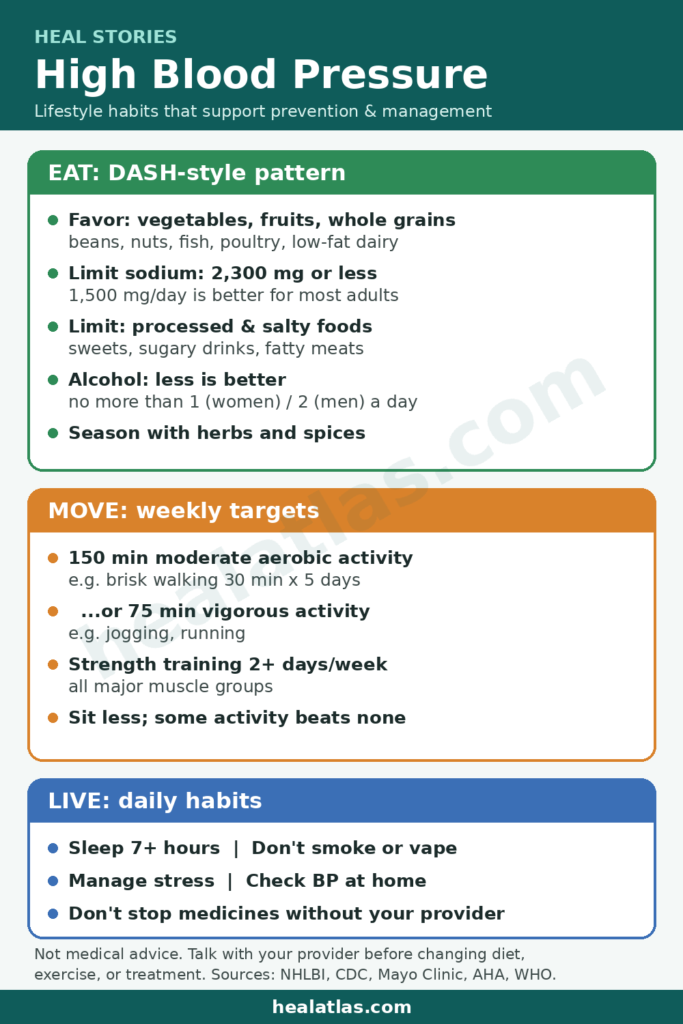
High blood pressure is common, often silent, and very manageable with the right care. This Heal Stories guide pulls together what trusted health organizations say about everyday habits that support prevention and management, alongside the care plan you build with your healthcare provider.
What it is
Blood pressure is the force of blood pushing against the walls of your arteries. High blood pressure (hypertension) means that force stays too high over time, which can damage the heart, blood vessels, kidneys, and brain. (NHLBI) The WHO defines hypertension as blood pressure of 140/90 mm Hg or higher, confirmed on two different days, and estimates it affected about 1.4 billion adults aged 30–79 worldwide in 2024. (WHO)
Many people have no symptoms, so the only way to know is to have your blood pressure checked. (WHO) Risk factors include older age, genetics, overweight or obesity, physical inactivity, a high-salt diet, and drinking too much alcohol. (WHO)
Signs that mean see a doctor now
- Call 911 if your blood pressure is higher than 180/120 mm Hg and you have chest pain, shortness of breath, back pain, numbness, weakness, a change in vision, or difficulty speaking. This is a medical emergency; do not wait to see if it comes down. (AHA)
- If a reading is higher than 180/120 mm Hg, wait at least 1 minute and measure again. If it is still that high but you have no symptoms, contact your healthcare professional as soon as possible. (AHA)
- If you have been diagnosed, track your readings and medicines; these records help your care team. (AHA)
Prevention
Healthy lifestyle habits can help prevent high blood pressure and lower your risk of heart disease and stroke. (CDC)
- Eat a healthy, lower-salt diet. (CDC)
- Reach and keep a healthy weight. Overweight and obesity raise risk; Mayo Clinic notes blood pressure may drop about 1 mm Hg per kilogram (2.2 lb) lost in people with excess weight. (CDC) (Mayo Clinic)
- Be physically active most days of the week. (CDC)
- Don’t smoke or vape. Tobacco and nicotine raise blood pressure. (CDC) (Mayo Clinic)
- Limit alcohol. CDC advises no more than 2 drinks a day for men and 1 for women; Mayo Clinic notes that less is better. (CDC) (Mayo Clinic)
- Get enough sleep and manage stress. CDC recommends at least 7 hours of sleep a night for adults. (CDC) (CDC)
- Check your blood pressure at home and at regular checkups. (Mayo Clinic)
Food practices
The NHLBI’s DASH (Dietary Approaches to Stop Hypertension) eating plan is a flexible, heart-healthy pattern that helps lower blood pressure. (NHLBI) A systematic review and meta-analysis of randomized trials found DASH lowered systolic and diastolic blood pressure in adults with and without hypertension. (PubMed review)
Foods to favor
- Vegetables and fruits (NHLBI)
- Whole grains (NHLBI)
- Fat-free or low-fat dairy (NHLBI)
- Fish, poultry, beans, nuts, and seeds (NHLBI)
- Vegetable oils, and foods rich in potassium, calcium, magnesium, and fiber (NHLBI) (Mayo Clinic)
- Herbs and spices in place of table salt (Mayo Clinic) (more ideas: potassium-rich foods, magnesium-rich foods, and our healthy foods guide)
Foods to limit
- Sodium: 2,300 mg a day or less; 1,500 mg a day or less is better for most adults. (Mayo Clinic) A meta-analysis of 133 trials found that reducing sodium lowered blood pressure, with larger reductions linked to bigger effects. (PubMed review)
- Processed and packaged foods, where most dietary sodium comes from. Read labels. (Mayo Clinic)
- Foods high in saturated fat, such as fatty meats, full-fat dairy, and tropical oils (NHLBI)
- Sugar-sweetened drinks and sweets (NHLBI)
- Alcohol (CDC)
Many salt substitutes contain potassium chloride. People with kidney disease or who take certain medicines (such as ACE inhibitors, ARBs, or potassium-sparing diuretics) should talk with their healthcare provider before using salt substitutes, because of the risk of high blood potassium (hyperkalemia). (NIH ODS)
A sample day of meals
An example of a DASH-style day, built from the food groups above. Portions and calorie needs vary; a registered dietitian or your provider can tailor it. (NHLBI)
| Meal | Example |
|---|---|
| Breakfast | Oatmeal with berries and unsalted walnuts; low-fat milk or yogurt |
| Lunch | Large salad with greens, beans, tomatoes, and grilled chicken; olive-oil dressing; whole-grain roll |
| Snack | An apple or banana and a small handful of unsalted almonds |
| Dinner | Baked salmon, brown rice, steamed broccoli and carrots seasoned with lemon and herbs |
| Drinks | Water; limit sugary drinks and alcohol |
Exercise and lifestyle habits
Regular physical activity helps keep a healthy weight and lower blood pressure. (CDC) A large network meta-analysis of randomized trials found that aerobic, dynamic resistance, combined, high-intensity interval, and isometric exercise training all lowered resting blood pressure. (PubMed review) Check with your provider before starting a new exercise program. (Mayo Clinic)
| Habit | How often | How intense |
|---|---|---|
| Moderate aerobic activity (brisk walking, cycling, swimming, dancing) | At least 150 min/week, e.g. 30 min × 5 days | Moderate: you can talk but not sing |
| Or vigorous aerobic activity (jogging, running) | 75 min/week, or a mix of moderate and vigorous | Vigorous |
| Muscle strengthening (all major muscle groups) | 2 or more days/week | Moderate or greater |
| Move more, sit less | Daily | Any amount helps |
| Sleep | At least 7 hours a night for adults (7–9 hours for ages 61–64; 7–8 hours for 65+) | — |
| Stress management (e.g. deep breathing, meditation, social support) | Daily | — |
Sources for the table: (CDC) (Mayo Clinic) (CDC)
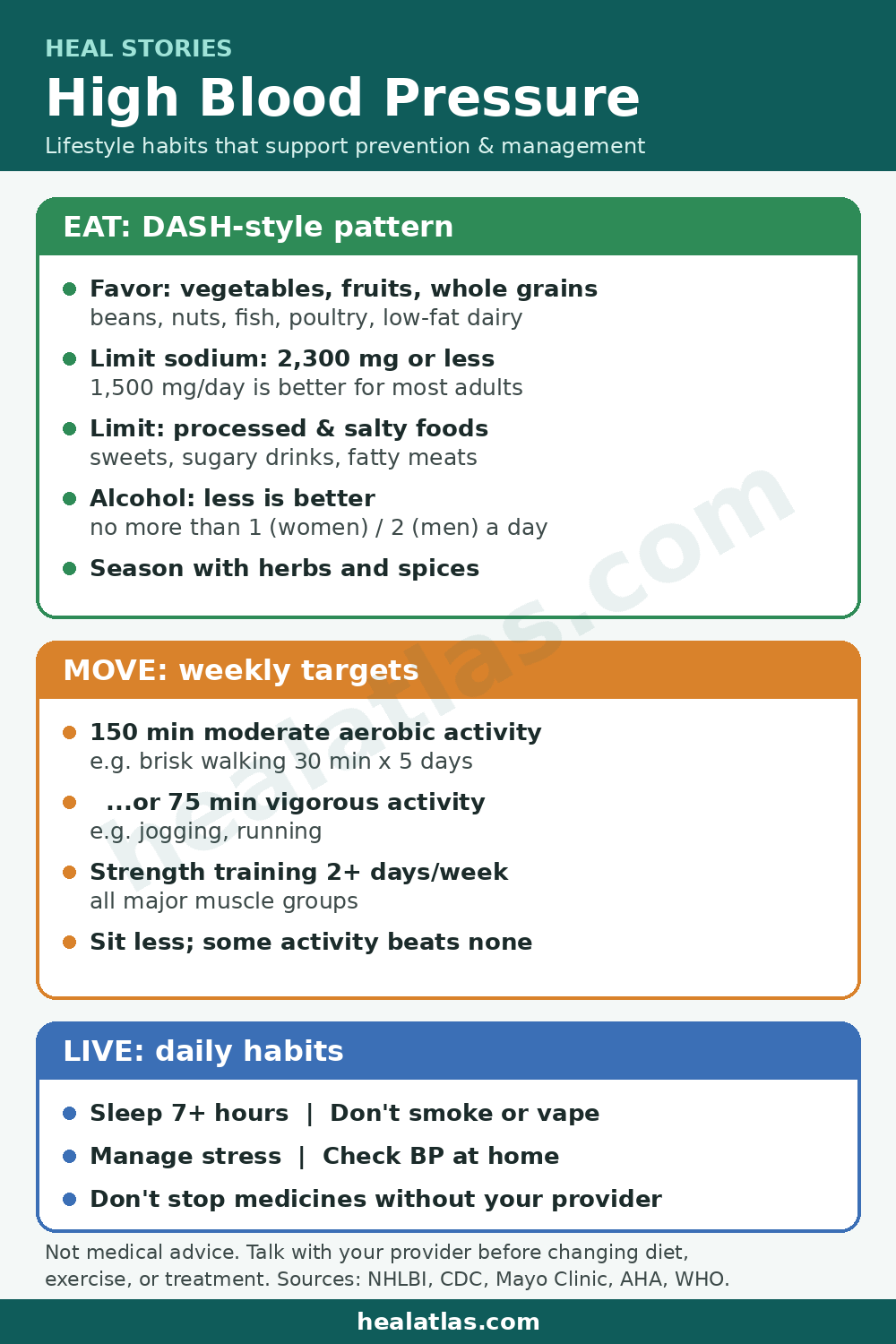
Infographic
FAQ
Can lifestyle changes cure high blood pressure?
No. Healthy habits can help lower blood pressure and support its management, and may delay or lessen the need for medicine for some people, but they are not a cure. Many people still need medicine, so do not stop or change any prescribed medicine without talking to your healthcare provider. (Mayo Clinic) (WHO)
How much sodium should I aim for?
Mayo Clinic advises limiting sodium to 2,300 mg a day or less, and notes that 1,500 mg a day or less is better for most adults. (Mayo Clinic)
What is the DASH eating plan?
DASH (Dietary Approaches to Stop Hypertension) is a flexible eating pattern from the NHLBI that emphasizes vegetables, fruits, whole grains, fat-free or low-fat dairy, fish, poultry, beans, and nuts, and limits saturated fat, sodium, and sugar. (NHLBI)
How much exercise is recommended?
Adults should aim for at least 150 minutes a week of moderate-intensity activity such as brisk walking, or 75 minutes of vigorous activity, plus muscle-strengthening activity on 2 or more days a week. (CDC)
When is high blood pressure an emergency?
The AHA advises calling 911 if your blood pressure is higher than 180/120 mm Hg and you have symptoms such as chest pain, shortness of breath, back pain, numbness, weakness, vision changes, or difficulty speaking. (AHA)
Does high blood pressure cause symptoms?
Often it does not. Many people have no symptoms, so the only way to know is to have your blood pressure checked. (WHO) (NHLBI)
Explore more on HealAtlas: is Sichuan food healthy? A lower-salt Sichuan diet trial · healthiest Cantonese food and lower-sodium dim sum choices
Sources
- NHLBI (NIH). High Blood Pressure – What Is High Blood Pressure? https://www.nhlbi.nih.gov/health/high-blood-pressure (accessed Oct 25, 2026)
- NHLBI (NIH). DASH Eating Plan. https://www.nhlbi.nih.gov/education/dash-eating-plan (accessed Oct 25, 2026)
- CDC. Preventing High Blood Pressure. https://www.cdc.gov/high-blood-pressure/prevention/index.html (accessed Oct 25, 2026)
- CDC. Adult Activity: An Overview. https://www.cdc.gov/physical-activity-basics/guidelines/adults.html (accessed Oct 25, 2026)
- World Health Organization. Hypertension fact sheet. https://www.who.int/news-room/fact-sheets/detail/hypertension (accessed Oct 25, 2026)
- Mayo Clinic. 10 ways to manage high blood pressure without medicine. https://www.mayoclinic.org/diseases-conditions/high-blood-pressure/in-depth/high-blood-pressure/art-20046974 (accessed Oct 25, 2026)
- American Heart Association. When to Call 911 About High Blood Pressure. https://www.heart.org/en/health-topics/high-blood-pressure/understanding-blood-pressure-readings/hypertensive-crisis-when-you-should-call-911-for-high-blood-pressure (accessed Oct 25, 2026)
- Filippou CD, et al. DASH Diet and Blood Pressure Reduction in Adults with and without Hypertension: A Systematic Review and Meta-Analysis of RCTs. Adv Nutr. 2020. PMID 32330233. https://pubmed.ncbi.nlm.nih.gov/32330233/ (accessed Oct 25, 2026)
- Edwards JJ, et al. Exercise training and resting blood pressure: a large-scale pairwise and network meta-analysis of RCTs. Br J Sports Med. 2023. PMID 37491419. https://pubmed.ncbi.nlm.nih.gov/37491419/ (accessed Oct 25, 2026)
- Huang L, et al. Effect of dose and duration of reduction in dietary sodium on blood pressure levels: systematic review and meta-analysis of randomised trials. BMJ. 2020. PMID 32094151. https://pubmed.ncbi.nlm.nih.gov/32094151/ (accessed Oct 25, 2026)
- NIH Office of Dietary Supplements. Potassium: Fact Sheet for Health Professionals. https://ods.od.nih.gov/factsheets/Potassium-HealthProfessional/ (accessed Oct 25, 2026)
- CDC. About Sleep. https://www.cdc.gov/sleep/about/index.html (accessed Oct 25, 2026)