
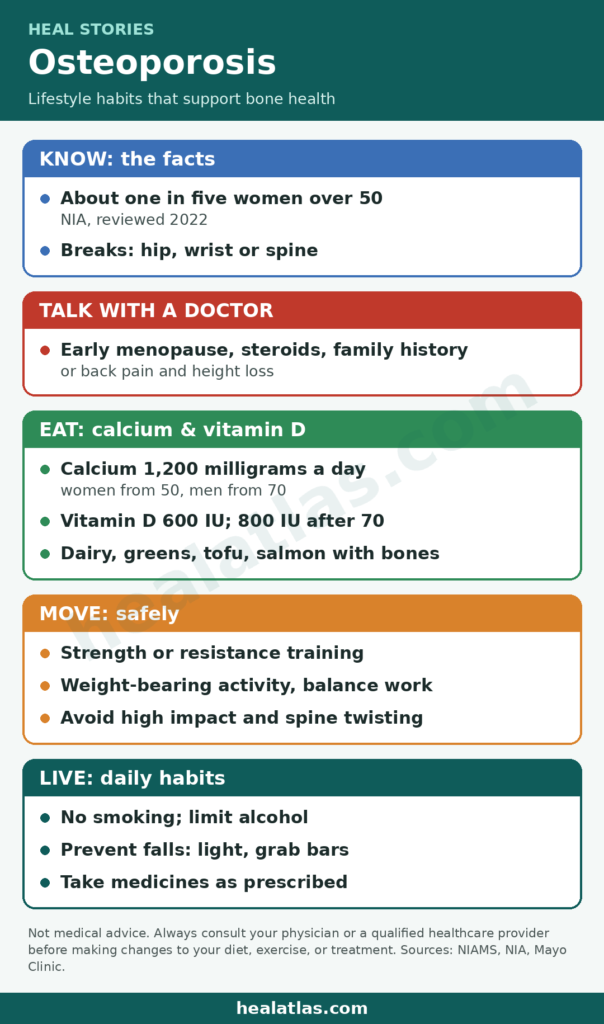
Osteoporosis weakens bones so they break more easily, often without any warning signs until a fracture happens. This Heal Stories guide gathers what trusted health organizations say about food, exercise and safety habits that support bone health and help manage osteoporosis, alongside the care plan and any medicines your healthcare provider prescribes.
What it is
Osteoporosis causes bones to become weak and brittle, so that a fall or even mild stresses such as bending over or coughing can cause a break. Breaks most commonly occur in the hip, wrist or spine. (Mayo Clinic) (NIAMS) According to NIA (content reviewed November 15, 2022), osteoporosis affects about one in five women over age 50, but only about one in 20 men. (NIA)
When to talk with a doctor
- Make an appointment to talk about osteoporosis if you went through early menopause, took corticosteroids for several months at a time, or have a parent or sibling with osteoporosis, especially if a parent had a hip fracture. (Mayo Clinic)
- Tell your care team about possible signs of a fracture: back pain caused by a broken or collapsed bone in the spine, loss of height over time, a stooped posture, or a bone that breaks much more easily than expected. (Mayo Clinic)
Prevention
- Get enough calcium and vitamin D. Most people need at least 600 IU of vitamin D a day, rising to 800 IU after age 70. Calcium needs rise from 1,000 milligrams a day to 1,200 milligrams when women turn 50 and men turn 70. (Mayo Clinic)
- Do weight-bearing and strength exercise and add balance work such as tai chi to lower fall risk. (Mayo Clinic)
- Don’t smoke, and limit alcohol: NIAMS advises no more than one drink a day for women and two for men. (NIAMS)
- Take medicines as prescribed. Even when medicines are used, diet, exercise and lifestyle choices still play an important role in bone health. (NIAMS) (Mayo Clinic)
- Prevent falls: wear low-heeled shoes with nonslip soles, remove cords and area rugs, keep rooms brightly lit, and install grab bars. (Mayo Clinic)
Food practices
A diet rich in calcium and vitamin D helps support bone health. NIA also advises getting enough protein. (NIAMS) (NIA)
Foods to favor
- Calcium: low-fat dairy products; dark green leafy vegetables such as bok choy, collards and turnip greens; broccoli; canned sardines and salmon with bones; tofu; and calcium-fortified foods such as soymilk, orange juice, cereals and breads (NIAMS) (Mayo Clinic)
- Vitamin D: fatty fish such as salmon and trout, egg yolks, and vitamin D-fortified milk and cereal (NIAMS) (Mayo Clinic)
Foods and habits to limit
- Alcohol: more than two drinks a day may decrease bone formation and raise your risk of falling. (Mayo Clinic)
- Extra calcium from supplements: total calcium from diet and supplements combined should be no more than 2,000 milligrams a day for people older than 50, and too much has been linked to kidney stones. Ask your healthcare professional which supplements, if any, are right for you. (Mayo Clinic)
A sample day of meals
An example day built from the calcium and vitamin D sources above. Needs vary; ask your healthcare team or a dietitian. (NIAMS) (Mayo Clinic)
| Meal | Example |
|---|---|
| Breakfast | Calcium-fortified cereal with low-fat milk and a boiled egg |
| Lunch | Tofu stir-fry with bok choy and broccoli over rice |
| Snack | Low-fat yogurt |
| Dinner | Baked salmon with collard greens and a whole-grain roll |
| Drinks | Water or calcium-fortified orange juice; no alcohol |
Exercise and lifestyle habits
The best exercise for your bones is strength-building or resistance training. People with osteoporosis should avoid high-impact exercise, and a physical therapist can recommend a safe program. (NIAMS) NIA advises avoiding movements that twist the spine or bend forward from the waist, such as sit-ups and toe touches. (NIA)
| Habit | How often | How intense |
|---|---|---|
| Weight-bearing activity (walking, stair climbing, dancing) | Build toward 150 minutes a week, as able | Moderate; avoid high impact if you have osteoporosis |
| Strength or resistance training | 2 or more days a week | All major muscle groups, as advised by a physical therapist |
| Balance exercise such as tai chi | Regularly | Gentle |
| Avoid spine twisting and forward bending | Always | No sit-ups or toe touches |
Sources for the table: (CDC) (NIAMS) (NIA) (Mayo Clinic)
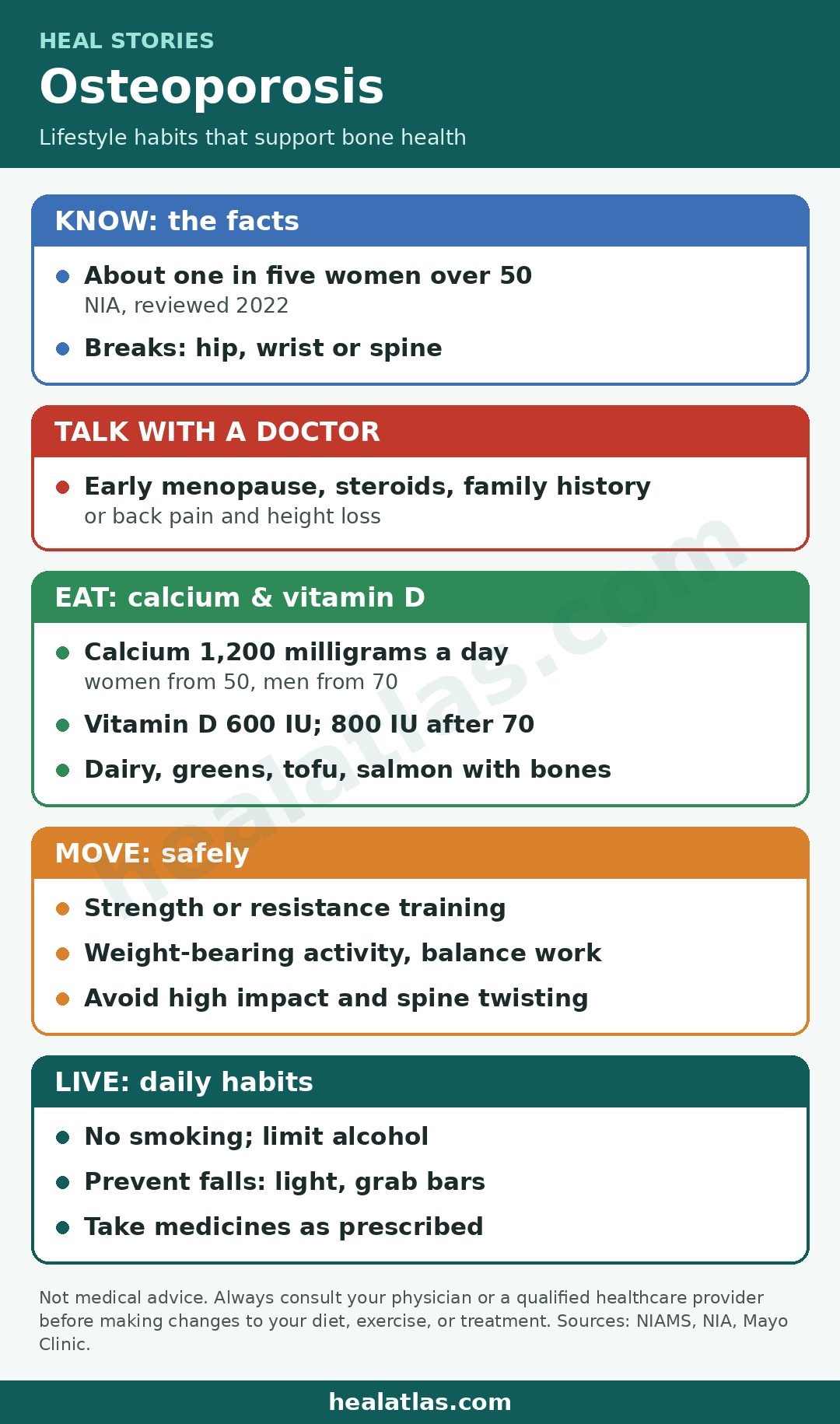
Infographic
Related on HealAtlas: Calcium and vitamin D for bones · Menopause hormone therapy and bone loss · Heal Stories: Knee Osteoarthritis
FAQ
How common is osteoporosis?
According to NIA (content reviewed November 15, 2022), it affects about one in five women over age 50, but only about one in 20 men. (NIA)
How much calcium and vitamin D do I need?
Mayo Clinic says calcium needs are 1,000 milligrams a day, rising to 1,200 milligrams when women turn 50 and men turn 70. Most people need at least 600 IU of vitamin D, and 800 IU after age 70. (Mayo Clinic)
What exercise is safe with osteoporosis?
Strength or resistance training is best for bones. Avoid high-impact exercise and movements that twist the spine or bend forward from the waist. A physical therapist can recommend a program. (NIAMS) (NIA)
Which foods are rich in calcium?
Low-fat dairy, bok choy, collards, turnip greens, broccoli, canned sardines and salmon with bones, tofu, and calcium-fortified soymilk, orange juice, cereals and breads. (NIAMS)
Can I prevent falls at home?
Wear low-heeled shoes with nonslip soles, remove cords and area rugs, keep rooms brightly lit and install grab bars. Strength and balance exercise also helps. (Mayo Clinic) (NIA)
When should I talk with a doctor about osteoporosis?
Make an appointment if you had early menopause, took corticosteroids for several months, or have a parent or sibling with osteoporosis. Mention back pain, height loss or a stooped posture. (Mayo Clinic)
Sources
- CDC. Adult Activity: An Overview. https://www.cdc.gov/physical-activity-basics/guidelines/adults.html (accessed Oct 25, 2026)
- NIAMS (NIH). Osteoporosis: Overview. https://www.niams.nih.gov/health-topics/osteoporosis (accessed Oct 25, 2026)
- NIAMS (NIH). Osteoporosis: Diagnosis, Treatment, and Steps to Take. https://www.niams.nih.gov/health-topics/osteoporosis/diagnosis-treatment-and-steps-to-take (accessed Oct 25, 2026)
- National Institute on Aging (NIH). Osteoporosis. https://www.nia.nih.gov/health/osteoporosis/osteoporosis (accessed Oct 25, 2026)
- Mayo Clinic. Osteoporosis – Symptoms and causes. https://www.mayoclinic.org/diseases-conditions/osteoporosis/symptoms-causes/syc-20351968 (accessed Oct 25, 2026)