
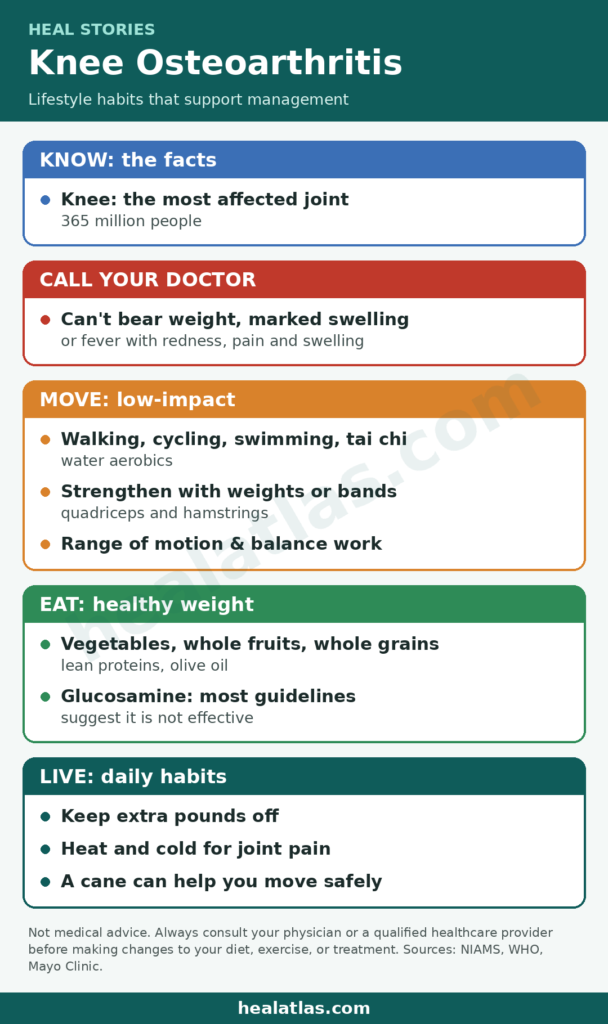
Knee osteoarthritis is one of the most common causes of joint pain. This Heal Stories guide gathers what trusted health organizations say about everyday habits that support management of knee osteoarthritis and help protect your knees, alongside the care plan you build with your healthcare provider.
What it is
In 2019, about 528 million people worldwide were living with osteoarthritis. With a prevalence of 365 million, the knee is the most frequently affected joint. Risk factors include a history of joint injury or overuse, older age, and being overweight. (WHO)
Symptoms include joint pain; joint stiffness, usually lasting less than 30 minutes, in the morning or after resting; swelling after a lot of activity; and a feeling that the joint is loose or unstable. (NIAMS)
Signs that mean see a doctor now
- Call your doctor if you can’t bear weight on your knee or it feels unstable or gives out, have marked knee swelling, can’t fully extend or flex your knee, see an obvious deformity, have a fever in addition to redness, pain and swelling in your knee, or have severe knee pain associated with an injury. (Mayo Clinic)
- Septic arthritis (a joint infection) causes swelling, pain and redness, often with a fever. If you have knee pain with these symptoms, see your doctor right away. (Mayo Clinic)
Prevention
- Keep extra pounds off. Maintaining a healthy weight is one of the best things you can do for your knees. (Mayo Clinic)
- Get strong, stay flexible. Build up your quadriceps and hamstrings, and include balance, stability, and flexibility exercises. (Mayo Clinic)
- Be smart about exercise. With osteoarthritis or chronic knee pain, consider swimming, water aerobics or other low-impact activities, at least a few days a week. (Mayo Clinic)
If you are overweight or obese, losing weight can help to reduce pain, prevent more injury, and increase mobility, especially in weight-bearing joints such as knees. (NIAMS) The ACR/Arthritis Foundation guideline strongly recommends exercise, weight loss for people with knee or hip OA who are overweight or obese, self-management programs, tai chi, and cane use. (ACR/AF guideline)
Food practices
Exercise and healthy eating to build strong muscles and keep a healthy weight can reduce symptoms. (WHO) Most guidelines suggest glucosamine is not effective for osteoarthritis. (WHO)
Foods to favor
- Vegetables of all types, and whole fruits rather than fruit juices (NIDDK)
- Whole grains, such as brown rice, oats, and whole-wheat bread (NIDDK)
- Protein from lean meats, poultry, eggs, seafood, beans, peas, lentils, nuts, and seeds (NIDDK)
- Oils such as olive oil and oils found in seafood, nuts, and avocados (NIDDK)
Foods to limit
- Added sugars and saturated fat, each to less than 10% of calories per day (NIDDK)
- Sodium, or salt, to less than 2,300 milligrams per day (NIDDK)
A sample day of meals
An example day built from the healthy eating plan above to support a healthy weight. Needs vary; ask your healthcare team or a dietitian. (NIDDK)
| Meal | Example |
|---|---|
| Breakfast | Oats with whole fruit and low-fat yogurt |
| Lunch | Lentil and vegetable soup with whole-wheat bread |
| Snack | A handful of nuts and a piece of fruit |
| Dinner | Grilled fish or chicken, brown rice, and vegetables with olive oil |
| Drinks | Water instead of sugary drinks |
Exercise and lifestyle habits
Speak to your doctor or physical therapist about a safe, well-rounded exercise program. (NIAMS) A 2024 Cochrane review of 139 trials found moderate-certainty evidence that exercise likely improves physical function compared with attention control or placebo, and low-certainty evidence of a slight improvement in pain. (Cochrane review) Heat and cold therapies can reduce joint pain, and a cane or walker can help you move around safely. (NIAMS)
| Habit | How often | How intense |
|---|---|---|
| Low-impact activity (walking, cycling, swimming, tai chi, water aerobics) | Build toward at least 150 minutes a week, as able | Moderate, without putting stress on the joints |
| Strengthening with weights or exercise bands | 2 or more days a week | Muscles that support the joints |
| Range-of-motion and stretching | Regularly | Gentle, to keep joints limber |
| Balance and agility exercises | Regularly | As advised by your physical therapist |
| Healthy weight | Ongoing | Weight loss if overweight |
Sources for the table: (NIAMS) (CDC) (ACR/AF guideline)
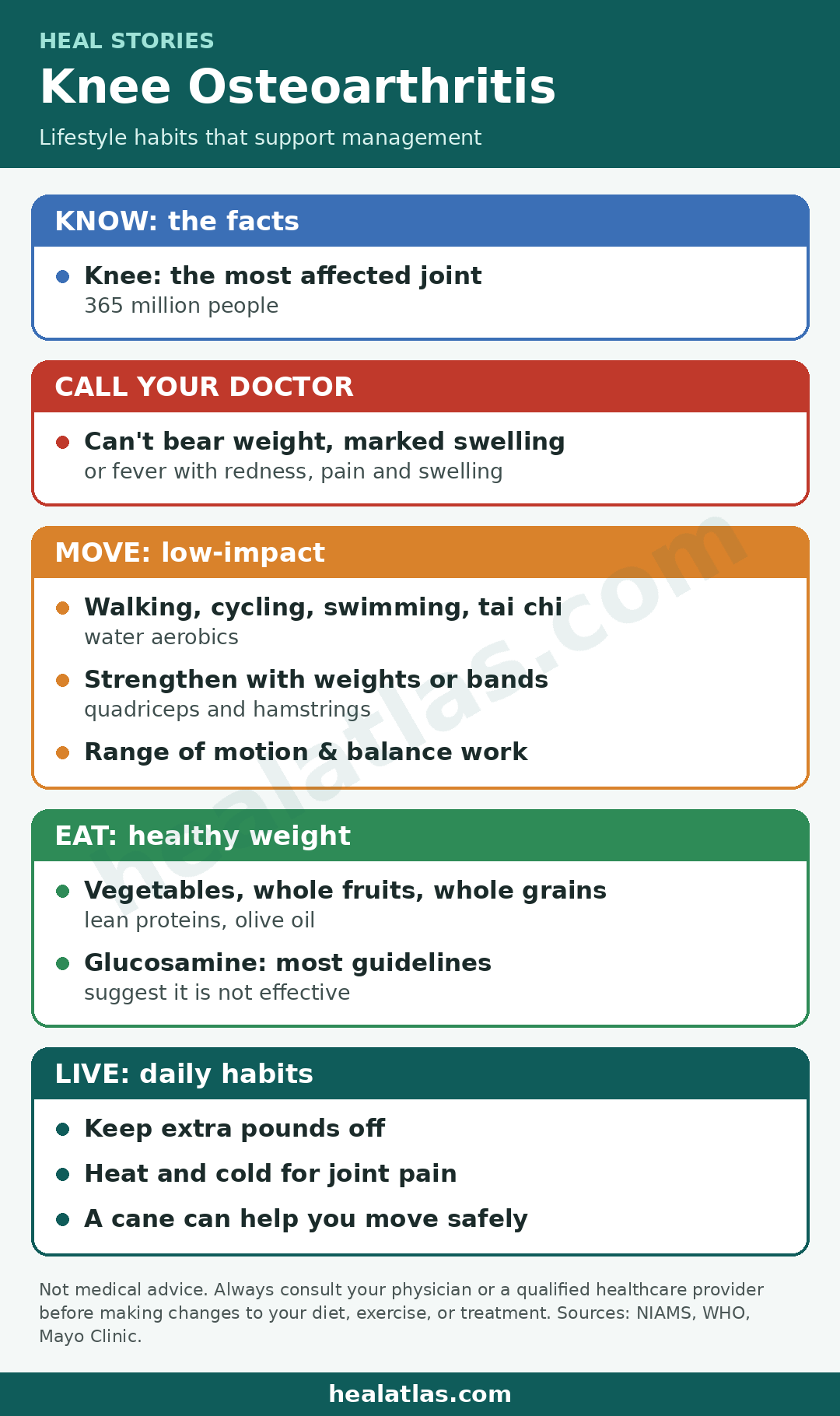
Infographic
Related on HealAtlas: High blood pressure and joint cartilage damage · 4-minute daily strength training for older adults · Heal Stories: High Blood Pressure
FAQ
What exercise is best for knee osteoarthritis?
NIAMS lists range-of-motion, strengthening, water exercise, balance, and low-impact activities such as walking, cycling, swimming, and tai chi. Speak to your doctor or physical therapist about a safe program. (NIAMS)
Does losing weight help knee osteoarthritis?
If you are overweight or obese, losing weight can help reduce pain, prevent more injury, and increase mobility, especially in knees and hips. The ACR/Arthritis Foundation guideline strongly recommends it. (NIAMS) (ACR/AF guideline)
Does glucosamine help?
The WHO says most guidelines suggest glucosamine is not effective for osteoarthritis. (WHO)
When should I call a doctor about knee pain?
Call your doctor if you can’t bear weight on your knee, have marked swelling, can’t fully extend or flex it, see a deformity, or have a fever with redness, pain and swelling. (Mayo Clinic)
Does heat or cold help?
Heat and cold therapies can reduce joint pain. Heat increases blood flow, tolerance for pain, and flexibility, and cold numbs the nerves around the joint. (NIAMS)
How common is knee osteoarthritis?
About 528 million people worldwide were living with osteoarthritis in 2019, and the knee is the most frequently affected joint, with a prevalence of 365 million. (WHO)
Sources
- CDC. Adult Activity: An Overview. https://www.cdc.gov/physical-activity-basics/guidelines/adults.html (accessed Oct 25, 2026)
- NIAMS (NIH). Osteoarthritis: Symptoms, Causes and Risk Factors. https://www.niams.nih.gov/health-topics/osteoarthritis (accessed Oct 25, 2026)
- NIAMS (NIH). Osteoarthritis: Diagnosis, Treatment, and Steps to Take. https://www.niams.nih.gov/health-topics/osteoarthritis/diagnosis-treatment-and-steps-to-take (accessed Oct 25, 2026)
- World Health Organization. Osteoarthritis fact sheet. https://www.who.int/news-room/fact-sheets/detail/osteoarthritis (accessed Oct 25, 2026)
- Mayo Clinic. Knee pain – Symptoms and causes. https://www.mayoclinic.org/diseases-conditions/knee-pain/symptoms-causes/syc-20350849 (accessed Oct 25, 2026)
- NIDDK (NIH). Healthy Eating & Physical Activity for Life. https://www.niddk.nih.gov/health-information/weight-management/adult-overweight-obesity/eating-physical-activity (accessed Oct 25, 2026)
- Kolasinski SL, et al. 2019 American College of Rheumatology/Arthritis Foundation Guideline for the Management of Osteoarthritis of the Hand, Hip, and Knee. Arthritis Care Res. 2020. PMID 31908149. https://pubmed.ncbi.nlm.nih.gov/31908149/ (accessed Oct 25, 2026)
- Lawford BJ, et al. Exercise for osteoarthritis of the knee. Cochrane Database Syst Rev. 2024. PMID 39625083. https://pubmed.ncbi.nlm.nih.gov/39625083/ (accessed Oct 25, 2026)