
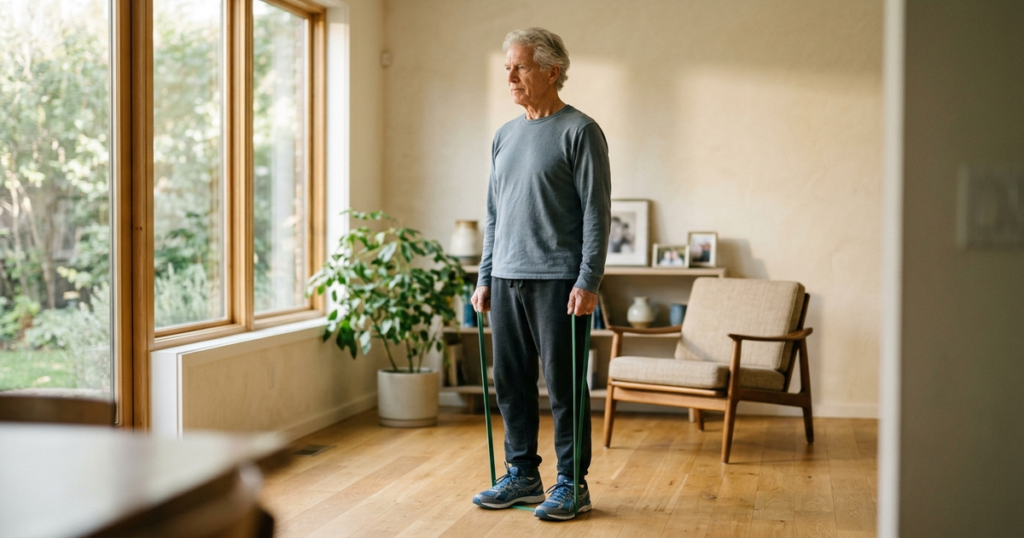
Can four minutes of daily exercise meaningfully protect physical independence as you age? For decades, conventional fitness guidance has insisted that preserving mobility requires prolonged workouts—often demanding 150 minutes of weekly activity that feels out of reach for sedentary seniors. However, a randomized controlled trial from Penn State College of Medicine suggests a far more practical path forward: brief, consistent daily functional strength training.
The study, known as the FAST-2 (Functional Activity Strength Training-2) trial and published in PLOS ONE, evaluated whether an ultra-short, four-minute daily routine could improve mobility and physical function in adults aged 65 and older. By having participants complete four functional movements for 30 seconds of active work followed by 30 seconds of rest, researchers observed significant gains in leg strength, balance, and transfer speed over 12 weeks. These findings suggest that maintaining mobility does not require hours of heavy exertion, but rather targeted neuromuscular stimulation that older adults can realistically sustain.
The Challenge of Sarcopenia and Fall Risk
Maintaining muscular strength is a fundamental pillar of healthy aging and autonomy. As adults cross their sixth and seventh decades, age-related muscle loss (sarcopenia) and the loss of muscular strength and power (dynapenia) accelerate. Type II fast-twitch muscle fibers—responsible for rapid bursts of power to recover balance after a slip—atrophy twice as quickly as endurance-oriented type I fibers.
According to epidemiological surveillance from the Centers for Disease Control and Prevention (CDC), unintentional falls represent the leading cause of injury-related mortality and trauma among adults aged 65 and older in the United States. Each year, falls generate over 3 million emergency department visits and 800,000 hospitalizations, frequently precipitating permanent functional decline or admission to assisted care.
Recognizing this crisis, the Physical Activity Guidelines for Americans issued by the U.S. Department of Health and Human Services (HHS) emphasize that older adults should engage in multicomponent physical activity that includes muscle-strengthening and balance training at least two days per week. Yet national surveillance indicates that fewer than 20% of older adults meet these recommendations. Joint discomfort, transportation barriers, and uncertainty about workout design often prevent seniors from beginning.
Inside the FAST-2 Trial: The 4-Minute Routine
To address this adherence gap, lead investigator Dr. Christopher Sciamanna and colleagues at Penn State designed the FAST-2 trial for older adults with existing mobility limitations. The trial enrolled 97 participants with an average age of 74 who were largely sedentary, reporting an average of only 18 minutes of physical activity per week at baseline.
Participants were randomly assigned either to perform the four-minute home routine once daily or to an inactive control group. Those in the exercise group received four elastic resistance bands, an adjustable step platform, and instructional guides detailing safe execution and progressive adaptations.
The daily protocol consists of four functional movements performed sequentially for 30 seconds of active effort, followed immediately by 30 seconds of passive recovery, totaling four minutes:
- Push-ups (30 seconds work, 30 seconds rest): Targets the chest, shoulders, and triceps while engaging core stabilizers. Participants can perform push-ups against a wall or countertop before progressing to an incline bench or floor positions.
- Chair Stands (30 seconds work, 30 seconds rest): Targets the quadriceps, gluteal complex, and hamstrings through repeated sit-to-stand transitions from a sturdy chair. Beginners can use their hands on their knees for support, advancing to unassisted stands as power improves.
- Two-Arm Rows (30 seconds work, 30 seconds rest): Uses elastic resistance bands anchored securely to work the upper back and biceps, reinforcing upright postural stability and pulling mechanics.
- Stair Stepping (30 seconds work, 30 seconds rest): Involves rhythmic stepping on and off an adjustable platform, challenging single-leg weight bearing, ankle stability, and dynamic balance.
| Exercise | Primary Muscle Groups | Daily Functional Application | Beginner Modification & Progression |
|---|---|---|---|
| Wall or Floor Push-Ups | Pectorals, deltoids, triceps, core | Pushing heavy doors open, rising from the floor | Wall push-ups → Countertop incline → Floor knee push-ups |
| Chair Stands | Quadriceps, gluteals, hamstrings | Rising smoothly from chairs, sofas, and car seats | Hands-on-knees assisted → Unassisted → Tempo chair squats |
| Two-Arm Resistance Rows | Latissimus dorsi, rhomboids, biceps | Carrying groceries, pulling open doors, posture | Seated light-band row → Standing split-stance medium band |
| Stair Stepping | Calves, quadriceps, ankle stabilizers | Navigating curbs, outdoor steps, and uneven ground | Low 2-inch riser with wall support → Free-standing 6-inch step |
Measurable Results: Gains in Leg Power and Balance
Despite requiring only 60 seconds of cumulative lower-body resistance work per day, the 12-week intervention yielded statistically significant improvements in validated physical performance tests:
- 4.2 Additional Chair Stands: Participants completed an average of 4.2 more repetitions during the standardized 30-second chair-stand assessment, reflecting substantial gains in functional lower-body strength.
- 3.6 More Seconds of Single-Leg Balance: Unipedal balance duration increased by 3.6 seconds. Single-leg stance is one of the most reliable clinical markers for assessing postural stability and predicting fall probability.
- 2.3 Seconds Faster Sit-to-Stand: Participants reduced their completion time on the timed sit-to-stand assessment by 2.3 seconds, demonstrating greater rapid force production.
Crucially, the study recorded an exceptional 81% adherence rate across the 12-week duration. In exercise science, participant adherence is often the single greatest obstacle to long-term success. By eliminating travel barriers and excessive fatigue, the four-minute micro-dose proved remarkably sustainable for older adults who previously avoided exercise.
Why Brief Functional Resistance Works
How can just four minutes produce measurable physiological adaptations? The answer lies in neuromuscular biology. According to the National Institute on Aging (NIA), targeted resistance training stimulates motor unit recruitment—the communication channels between spinal motor neurons and muscle fibers—well before visible muscle growth occurs.
When an inactive older adult performs chair stands or band rows, the central nervous system rapidly adapts by recruiting dormant high-threshold motor units and synchronizing muscle firing rates. This neuromuscular re-education enhances the rate of force development (RFD). When a person stumbles, they have less than 400 milliseconds to plant their foot and produce stabilizing force. Brief, high-effort resistance training sharpens this reflexive power, providing structural resilience that steady-state walking cannot match.
Study Limitations and Evidence Quality
While the FAST-2 trial provides compelling randomized controlled trial evidence, several limitations warrant consideration. The study cohort comprised 97 older adults, and while the randomized design established a causal link between the FAST-2 routine and improvements in proxy functional tests, it was not powered to track multi-year longitudinal endpoints like direct fall events or nursing home admissions.
Furthermore, participants were volunteers who received personal equipment and structured initial instruction, which may introduce selection bias. For individuals with advanced osteoarthritis, cardiovascular instability, or severe neurological disorders, home exercise must be personalized under clinical guidance, and progressions should be tailored carefully to joint tolerance.
Related Reading
- Daily Floor Exercises That Improve Balance After 60
- Muscular Strength Linked to Lower Death Risk in Older Women
- Cardio Plus Strength: The Sweet Spot for Longevity
Sources and Further Reading
- Dandekar S, Kurth J, Shang Y, et al. Brief daily functional strength training to improve functional performance in older adults with mobility disability: A randomized trial. PLOS ONE. 2026. https://doi.org/10.1371/journal.pone.0336748
- Centers for Disease Control and Prevention. Older Adult Fall Prevention Data and Research. CDC Injury Center. 2024. https://www.cdc.gov/falls/data-research/index.html
- U.S. Department of Health and Human Services. Physical Activity Guidelines for Americans, 2nd Edition. Health.gov. 2024. https://health.gov/our-work/nutrition-physical-activity/physical-activity-guidelines
- National Institute on Aging. Four Types of Exercise Can Improve Your Health and Physical Ability. NIH NIA Resources. 2024. https://www.nia.nih.gov/health/exercise-and-physical-activity/four-types-exercise-can-improve-your-health-and-physical
Disclosure: This content is for informational purposes only and is not medical advice. Always consult a qualified healthcare provider before making changes to your health regimen.