
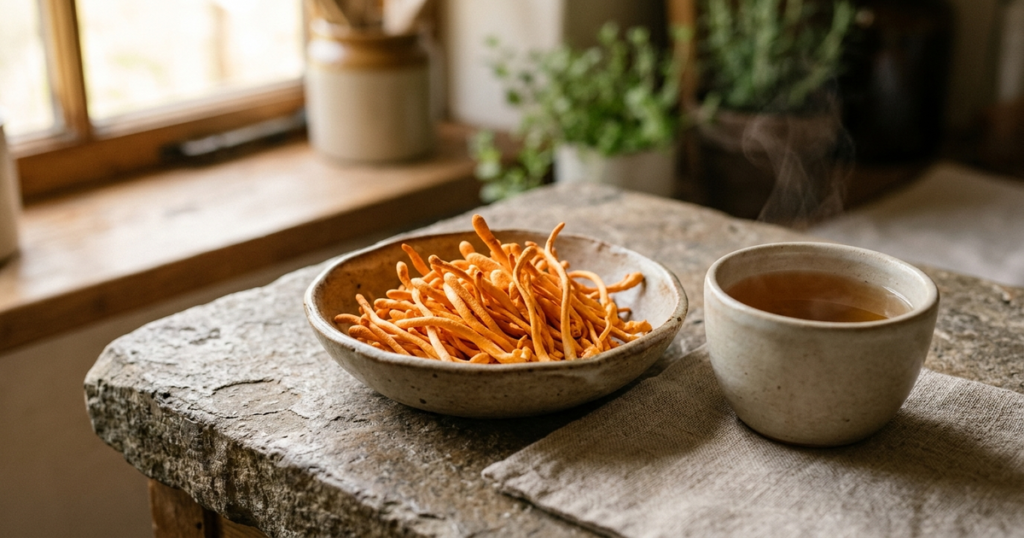
For centuries, traditional practitioners in Himalayan regions valued wild caterpillar fungus (historically classified as Ophiocordyceps sinensis) as an herbal vitality tonic. Today, modern research centers on Cordyceps militaris, a cultivated species rich in the bioactive compound cordycepin. Unlike central nervous system stimulants like caffeine that temporarily mask fatigue, Cordyceps acts directly on cellular bioenergetics: mitochondrial respiration and oxygen utilization.
Whether seeking to delay muscular fatigue or sustain daily stamina, understanding what peer-reviewed research confirms—and where evidence remains preliminary—is essential. While laboratory models reveal compelling pathways, clinical trials establish realistic parameters and timelines.
Cellular Bioenergetics: How Cordyceps Influences ATP and Oxygen Delivery
To understand how Cordyceps supports stamina, researchers examine adenosine triphosphate (ATP), the body’s primary cellular energy currency. Cordyceps contains two main active fractions: bioactive nucleosides (cordycepin and adenosine) and fungal beta-glucan polysaccharides.
Cordycepin, chemically known as 3′-deoxyadenosine, closely mimics cellular adenosine. A pharmacological review in 3 Biotech details that cordycepin interacts with purinergic receptors and stimulates adenosine monophosphate-activated protein kinase (AMPK). Known as the master metabolic regulator, AMPK promotes mitochondrial biogenesis and enhances glucose uptake into active muscle fibers.
Furthermore, adenosine within Cordyceps supports vascular relaxation via endothelial nitric oxide pathways. By improving microvascular blood flow, Cordyceps assists oxygen delivery to working muscle while clearing metabolic byproducts. Much like adaptogens that foster physical resilience without central stimulation—such as Rhodiola rosea for stress and fatigue—Cordyceps works upstream by bolstering cellular reserve capacity.
Human Clinical Trials: VO2 Max and Exercise Tolerance
While animal studies suggest dramatic stamina enhancements, human clinical trials provide an evidence-based evaluation of what Cordyceps achieves. The landmark modern trial on cultivated Cordyceps militaris was conducted at the University of North Carolina at Chapel Hill and published in the Journal of Dietary Supplements.
In this double-blind trial, 28 recreationally active adults (average age 22.7) received either 4 grams daily of a standardized Cordyceps militaris blend or a maltodextrin placebo, undergoing cycle ergometry after 1 week (acute) and 3 weeks (chronic).
The trial established a crucial finding: acute 1-week supplementation produced no significant performance changes. However, after three weeks of consistent intake, participants consuming Cordyceps achieved notable gains:
- Maximal Oxygen Uptake (VO2 Max): Increased by an average of 4.8 mL/kg/min (~11% improvement, p = 0.042), compared to minimal changes in the placebo arm.
- Ventilatory Threshold (VT): Elevated significantly by 0.19 L/min, enabling individuals to sustain higher exercise intensities before rapid lactate accumulation.
- Time to Exhaustion (TTE): Extended by an average of 28.1 seconds during high-intensity graded workload trials.
These findings indicate that Cordyceps does not act as an immediate stimulant; its benefits require cumulative cellular adaptation over several weeks. Similar aerobic improvements emerged in an earlier double-blind trial published in the Chinese Journal of Integrative Medicine. In that study, 37 healthy older adults (mean age 67) received 3 grams daily of fermented Cordyceps Cs-4 for six weeks, demonstrating significant gains in maximal oxygen intake (18.8 to 20.0 mL/kg/min) and delayed metabolic fatigue, complementing regimens like daily functional strength training.
Clinical Evidence Summary: What Trials Confirm vs. What Remains Unproven
Navigating functional mushroom claims requires distinguishing randomized human trials from preclinical laboratory findings. The table below summarizes key parameters evaluated across clinical and mechanistic studies.
| Health Parameter | Level of Evidence | Study Population / Model | Observed Clinical Finding | Key Limitation |
|---|---|---|---|---|
| Aerobic Capacity (VO2 Max) | Randomized Controlled Trial (RCT) | 28 active adults (3-week daily intervention) | Statistically significant ~11% rise in VO2 max and ventilatory threshold | Modest sample size; requires chronic daily dosing rather than acute intake |
| Older Adult Exercise Tolerance | Randomized Controlled Trial (RCT) | 37 sedentary adults aged 60–75 (6-week trial) | Significant increase in peak oxygen consumption and fatigue threshold | Tested fermented mycelial Cs-4 extract rather than raw fruiting body |
| Mitochondrial ATP Synthesis | Preclinical / Mechanistic Review | Rodent and cell culture models | AMPK pathway activation and increased cellular ATP turnover | Mechanistic plausibility; cannot directly equate to human clinical outcomes |
| Immune Cytokine Modulation | Laboratory & Preliminary Human | Ex vivo peripheral blood mononuclear cells | Beta-glucan stimulation of macrophages and balanced cytokine release | Lacks large-scale clinical trials measuring longitudinal infection rates |
Source: Synthesized from peer-reviewed findings in the Journal of Dietary Supplements (PMC5236007), 3 Biotech (PMC3909570), and the Chinese Journal of Integrative Medicine (PMID: 15373961).
Cordyceps Sinensis vs. Cordyceps Militaris: Choosing the Right Extract
Consumers exploring natural mushroom supplements frequently encounter two species: Cordyceps sinensis and Cordyceps militaris. Understanding the difference is vital for product quality, therapeutic efficacy, and sustainability.
Wild Cordyceps sinensis parasitizes ghost moth caterpillars in Himalayan meadows. Extreme scarcity pushes genuine wild specimens past $20,000 per kilogram, making them virtually nonexistent in commercial supplements. Most retail products utilize Cs-4, a fermented mycelial culture. While Cs-4 benefits older adults in clinical settings, it does not form true fruiting bodies.
In contrast, Cordyceps militaris can be cultivated organically on grain substrates to produce vibrant orange fruiting bodies. Analytical testing shows that cultivated Cordyceps militaris fruiting bodies contain up to 30 to 90 times higher concentrations of active cordycepin than fermented sinensis mycelium. Much like evaluating nootropic compounds such as Lion’s Mane mushroom for brain health, choosing third-party verified extracts derived from whole fruiting bodies ensures reliable bioactivity.
Safety, Drug Interactions, and Quality Guidelines
The National Center for Complementary and Integrative Health (NCCIH) notes that while botanical remedies offer promising applications, dietary supplements are biologically active and carry potential interactions that require cautious evaluation.
In clinical trials, Cordyceps is generally well tolerated, with mild digestive symptoms reported in rare cases. However, specific medical contraindications must be considered:
- Blood-Thinning Medications: Because Cordyceps exhibits mild antiplatelet activity, individuals taking anticoagulant medications (such as warfarin or aspirin) should avoid high-dose extracts or consult their physician. Discontinue supplementation at least two weeks before elective surgery.
- Autoimmune Conditions: Due to the immune-modulating properties of fungal beta-glucans, individuals with systemic lupus erythematosus, multiple sclerosis, or rheumatoid arthritis should exercise caution, as immune stimulation could theoretically influence disease activity.
- Blood Sugar Medications: Preclinical studies suggest Cordyceps may enhance insulin sensitivity. Diabetics taking insulin or oral hypoglycemics should monitor blood glucose levels closely under physician supervision.
- Third-Party Quality Verification: Mushrooms naturally absorb environmental minerals. Select brands verified by independent third-party testing organizations (such as USP, NSF International, or ConsumerLab) to ensure absence of heavy metals and confirm guaranteed cordycepin percentages.
Many individuals pair Cordyceps with energy precursors like creatine for energy support. Clinical trials evaluate dosages from 1 to 4 grams daily of standardized extract, typically taken with morning meals.
Sources and Further Reading
- Hirsch KR, Smith-Ryan AE, Roelofs EJ, Trexler ET, Mock MG. Cordyceps militaris Improves Tolerance to High-Intensity Exercise After Acute and Chronic Supplementation. Journal of Dietary Supplements. 2017;14(1):42-53. Available from: https://www.ncbi.nlm.nih.gov/pmc/articles/PMC5236007/
- Tuli HS, Sandhu SS, Sharma AK. Pharmacological and therapeutic potential of Cordyceps with special reference to cordycepin. 3 Biotech. 2014;4(1):1-12. Available from: https://www.ncbi.nlm.nih.gov/pmc/articles/PMC3909570/
- Yi X, Xi-zhen H, Chao-Zhi J. Randomized double-blind placebo-controlled clinical trial and assessment of Fermentation Product of Cordyceps sinensis (Cs-4) in increasing aerobic capacity and respiratory function of the healthy elderly subjects. Chinese Journal of Integrative Medicine. 2004;10(3):187-192. Available from: https://pubmed.ncbi.nlm.nih.gov/15373961/
- National Center for Complementary and Integrative Health (NCCIH). Dietary and Herbal Supplements: Consumer Health Information. National Institutes of Health. Updated June 2024. Available from: https://www.nccih.nih.gov/health/dietary-and-herbal-supplements
Related Reading
- Lion’s Mane Mushroom: What Science Says About Brain Benefits
- Rhodiola Rosea: Adaptogen for Stress, Fatigue, and Focus
- 4-Minute Daily Strength Training Boosts Senior Mobility
- Creatine for the Brain: What the Science Now Shows
Disclosure: This content is for informational purposes only and is not medical advice. Always consult a qualified healthcare provider before making changes to your health regimen.