
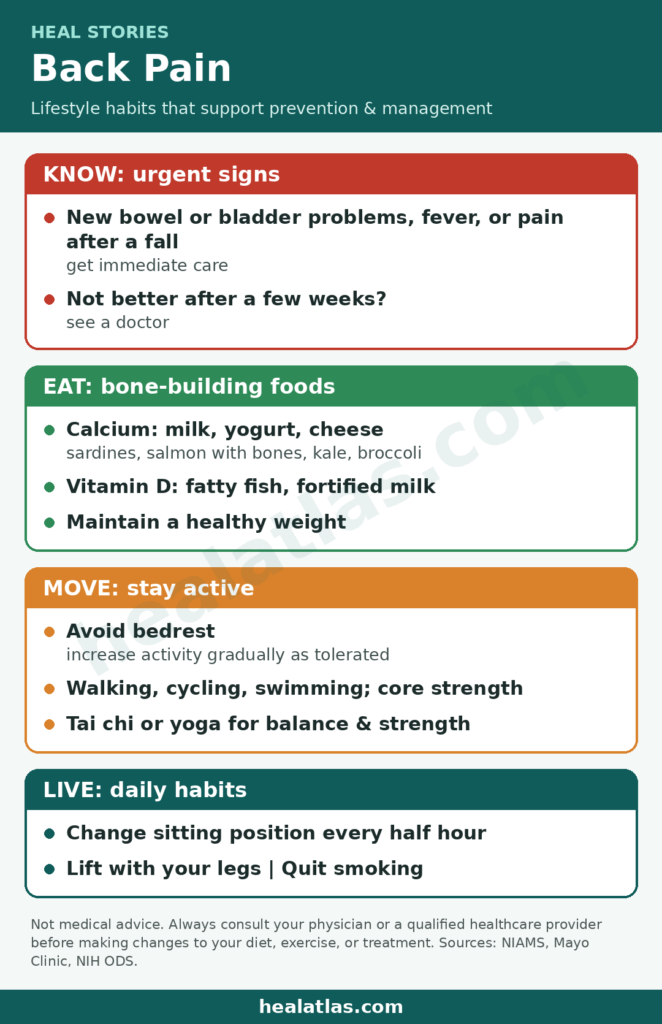
Almost everyone has back pain at some point. This Heal Stories guide gathers what trusted health organizations say about everyday habits that support prevention and management of back pain, alongside the care plan you build with your healthcare provider.
What it is
Anyone can have back pain, and almost everyone will experience back pain at some point in their life. It is more common among people who are not physically fit; for example, weak back and stomach muscles may not properly support the spine. (NIAMS)
Guidelines note that most people with acute or subacute low back pain improve over time regardless of treatment. (ACP guideline)
Signs that mean see a doctor now
- Get immediate care if back pain causes new bowel or bladder problems, comes with a fever, or follows a fall, blow to the back or other injury. (Mayo Clinic)
- See a doctor if your pain does not improve after a few weeks, or if it comes with numbness and tingling; weakness, pain, or numbness in your legs; trouble urinating; or weight loss that you did not intend. (NIAMS)
- Contact a healthcare professional if pain spreads down one or both legs, especially below the knee. (Mayo Clinic)
Prevention
NIAMS lists these steps for a healthy back: (NIAMS)
- Exercise regularly to keep back muscles strong. Balance and strength exercises, such as tai chi and yoga, can decrease your risk of falling and injuring your back. (NIAMS)
- Eat a healthy diet that includes enough calcium and vitamin D, nutrients that keep your spine strong. (NIAMS)
- Maintain a healthy weight. Being overweight can put unnecessary stress and strain on your back. (NIAMS)
- Practice good posture, and if you lift a heavy item, use your leg and abdominal muscles instead of your back. (NIAMS)
- Change your sitting position at least every half hour, and quit smoking. (Mayo Clinic)
Many products promise prevention or relief, but Mayo Clinic notes there is no good evidence that special shoes, shoe inserts or back supports help prevent or relieve back pain. (Mayo Clinic)
Food practices
Food supports back health mainly through bone-building nutrients and a healthy weight. (NIAMS)
Foods to favor
- Milk, yogurt, and cheese, the main food sources of calcium for most people in the United States (NIH ODS)
- Canned sardines and salmon with bones; kale, broccoli, and Chinese cabbage (bok choi) (NIH ODS)
- Fatty fish (like trout, salmon, tuna, and mackerel), among the best natural sources of vitamin D (NIH ODS)
- Fortified milk or plant-based alternatives such as soy, almond, or oat milk (NIH ODS)
Foods to limit
- Eating patterns that lead to weight gain, since being overweight can strain your back (NIAMS)
- Tobacco: quitting smoking is one of the healthy habits NIAMS lists for back pain (NIAMS)
A sample day of meals
An example day built from the calcium and vitamin D foods above. Needs vary; ask a healthcare professional or dietitian for a plan that fits you. (NIH ODS)
| Meal | Example |
|---|---|
| Breakfast | Yogurt or a bowl of fortified cereal with fortified milk |
| Lunch | Salad with kale or broccoli and canned salmon with bones |
| Snack | A small piece of cheese and fruit |
| Dinner | Baked trout or mackerel with bok choi and a whole grain |
| Drinks | Water, milk, or a fortified soy, almond, or oat beverage |
Exercise and lifestyle habits
For back pain, NIAMS advises avoiding bedrest and gradually increasing physical activity as tolerated. Check with your doctor or physical therapist before starting any exercise routine. (NIAMS) A Cochrane review of 249 trials found moderate-certainty evidence that exercise treatment is more effective for chronic low back pain than no treatment, usual care or placebo for pain outcomes. (Cochrane review) The American College of Physicians recommends nonpharmacologic treatments first for chronic low back pain, including exercise, tai chi, yoga, and mindfulness-based stress reduction. (ACP guideline)
| Habit | How often | How intense |
|---|---|---|
| Low-impact aerobic activity (walking, cycling, swimming) | Most days; build up toward at least 150 minutes a week | Moderate; increase gradually as tolerated |
| Core and back strengthening | 2 or more days a week | Work with a physical therapist when possible |
| Tai chi or yoga (balance and strength) | Regularly | Gentle; avoid moves that increase pain |
| Change sitting position | At least every half hour | — |
| Bedrest | Avoid | Limit only activities that cause pain |
Sources for the table: (Mayo Clinic) (NIAMS) (CDC) (ACP guideline)
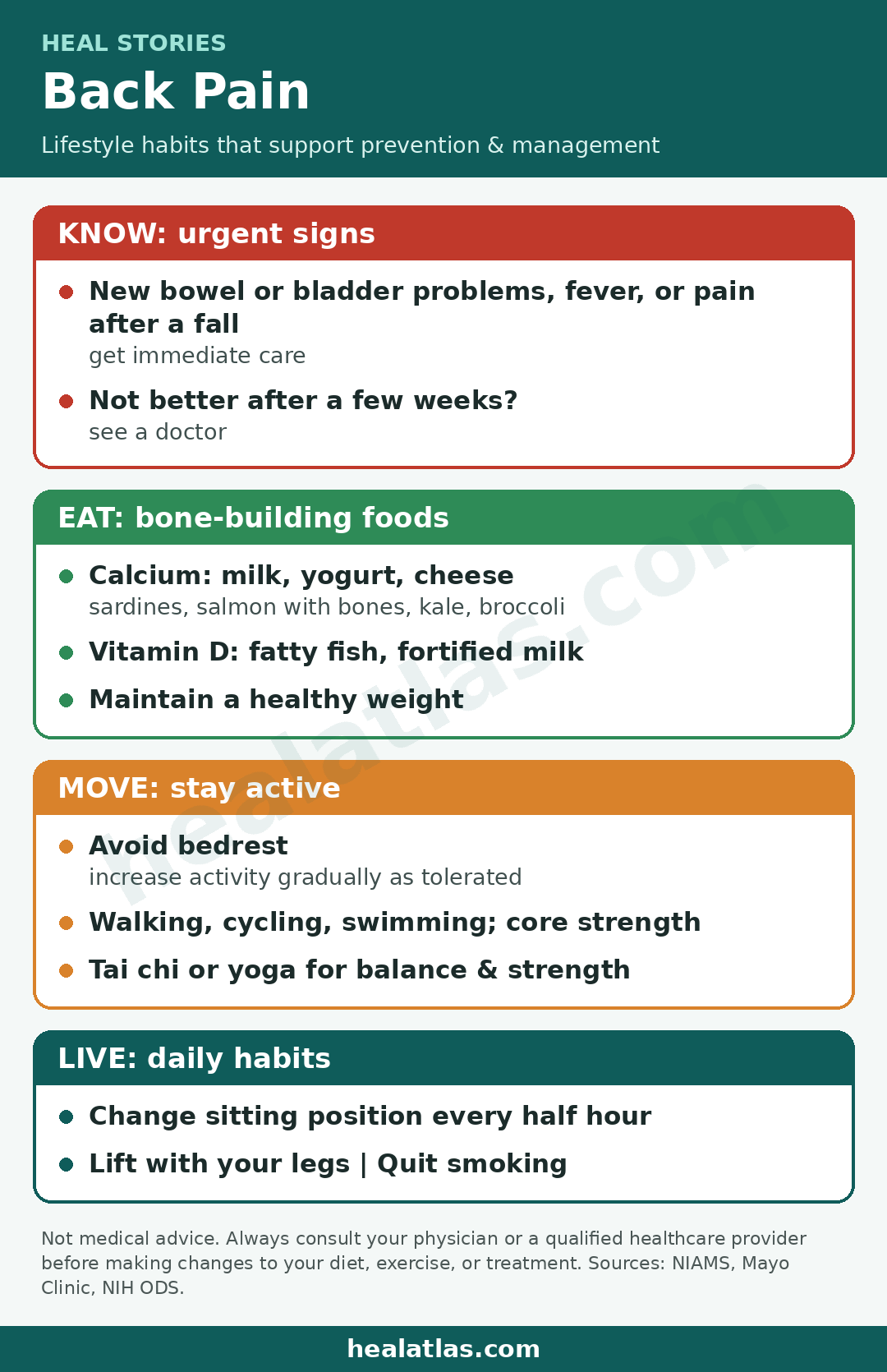
Infographic
Related on HealAtlas: 4-minute daily strength training for older adults · Mindfulness for pain relief: how the brain rewires · Heal Stories: Poor Sleep (Insomnia)
FAQ
Should I rest in bed when my back hurts?
NIAMS advises avoiding bedrest. Instead, limit activities or exercise that cause pain and gradually increase physical activity as tolerated. (NIAMS)
When is back pain an emergency?
Get immediate care if back pain causes new bowel or bladder problems, comes with a fever, or follows a fall, blow to the back or other injury. (Mayo Clinic)
Does exercise help chronic low back pain?
Yes. A Cochrane review of 249 trials found moderate-certainty evidence that exercise treatment is more effective than no treatment, usual care or placebo for pain. Check with your doctor or physical therapist before starting. (Cochrane review) (NIAMS)
Which foods support a healthy spine?
NIAMS recommends a healthy diet with enough calcium and vitamin D. Milk, yogurt, and cheese are main sources of calcium, and fatty fish such as salmon and trout are among the best natural sources of vitamin D. (NIAMS) (NIH ODS) (NIH ODS)
Do back braces or special shoes help back pain?
Mayo Clinic says there is no good evidence that special shoes, shoe inserts or back supports help prevent or relieve back pain. (Mayo Clinic)
Are yoga and tai chi good for back pain?
NIAMS lists tai chi and yoga as balance and strength exercises to try, and the American College of Physicians includes tai chi and yoga among first-line nonpharmacologic options for chronic low back pain. (NIAMS) (ACP guideline)
Sources
- CDC. Adult Activity: An Overview. https://www.cdc.gov/physical-activity-basics/guidelines/adults.html (accessed Oct 25, 2026)
- NIAMS (NIH). Back Pain: Symptoms, Causes and Risk Factors. https://www.niams.nih.gov/health-topics/back-pain (accessed Oct 25, 2026)
- NIAMS (NIH). Back Pain: Diagnosis, Treatment, and Steps to Take. https://www.niams.nih.gov/health-topics/back-pain/diagnosis-treatment-and-steps-to-take (accessed Oct 25, 2026)
- Mayo Clinic. Back pain – Symptoms and causes. https://www.mayoclinic.org/diseases-conditions/back-pain/symptoms-causes/syc-20369906 (accessed Oct 25, 2026)
- NIH Office of Dietary Supplements. Calcium – Fact Sheet for Consumers. https://ods.od.nih.gov/factsheets/Calcium-Consumer/ (accessed Oct 25, 2026)
- NIH Office of Dietary Supplements. Vitamin D – Fact Sheet for Consumers. https://ods.od.nih.gov/factsheets/VitaminD-Consumer/ (accessed Oct 25, 2026)
- Hayden JA, et al. Exercise therapy for chronic low back pain. Cochrane Database Syst Rev. 2021;9:CD009790. PMID 34580864. https://pubmed.ncbi.nlm.nih.gov/34580864/ (accessed Oct 25, 2026)
- Qaseem A, et al. Noninvasive Treatments for Acute, Subacute, and Chronic Low Back Pain: A Clinical Practice Guideline From the American College of Physicians. Ann Intern Med. 2017. PMID 28192789. https://pubmed.ncbi.nlm.nih.gov/28192789/ (accessed Oct 25, 2026)