
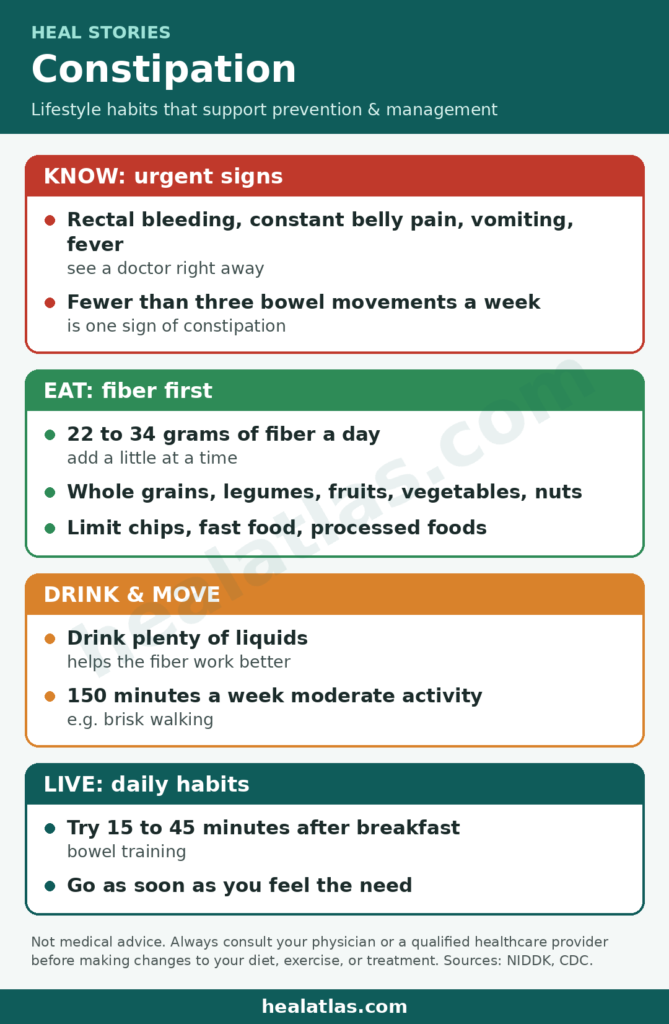
Constipation is common at every age. This Heal Stories guide gathers what trusted health organizations say about everyday habits that support prevention and management of constipation, alongside the care plan you build with your healthcare provider.
What it is
With constipation, you may have fewer than three bowel movements a week; stools that are hard, dry, or lumpy, or difficult or painful to pass; or a feeling that not all stool has passed. People have different bowel patterns, and only you know what’s normal for you. (NIDDK)
About 16 out of 100 adults have symptoms of constipation, and about 33 out of 100 adults ages 60 and older. People who eat little to no fiber and people who take certain medicines or supplements are more likely to become constipated. (NIDDK)
Signs that mean see a doctor now
- See a doctor right away if you have constipation and bleeding from your rectum, blood in your stool, constant pain in your abdomen, inability to pass gas, vomiting, fever, lower back pain, or losing weight without trying. (NIDDK)
- If you think a medicine or supplement is causing constipation, talk with your health care professional. Don’t change or stop any medicine or supplement without talking with a health care professional. (NIDDK)
Prevention
You may be able to treat and prevent constipation by changing what you eat and drink. (NIDDK)
- Eat enough fiber. Depending on your age and sex, adults should get 22 to 34 grams of fiber a day. Add fiber a little at a time so your body gets used to the change. (NIDDK)
- Drink plenty of liquids to help the fiber work better. (NIDDK)
- Get regular physical activity, which may help relieve your symptoms. (NIDDK)
- Try bowel training: for example, trying to have a bowel movement 15 to 45 minutes after breakfast may help, because eating helps your colon move stool. Use the bathroom as soon as you feel the need to go. (NIDDK)
Food practices
A meta-analysis of 16 randomized trials found that 66% of people responded to fiber supplements versus 41% with control treatment, with psyllium, doses above 10 g a day, and durations of at least 4 weeks appearing optimal. Flatulence was more common with fiber. (PubMed meta-analysis) Your health care professional may recommend a laxative for a short time and will tell you which type is best for you. (NIDDK)
Foods to favor
- Whole grains, such as whole wheat bread and pasta, oatmeal, and bran flake cereals (NIDDK)
- Legumes, such as lentils, black beans, kidney beans, soybeans, and chickpeas (NIDDK)
- Fruits, such as berries, apples with the skin on, oranges, and pears (NIDDK)
- Vegetables, such as carrots, broccoli, green peas, and collard greens (NIDDK)
- Nuts, such as almonds, peanuts, and pecans, plus plenty of water (NIDDK)
Foods to limit
- Foods with little to no fiber, such as chips, fast food, and meat (NIDDK)
- Prepared foods, such as some frozen meals and snack foods (NIDDK)
- Processed foods, such as hot dogs or some microwavable dinners (NIDDK)
A sample day of meals
An example day built from the fiber sources above. Increase fiber gradually; a dietitian can help plan meals with the right amount of fiber for you. (NIDDK)
| Meal | Example |
|---|---|
| Breakfast | Oatmeal or bran flake cereal with berries; a glass of water |
| Lunch | Lentil or black bean soup with whole wheat bread and carrots |
| Snack | An apple with the skin on and a few almonds |
| Dinner | Whole wheat pasta with broccoli, green peas, and chickpeas |
| Drinks | Plenty of water and other liquids through the day |
Exercise and lifestyle habits
Getting regular physical activity may help relieve constipation symptoms. (NIDDK)
| Habit | How often | How intense |
|---|---|---|
| Moderate aerobic activity, such as brisk walking | At least 150 minutes a week, e.g. 30 minutes a day, 5 days a week | Moderate intensity |
| Muscle strengthening | 2 or more days a week | All major muscle groups |
| Bowel training | Daily, 15 to 45 minutes after breakfast | Give yourself enough time; relax, feet on a footstool |
| Fiber | 22 to 34 grams a day | Add a little at a time |
| Liquids | Throughout the day | Plenty, especially with more fiber |
Sources for the table: (CDC) (NIDDK) (NIDDK)
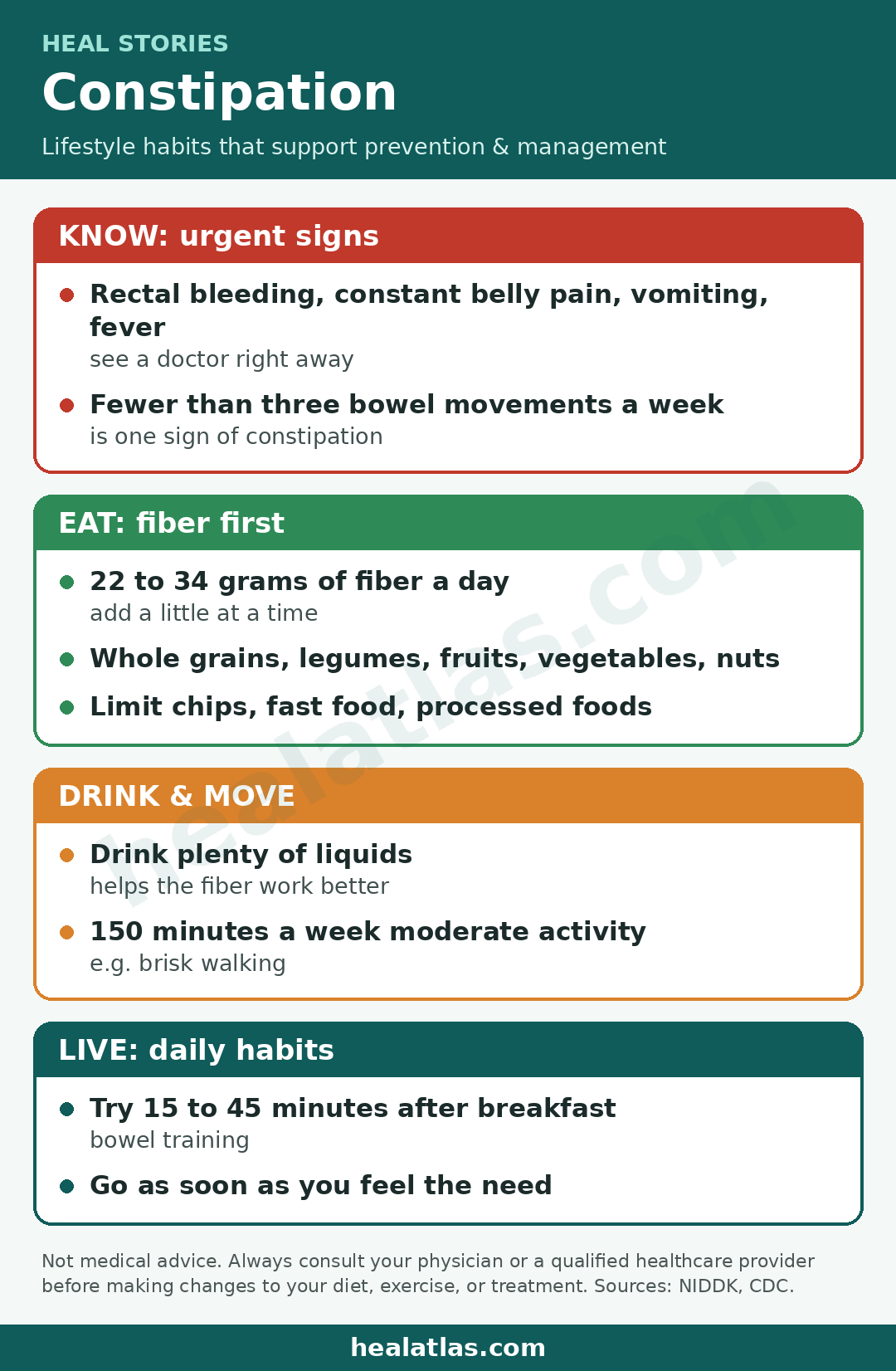
Infographic
Related on HealAtlas: Flaxseed: what science shows for blood pressure and gut health · The food matrix: why whole foods beat isolated nutrients · Heal Stories: Acid Reflux (GERD)
FAQ
How much fiber should I eat for constipation?
Depending on age and sex, adults should get 22 to 34 grams of fiber a day. Add it a little at a time and drink plenty of liquids to help the fiber work better. (NIDDK)
Do fiber supplements help?
A 2022 meta-analysis of 16 trials found 66% of people responded to fiber supplements versus 41% with control, with psyllium, doses above 10 g a day, and at least 4 weeks appearing optimal. Ask your health care professional which option suits you. (PubMed meta-analysis) (NIDDK)
When should I see a doctor about constipation?
See a doctor right away if constipation comes with rectal bleeding, blood in your stool, constant abdominal pain, inability to pass gas, vomiting, fever, lower back pain, or weight loss without trying. (NIDDK)
What foods should I limit?
Limit foods with little to no fiber, such as chips, fast food, meat, prepared foods like some frozen meals and snack foods, and processed foods like hot dogs. (NIDDK)
Can my medicine cause constipation?
Certain medicines and supplements can. Talk with your health care professional, and don’t change or stop any medicine or supplement without talking with a health care professional. (NIDDK) (NIDDK)
What is bowel training?
Training yourself to have a bowel movement at the same time each day, for example 15 to 45 minutes after breakfast, because eating helps your colon move stool. (NIDDK)
Sources
- CDC. Adult Activity: An Overview. https://www.cdc.gov/physical-activity-basics/guidelines/adults.html (accessed Oct 25, 2026)
- NIDDK (NIH). Definition & Facts for Constipation. https://www.niddk.nih.gov/health-information/digestive-diseases/constipation/definition-facts (accessed Oct 25, 2026)
- NIDDK (NIH). Symptoms & Causes of Constipation. https://www.niddk.nih.gov/health-information/digestive-diseases/constipation/symptoms-causes (accessed Oct 25, 2026)
- NIDDK (NIH). Treatment for Constipation. https://www.niddk.nih.gov/health-information/digestive-diseases/constipation/treatment (accessed Oct 25, 2026)
- NIDDK (NIH). Eating, Diet, & Nutrition for Constipation. https://www.niddk.nih.gov/health-information/digestive-diseases/constipation/eating-diet-nutrition (accessed Oct 25, 2026)
- van der Schoot A, et al. The effect of fiber supplementation on chronic constipation in adults: an updated systematic review and meta-analysis of randomized controlled trials. Am J Clin Nutr. 2022. PMID 35816465. https://pubmed.ncbi.nlm.nih.gov/35816465/ (accessed Oct 25, 2026)