

Prediabetes is common and often silent, and it is a chance to act early. This Heal Stories guide pulls together what trusted health organizations say about everyday habits that support prevention and management, alongside the care plan you build with your healthcare provider.
What it is
With prediabetes, blood sugar levels are higher than normal but not high enough for a type 2 diabetes diagnosis. It raises the risk of type 2 diabetes, heart disease, and stroke, and more than 2 in 5 American adults have it. (CDC)
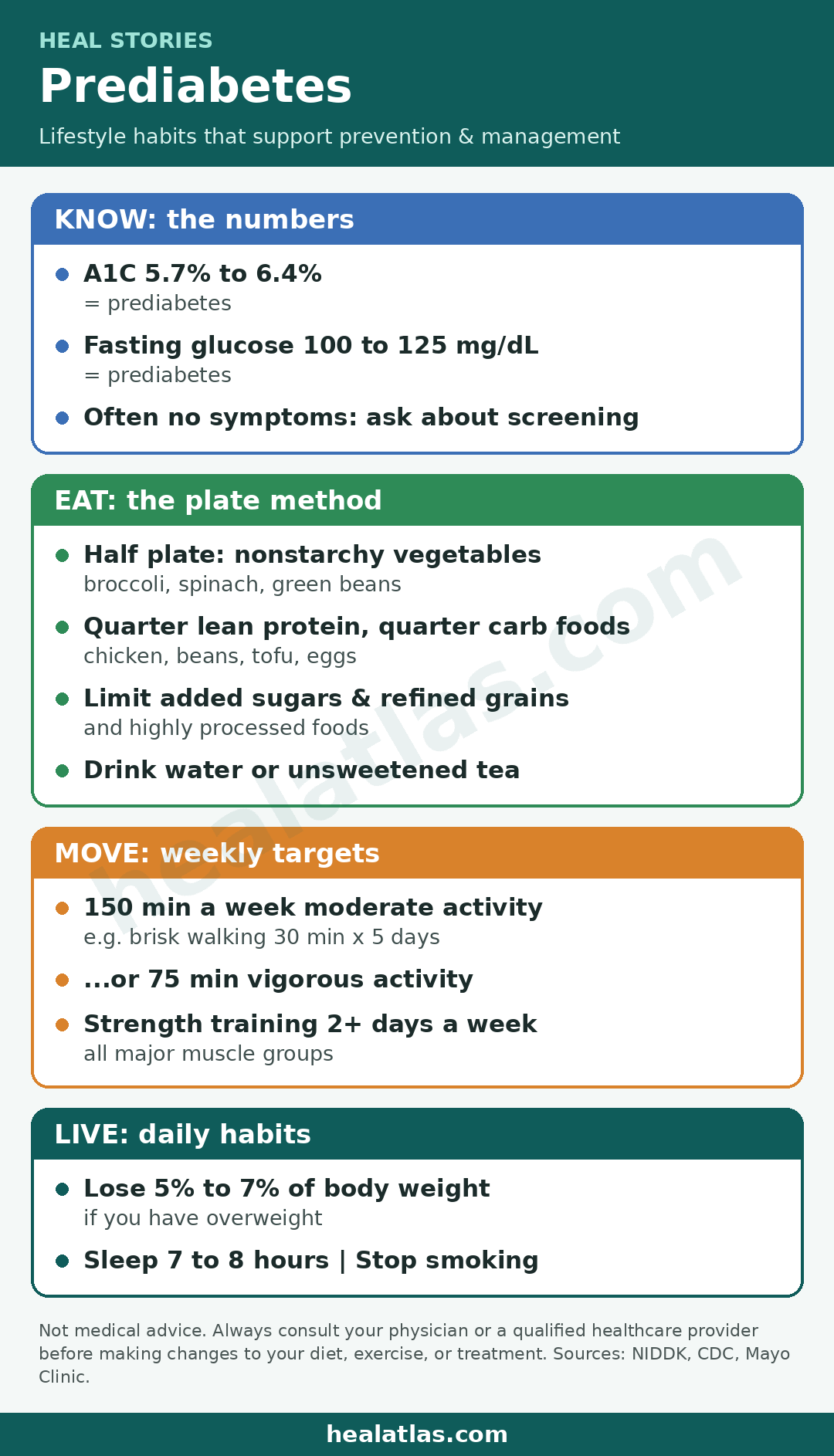
Prediabetes is diagnosed with blood tests: an A1C of 5.7% to 6.4%, a fasting plasma glucose of 100 to 125 mg/dL, or an oral glucose tolerance test result of 140 to 199 mg/dL. (NIDDK) People with prediabetes usually have no symptoms. (NIDDK) One possible sign is darkened skin on parts of the body such as the neck, armpits, and groin. (Mayo Clinic)
Risk factors include having overweight, obesity, or a large waist size; being age 35 or older; a family history of diabetes; not being physically active; smoking; and a history of gestational diabetes. (NIDDK)
Signs that mean see a doctor now
- See your healthcare professional if you have symptoms that may mean prediabetes has moved to type 2 diabetes: greater thirst, urinating more often, greater hunger, tiredness, blurred vision, numbness or tingling in the feet or hands, repeat infections, slow-healing sores, or weight loss without trying. (Mayo Clinic)
- If you have risk factors for diabetes, ask your healthcare professional about blood sugar screening. (Mayo Clinic) (CDC)
- If tests show you have prediabetes, you should be tested for type 2 diabetes every year. (NIDDK)
Prevention
Making lifestyle changes can cut your risk of type 2 diabetes in half. The CDC-led National Diabetes Prevention Program lifestyle change program can lower your risk by 58% (71% if you’re over age 60). (CDC) The WHO lists a healthy diet, regular physical activity, maintaining a normal body weight, and avoiding tobacco as ways to prevent or delay the onset of type 2 diabetes. (WHO)
- Lose a small amount of weight if you have overweight: around 5% to 7% of your body weight, or about 10 to 14 pounds for a 200-pound person. (CDC)
- Get regular physical activity: at least 150 minutes a week of brisk walking or a similar activity. (CDC)
- Get good sleep: 7 to 8 hours of restful sleep a night may lower the risk of prediabetes turning into type 2 diabetes. (Mayo Clinic)
- Stop smoking. Stopping smoking can improve the way insulin works and improve your blood sugar level. (Mayo Clinic)
A Cochrane review of randomized trials in people at increased risk found that 14.8% of people in diet-plus-physical-activity programs developed type 2 diabetes, compared with 25.7% in comparison groups (moderate-quality evidence). (Cochrane review)
Food practices
A diet rich in fruits, vegetables, nuts, and whole grains is linked with a lower risk of prediabetes. Mayo Clinic advises choosing foods low in fat and calories and high in fiber, and eating a variety of foods. (Mayo Clinic)
Foods to favor
- Nonstarchy vegetables, such as broccoli, spinach, and green beans (CDC)
- Fruits, nuts, and whole grains (Mayo Clinic)
- Lean protein, such as chicken, beans, tofu, or eggs (CDC)
- Whole foods instead of highly processed foods as much as possible (CDC)
- Water or a low-calorie drink such as unsweetened iced tea (CDC)
The plate method: on a 9-inch plate, fill half with nonstarchy vegetables, one quarter with a lean protein, and one quarter with carb foods such as grains, starchy vegetables, rice, pasta, beans, fruit, or yogurt. (CDC)
Foods to limit
- Added sugars and refined grains, such as white bread, rice, and pasta (CDC)
- Highly processed foods (CDC)
- Red meats, saturated fat, and sugar: diets high in these are linked with a higher risk of prediabetes (Mayo Clinic)
- Fruit juice in place of whole fruit: drinking fruit juice raises blood sugar faster than eating whole fruit (CDC)
A sample day of meals
An example day built from the food groups and plate method above. Portions and needs vary; the CDC suggests asking for a referral to diabetes education for help with meal planning. (CDC)
| Meal | Example |
|---|---|
| Breakfast | Oatmeal (a whole grain) with berries and a few walnuts; water or unsweetened tea |
| Lunch | Half plate salad and green beans, one quarter grilled chicken or beans, one quarter brown rice |
| Snack | A whole apple (rather than juice) and a small handful of nuts |
| Dinner | Half plate broccoli and spinach, one quarter baked fish or tofu, one quarter whole-grain pasta |
| Drinks | Water or unsweetened iced tea |
Exercise and lifestyle habits
Physical activity helps you manage your weight, uses up sugar for energy, and helps the body use insulin better. (Mayo Clinic)
| Habit | How often | How intense |
|---|---|---|
| Moderate aerobic activity, such as brisk walking | At least 150 minutes a week, e.g. 30 minutes a day, 5 days a week | Moderate intensity |
| Or vigorous aerobic activity, such as jogging or running | 75 minutes a week, or an equivalent mix | Vigorous intensity |
| Muscle strengthening (legs, hips, back, abdomen, chest, shoulders, arms) | 2 or more days a week | All major muscle groups |
| Move more, sit less | Daily | Some activity is better than none |
| Sleep | 7 to 8 hours a night | Restful sleep |
| Tobacco | Stop smoking | — |
Sources for the table: (CDC) (Mayo Clinic)
Infographic
Related on HealAtlas: Type 2 diabetes: food, activity and daily habits that help manage it · Soleus pushup: how seated calf movement lowers blood sugar · The food matrix: why whole foods beat isolated nutrients
FAQ
Can prediabetes be reversed with lifestyle changes?
NIDDK says healthy living may help prevent or reverse insulin resistance and prediabetes, and the CDC says lifestyle changes can cut your risk of type 2 diabetes in half. These habits support prevention and management; your health care professional may also prescribe medicines, so work with your health care team on any changes. (NIDDK) (CDC)
What A1C level means prediabetes?
An A1C result between 5.7% and 6.4% means prediabetes. A fasting plasma glucose of 100 to 125 mg/dL also indicates prediabetes. (NIDDK)
How much weight loss helps?
If you have overweight, losing around 5% to 7% of your body weight, about 10 to 14 pounds for a 200-pound person, can lower your risk of type 2 diabetes. (CDC)
How much exercise is recommended?
Adults need at least 150 minutes a week of moderate-intensity activity such as brisk walking, for example 30 minutes a day, 5 days a week, or 75 minutes of vigorous activity, plus muscle-strengthening activity on 2 or more days a week. (CDC)
What is the plate method?
Using a 9-inch plate, fill half with nonstarchy vegetables, one quarter with a lean protein such as chicken, beans, tofu, or eggs, and one quarter with carb foods. Choose water or a low-calorie drink such as unsweetened iced tea. (CDC)
Does prediabetes cause symptoms?
Usually not. People with prediabetes usually have no symptoms, so blood tests are needed. See your healthcare professional if you have symptoms of type 2 diabetes, such as greater thirst, urinating more often, or blurred vision. (NIDDK) (Mayo Clinic)
Sources
- CDC. Adult Activity: An Overview. https://www.cdc.gov/physical-activity-basics/guidelines/adults.html (accessed Oct 25, 2026)
- NIDDK (NIH). Insulin Resistance & Prediabetes. https://www.niddk.nih.gov/health-information/diabetes/overview/what-is-diabetes/prediabetes-insulin-resistance (accessed Oct 25, 2026)
- CDC. Prediabetes – Your Chance to Prevent Type 2 Diabetes. https://www.cdc.gov/diabetes/prevention-type-2/prediabetes-prevent-type-2.html (accessed Oct 25, 2026)
- Mayo Clinic. Prediabetes – Symptoms and causes. https://www.mayoclinic.org/diseases-conditions/prediabetes/symptoms-causes/syc-20355278 (accessed Oct 25, 2026)
- Mayo Clinic. Prediabetes – Diagnosis and treatment. https://www.mayoclinic.org/diseases-conditions/prediabetes/diagnosis-treatment/drc-20355284 (accessed Oct 25, 2026)
- CDC. Diabetes Meal Planning. https://www.cdc.gov/diabetes/healthy-eating/diabetes-meal-planning.html (accessed Oct 25, 2026)
- World Health Organization. Diabetes fact sheet. https://www.who.int/news-room/fact-sheets/detail/diabetes (accessed Oct 25, 2026)
- Hemmingsen B, et al. Diet, physical activity or both for prevention or delay of type 2 diabetes mellitus and its associated complications in people at increased risk of developing type 2 diabetes mellitus. Cochrane Database Syst Rev. 2017. PMID 29205264. https://pubmed.ncbi.nlm.nih.gov/29205264/ (accessed Oct 25, 2026)