

High cholesterol has no symptoms, but it is very manageable once you know your numbers. This Heal Stories guide pulls together what trusted health organizations say about everyday habits that support prevention and management, alongside the care plan you build with your healthcare provider.
What it is
Cholesterol is a waxy, fat-like substance that your body needs for good health, but in the right amounts. High levels of “bad” LDL cholesterol may create a buildup of plaque in your arteries, which can lead to a heart attack, stroke, or other health problems. “Good” HDL cholesterol carries cholesterol to the liver to be flushed out of the body. (NHLBI)
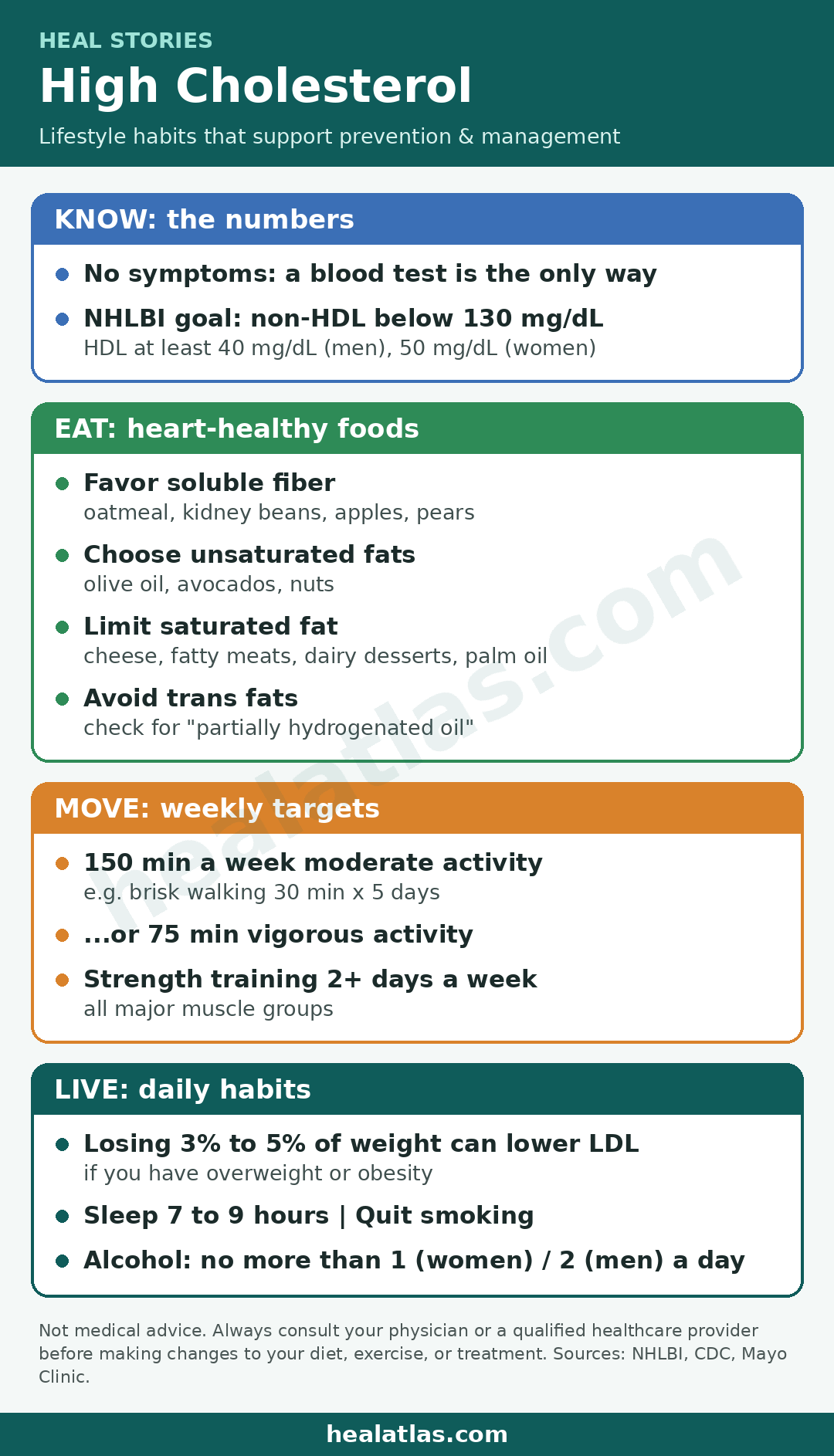
High cholesterol has no symptoms; a blood test is the only way to find out if you have it. (Mayo Clinic) A lipid panel measures LDL and HDL cholesterol and triglycerides. NHLBI describes the goal for a healthy lipid profile as non-HDL cholesterol below 130 mg/dL with an HDL of at least 40 mg/dL for men and 50 mg/dL for women; check with your provider on the levels that are best for you. (NHLBI)
Lifestyle factors such as a diet high in saturated and trans fats and not getting enough exercise are the most common cause. Genes (such as familial hypercholesterolemia), some health conditions, and some medicines can also lead to high cholesterol. (Mayo Clinic)
Signs that mean see a doctor now
- Call 911 if you have heart attack warning signs: chest discomfort; pain or discomfort in one or both arms, the back, neck, jaw, or stomach; shortness of breath; or other signs such as a cold sweat, nausea, or lightheadedness. (AHA)
- A stroke is also an emergency that needs treatment right away. (Mayo Clinic)
- Get your cholesterol checked on schedule. NHLBI advises screening every 5 years for younger adults, every 1 to 2 years for men ages 45 to 65 and women ages 55 to 65, and every year after 65. (NHLBI) People with high blood pressure, diabetes, or a family history of high cholesterol or heart disease may need more frequent screening. (Mayo Clinic)
Prevention
By living a healthy lifestyle, you can help keep your cholesterol in a healthy range. (CDC)
- Eat a heart-healthy diet that focuses on lean protein, fruits, vegetables, and whole grains, and limits saturated and trans fats. (Mayo Clinic)
- Aim for a healthy weight. Overweight and obesity raise LDL cholesterol. (CDC) Adults with overweight and obesity can lower LDL and raise HDL by losing only 3% to 5% of their weight. (NHLBI)
- Exercise on most days of the week for at least 30 minutes. (Mayo Clinic)
- Quit smoking. Smoking damages blood vessels and greatly increases the risk of heart disease. (CDC)
- Limit alcohol: no more than two drinks per day for men and one for women. (CDC)
- Sleep 7 to 9 hours and manage stress. Getting 7 to 9 hours of sleep lowers your risk for high LDL and total cholesterol, and chronic stress can sometimes raise LDL and lower HDL. (NHLBI)
Food practices
NHLBI’s Therapeutic Lifestyle Changes and DASH eating plans can help lower LDL cholesterol. They encourage limiting saturated fats; eating whole grains, fruits, and vegetables rather than refined carbohydrates; eating a variety of nuts; and preparing foods with little or no salt. (NHLBI)
Foods to favor
- Soluble fiber: oatmeal, kidney beans, Brussels sprouts, apples, and pears. Soluble fiber helps block some cholesterol from being absorbed. (Mayo Clinic) A meta-analysis of 58 trials found that oat β-glucan (median 3.5 g a day) lowered LDL cholesterol. (PubMed review)
- Unsaturated fats: avocados, vegetable oils like olive oil, and nuts (CDC)
- Omega-3-rich foods: salmon, mackerel, herring, walnuts, and flaxseeds. Omega-3s don’t lower LDL, but they have other heart benefits. (Mayo Clinic)
- Lean meats; seafood; fat-free or low-fat milk, cheese, and yogurt; whole grains; and fruits and vegetables (CDC)
Foods to limit
- Saturated fat: animal products such as cheese, fatty meats, and dairy desserts, and tropical oils such as palm oil. (CDC) A Cochrane review of long-term trials found that reducing saturated fat lowered the risk of combined cardiovascular events by 17%, with small reductions in total and LDL cholesterol. (Cochrane review)
- Trans fats: check ingredient lists for “partially hydrogenated oil.” (Mayo Clinic)
- Sodium (salt) and added sugars (CDC)
- Sweets and other high-sugar foods (NHLBI)
- Sugary drinks: swap them for tap water (Mayo Clinic)
A sample day of meals
An example day built from the foods above. Needs vary; a healthcare provider or dietitian can tailor it. NHLBI’s TLC booklet includes sample menus. (NHLBI)
| Meal | Example |
|---|---|
| Breakfast | Oatmeal with a sliced apple and walnuts; low-fat milk |
| Lunch | Salad with kidney beans, avocado, and an olive-oil dressing; whole-grain bread |
| Snack | A pear and a small handful of nuts |
| Dinner | Baked salmon, brown rice, and Brussels sprouts roasted in olive oil |
| Drinks | Tap water instead of sugary drinks |
Exercise and lifestyle habits
Physical activity can lower LDL cholesterol and triglycerides and raise HDL cholesterol. Before starting any exercise program, ask your provider what level of physical activity is right for you. (NHLBI)
| Habit | How often | How intense |
|---|---|---|
| Moderate aerobic activity, such as brisk walking | At least 150 minutes a week, e.g. 30 minutes a day, 5 days a week | Moderate intensity |
| Or vigorous aerobic activity, such as running or fast cycling | 75 minutes a week (CDC); Mayo Clinic suggests at least 25 minutes, 3 days a week | Vigorous intensity |
| Muscle strengthening (all major muscle groups) | 2 or more days a week | All major muscle groups |
| Short bursts of activity: stairs, parking farther away, a brisk lunch walk | Daily | Any amount helps |
| Sleep | 7 to 9 hours | — |
| Alcohol | No more than 1 drink a day (women) or 2 (men) | — |
Sources for the table: (CDC) (Mayo Clinic) (CDC) (NHLBI)
Infographic
Related on HealAtlas: The Portfolio Diet: how food lowers LDL cholesterol · The Nordic Diet: how it lowers LDL cholesterol and heart risk · Flaxseed: what science shows for blood pressure and gut health
FAQ
Can lifestyle changes replace cholesterol medicine?
Lifestyle changes support prevention and management and can boost the effect of cholesterol medicines, but sometimes healthy habits alone aren’t enough. If your healthcare professional prescribes medicine, take it exactly as you are told, and talk with them before changing anything. (Mayo Clinic)
Does high cholesterol cause symptoms?
No. High cholesterol has no symptoms, and a blood test is the only way to find out if you have it. (Mayo Clinic)
How often should adults get a cholesterol test?
NHLBI advises screening every 5 years for younger adults, every 1 to 2 years for men ages 45 to 65 and women ages 55 to 65, and every year for adults older than 65. (NHLBI)
Which foods help lower LDL cholesterol?
Foods with soluble fiber, such as oatmeal, kidney beans, Brussels sprouts, apples, and pears, help block some cholesterol from being absorbed. A meta-analysis of 58 trials found oat beta-glucan lowered LDL cholesterol. (Mayo Clinic) (PubMed review)
Which fats should I limit?
Limit saturated fat from foods such as cheese, fatty meats, dairy desserts, and palm oil, and avoid trans fats listed as partially hydrogenated oil. Choose unsaturated fats such as olive oil, avocados, and nuts instead. (CDC) (Mayo Clinic)
How much exercise helps cholesterol?
Adults need at least 150 minutes a week of moderate-intensity activity such as brisk walking, or 75 minutes of vigorous activity, plus muscle-strengthening on 2 or more days a week. Physical activity can lower LDL cholesterol and triglycerides and raise HDL cholesterol. (CDC) (NHLBI)
Sources
- CDC. Adult Activity: An Overview. https://www.cdc.gov/physical-activity-basics/guidelines/adults.html (accessed Oct 25, 2026)
- NHLBI (NIH). What Is Blood Cholesterol? https://www.nhlbi.nih.gov/health/blood-cholesterol (accessed Oct 25, 2026)
- NHLBI (NIH). Blood Cholesterol – Diagnosis. https://www.nhlbi.nih.gov/health/blood-cholesterol/diagnosis (accessed Oct 25, 2026)
- NHLBI (NIH). Blood Cholesterol – Treatment. https://www.nhlbi.nih.gov/health/blood-cholesterol/treatment (accessed Oct 25, 2026)
- Mayo Clinic. High cholesterol – Symptoms and causes. https://www.mayoclinic.org/diseases-conditions/high-blood-cholesterol/symptoms-causes/syc-20350800 (accessed Oct 25, 2026)
- Mayo Clinic. Top 5 lifestyle changes to improve your cholesterol. https://www.mayoclinic.org/diseases-conditions/high-blood-cholesterol/in-depth/reduce-cholesterol/art-20045935 (accessed Oct 25, 2026)
- CDC. Preventing High Cholesterol. https://www.cdc.gov/cholesterol/prevention/index.html (accessed Oct 25, 2026)
- American Heart Association. Warning Signs of a Heart Attack. https://www.heart.org/en/health-topics/heart-attack/warning-signs-of-a-heart-attack (accessed Oct 25, 2026)
- Hooper L, et al. Reduction in saturated fat intake for cardiovascular disease. Cochrane Database Syst Rev. 2020 Aug 21;8:CD011737 (updated version). PMID 32827219. https://pubmed.ncbi.nlm.nih.gov/32827219/ (accessed Oct 25, 2026)
- Ho HVT, et al. The effect of oat β-glucan on LDL-cholesterol, non-HDL-cholesterol and apoB for CVD risk reduction: a systematic review and meta-analysis of randomised-controlled trials. Br J Nutr. 2016. PMID 27724985. https://pubmed.ncbi.nlm.nih.gov/27724985/ (accessed Oct 25, 2026)