
Nordic Healing Foods: Scandinavian and Finnish Staples List
Nordic cooking from Denmark, Sweden, Norway, Finland and Iceland relies on cold-climate staples: oily fish, oats, barley and rye, berries, apples, root vegetables, cabbage and dairy. This World Healing Foods guide is a practical foods list by country. For the research on the Nordic diet and heart health, see our deep dive, the Nordic diet and cholesterol; for a related pattern, see the Atlantic diet. This page describes traditional foods and what research says about them. Foods support an overall healthy pattern; they do not treat any disease.
Food culture at a glance
Traditional meals often pair fish or a bean or pea soup with potatoes or root vegetables and dense rye bread, with porridge and berries at breakfast. WHO advises that carbohydrates come primarily from whole grains, vegetables, fruits and pulses, and lists oats among whole grains. (WHO) Mayo Clinic lists barley and oatmeal as whole grains, and advises checking that the words “whole grain” come first on bread labels. (Mayo Clinic)
Top healing foods and what research says
| Food | What it offers | Evidence strength |
|---|---|---|
| Salmon and mackerel | cold-water fatty fish; EPA and DHA omega-3s (NIH ODS) | Strong (nutrient source) |
| Herring and sardines | EPA and DHA omega-3s; pickled herring is salty (NIH ODS) | Strong (nutrient source) |
| Oats (porridge) | a whole grain with soluble fiber (Mayo Clinic) | Strong |
| Barley | a whole grain (Mayo Clinic) | Strong |
| Rye bread and crispbread | choose labels with whole grain listed first (Mayo Clinic) | Moderate |
| Berries (bilberry, lingonberry, blueberry) | fruit toward the 400 g a day goal (WHO) | Strong |
| Root vegetables and cabbage | vegetables; fiber (Mayo Clinic) | Strong (vegetables) |
| Canola (rapeseed) oil | an unsaturated plant oil (Mayo Clinic) | Strong |
| Peas and beans (ärtsoppa, yellow pea soup) | pulses; plant iron (NIH ODS) | Strong (nutrient source) |
| Plain yogurt and skyr | calcium; choose unsweetened (NIH ODS) | Strong (nutrient source) |
Regional food lists
Denmark
- Rugbrød (rye bread) open sandwiches with fish and vegetables
- Pickled beets and red cabbage
- Fish cakes, baked rather than fried
Sweden
- Ärtsoppa (yellow pea soup)
- Knäckebröd (rye crispbread)
- Baked salmon with dill and potatoes
- Lingonberries, with little added sugar
Norway and Iceland
- Baked cod, haddock and mackerel
- Fish soup with root vegetables
- Plain skyr with berries
Finland
- Oat or rye porridge with bilberries
- Karelian pies (rye crust)
- Salmon soup (lohikeitto), lighter on cream
- Root vegetable bakes
Evidence notes
- Fish: NIH lists salmon, mackerel, herring and sardines among cold-water fatty fish that provide EPA and DHA omega-3s. (NIH ODS)
- Oats and barley: Mayo Clinic notes that soluble fiber, found in oats, barley, beans and peas, may help lower cholesterol and blood sugar. (Mayo Clinic)
- Oils: Mayo Clinic lists canola oil among unsaturated fats to choose in place of saturated fats. (Mayo Clinic)
Watch-outs
- Smoked and pickled fish: USDA FoodData Central lists about 570 mg of sodium in 1 oz (28 g) of smoked salmon (lox, FDC ID 171985) and about 250 mg in 1 oz (28 g) of pickled Atlantic herring (FDC ID 175118). (USDA FoodData Central) (USDA FoodData Central) WHO recommends adults keep sodium under 2,000 mg a day. (WHO)
- Butter, cream and cheese: WHO lists butter, cream and cheese among sources of saturated fat. (WHO)
- Sugar: cinnamon buns, lingonberry jam and sweetened yogurts add free sugars; WHO advises keeping free sugars under 10% of daily energy. (WHO)
Building a balanced Nordic plate
WHO advises everyone older than 10 to aim for at least 400 grams of fruits and vegetables and at least 25 grams of naturally occurring dietary fibre a day, with lesser amounts for younger children. (WHO)
Mayo Clinic says foods with fiber may help you stay at a healthy weight and may lower the risk of diabetes, heart disease and some types of cancer. High-fiber foods also tend to be more filling, so you may eat less and stay satisfied longer. (Mayo Clinic)
NIH notes that teen girls and women with heavy periods, pregnant women and teens, and infants are more likely than others to have trouble getting enough iron, and that people who do not eat meat, poultry or seafood need almost twice as much iron because the body does not absorb plant (nonheme) iron as well. Pulse-based meals may support iron intake for these groups, especially when paired with vitamin C foods. (NIH ODS)
Mayo Clinic says choosing unsaturated fats in place of saturated fats can improve blood cholesterol, which may lower the risk of heart disease. It suggests using plant-based oils such as extra-virgin olive oil instead of butter or lard, and limiting processed foods that often contain saturated fat. (Mayo Clinic)
WHO advises limiting free sugars to less than 10% of total daily energy, about 50 grams (12 level teaspoons) for a person eating about 2,000 calories a day. Free sugars include sugars added by the manufacturer, cook or consumer, as well as sugars naturally present in honey, syrups and fruit juices. (WHO)
To keep sodium down, Mayo Clinic suggests replacing salt with fresh or dried herbs, spices, and citrus zest and juice, and limiting condiments. (Mayo Clinic) WHO recommends adults eat less than 2,000 mg of sodium a day, equivalent to less than 5 grams of salt, or just under a teaspoon. (WHO)
How to try it
- Start the day with oat porridge and berries
- Make oily fish such as salmon, herring or mackerel a regular part of your meals
- Cook with canola (rapeseed) oil instead of butter
- Choose rye bread with whole grain listed first on the label
Related: Nordic diet and cholesterol research, Atlantic diet research and whole grains.
Nearby cuisines: Central European healing foods · Mediterranean diet foods list · Japanese healing foods · Korean healthy food
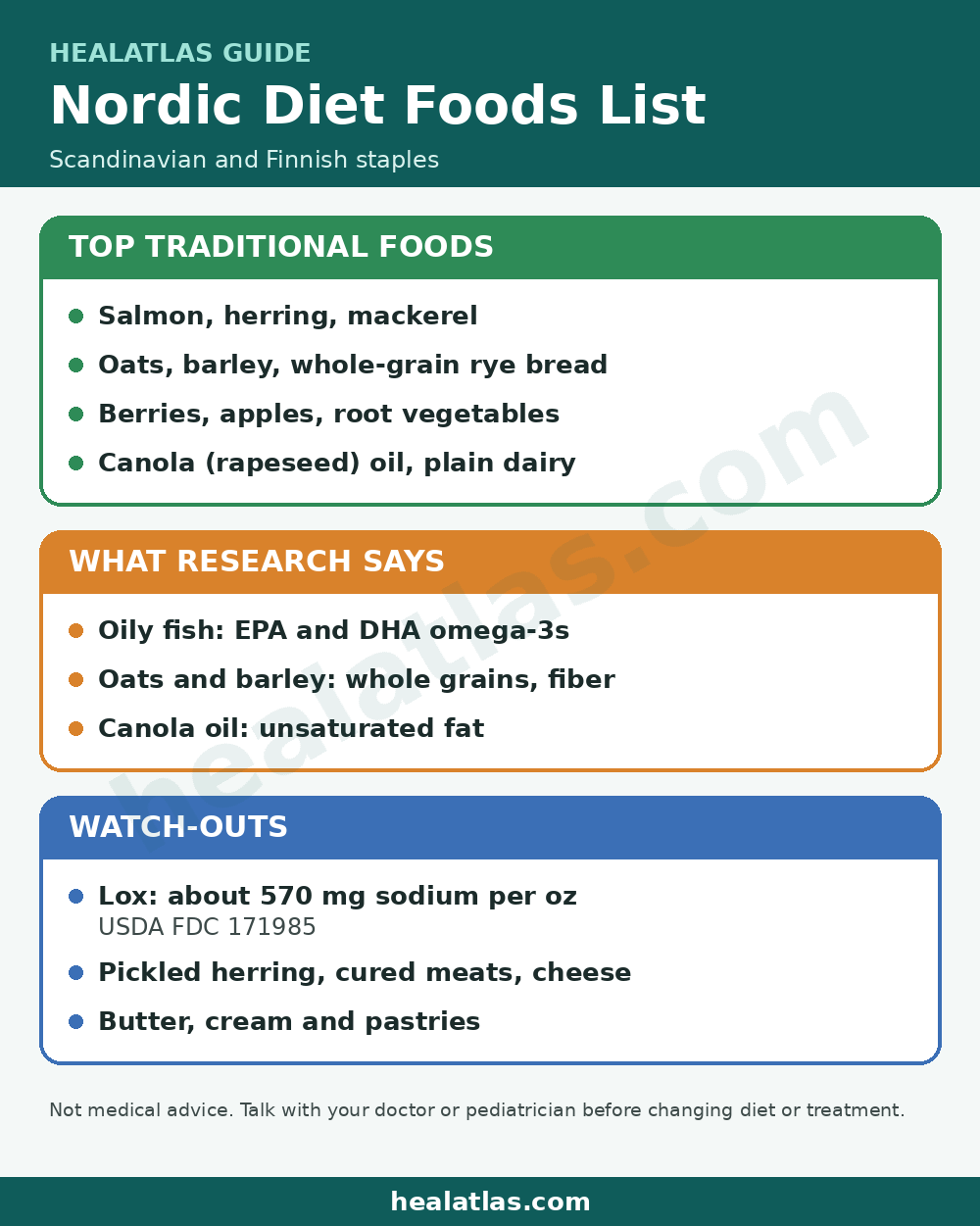
Infographic
Related on HealAtlas: World Healing Foods hub · Nordic diet and cholesterol · Central European healing foods · Whole grains
FAQ
What foods are in the Nordic diet?
Oily fish, oats, barley, rye bread, berries, apples, root vegetables, cabbage, peas and beans, canola oil and plain dairy. (NIH ODS) (Mayo Clinic) (Mayo Clinic)
Is rye bread a whole grain?
It depends on the bread. Many rye breads mix in refined flour, so check that the words “whole grain” come first on the ingredient list, as Mayo Clinic advises. (Mayo Clinic)
Is smoked salmon healthy?
Salmon provides EPA and DHA omega-3s, but smoked salmon is salty: USDA FoodData Central lists about 570 mg of sodium in 1 oz (28 g) of lox (FDC ID 171985). (NIH ODS) (USDA FoodData Central)
How is the Nordic diet different from the Mediterranean diet?
Both emphasize fish, whole grains, fruit and vegetables. The Nordic pattern uses canola oil, rye, oats, barley and berries where the Mediterranean uses olive oil, wheat and different produce. (Mayo Clinic) (Mayo Clinic)
Where can I read about Nordic diet research?
See our deep dive on the Nordic diet and cholesterol, which covers the trials in detail. This page focuses on the foods themselves.
Sources
- Mayo Clinic. Sodium: How to tame your salt habit. https://www.mayoclinic.org/healthy-lifestyle/nutrition-and-healthy-eating/in-depth/sodium/art-20045479 (accessed Oct 25, 2026)
- World Health Organization. Healthy diet fact sheet. https://www.who.int/news-room/fact-sheets/detail/healthy-diet (accessed Oct 25, 2026)
- World Health Organization. Sodium reduction fact sheet. https://www.who.int/news-room/fact-sheets/detail/sodium-reduction (accessed Oct 25, 2026)
- Mayo Clinic. Dietary fiber: Essential for a healthy diet. https://www.mayoclinic.org/healthy-lifestyle/nutrition-and-healthy-eating/in-depth/fiber/art-20043983 (accessed Oct 25, 2026)
- Mayo Clinic. Whole grains: Hearty options for a healthy diet. https://www.mayoclinic.org/healthy-lifestyle/nutrition-and-healthy-eating/in-depth/whole-grains/art-20047826 (accessed Oct 25, 2026)
- NIH Office of Dietary Supplements. Iron: Fact Sheet for Consumers. https://ods.od.nih.gov/factsheets/Iron-Consumer/ (accessed Oct 25, 2026)
- NIH Office of Dietary Supplements. Calcium: Fact Sheet for Consumers. https://ods.od.nih.gov/factsheets/Calcium-Consumer/ (accessed Oct 25, 2026)
- NIH Office of Dietary Supplements. Omega-3 Fatty Acids: Fact Sheet for Consumers. https://ods.od.nih.gov/factsheets/Omega3FattyAcids-Consumer/ (accessed Oct 25, 2026)
- Mayo Clinic. Mediterranean diet for heart health. https://www.mayoclinic.org/healthy-lifestyle/nutrition-and-healthy-eating/in-depth/mediterranean-diet/art-20047801 (accessed Oct 25, 2026)
- Mayo Clinic. Dietary fats: Know which types to choose. https://www.mayoclinic.org/healthy-lifestyle/nutrition-and-healthy-eating/in-depth/fat/art-20045550 (accessed Oct 25, 2026)
- USDA FoodData Central. Fish, salmon, chinook, smoked, (lox), regular, SR Legacy FDC ID 171985 (2,000 mg sodium per 100 g; 1 oz = 28.35 g). https://fdc.nal.usda.gov/food-search/?query=salmon%20chinook%20smoked%20lox (accessed Oct 25, 2026)
- USDA FoodData Central. Fish, herring, Atlantic, pickled, SR Legacy FDC ID 175118 (870 mg sodium per 100 g; 1 oz boneless = 28.35 g). https://fdc.nal.usda.gov/food-search/?query=herring%20atlantic%20pickled (accessed Oct 25, 2026)