
Middle Eastern Healing Foods: Persian, Turkish, Levantine and Gulf Staples
Middle Eastern cooking spans Iran (Persian), Turkey, the Levant and the Arabian Gulf, with shared staples: lentils, chickpeas, bulgur, yogurt, fresh herbs, vegetables and olive oil. This World Healing Foods guide covers healthy Middle Eastern foods by region. Levantine dishes also appear in our Mediterranean diet foods list, so this page goes deeper on Persian, Turkish and Gulf kitchens. This page describes traditional foods and what research says about them. Foods support an overall healthy pattern; they do not treat any disease.
Food culture at a glance
Many traditional meals are built on pulses (lentils, chickpeas and beans), grains and vegetables. WHO advises that carbohydrates come primarily from whole grains, vegetables, fruits and pulses. (WHO) Bulgur, cracked wheat used in tabbouleh and pilafs, is a whole grain. (Mayo Clinic)
Top healing foods and what research says
| Food | What it offers | Evidence strength |
|---|---|---|
| Lentils (adas) | pulses; fiber and plant iron (NIH ODS) | Strong (nutrient source) |
| Chickpeas and hummus | pulses; tahini adds sesame (Mayo Clinic) | Strong (fiber) |
| Fava beans (ful medames) | pulses; fiber (Mayo Clinic) | Strong (fiber) |
| Bulgur and freekeh | bulgur is a whole grain (Mayo Clinic) | Strong |
| Plain yogurt | calcium (NIH ODS) | Strong (nutrient source) |
| Olive oil | unsaturated fat (Mayo Clinic) | Strong |
| Walnuts and pistachios | unsaturated fats; may help lower LDL (Mayo Clinic) | Moderate |
| Fish (Gulf and Mediterranean coasts) | EPA and DHA omega-3s (NIH ODS) | Strong (nutrient source) |
| Fresh herbs (parsley, mint, dill) | flavor in place of salt (Mayo Clinic) | Limited |
| Garlic | supplements may lower cholesterol slightly (NIH NCCIH) | Limited |
Regional food lists
Persian (Iran)
- Ash reshteh (bean, lentil, herb and noodle soup)
- Khoresh sabzi (herb stew with kidney beans)
- Kuku sabzi (herb-packed baked egg dish)
- Plain yogurt and mast-o-khiar (yogurt with cucumber)
- Walnuts and pistachios as snacks
For more Persian dishes, see Persian healing foods.
Turkish
- Mercimek çorbası (red lentil soup)
- Bulgur pilavı
- Zeytinyağlı dishes: vegetables and beans cooked in olive oil
- Grilled fish
- Ayran (plain yogurt drink), lightly salted
Levantine (Lebanon, Syria, Jordan, Palestine)
- Hummus and ful medames
- Tabbouleh and fattoush
- Mujaddara (lentils with bulgur or rice)
- Grilled chicken and vegetables
Gulf (Saudi Arabia, UAE, Oman, Kuwait, Qatar, Bahrain)
- Grilled hammour and other fish
- Harees (wheat and meat porridge)
- Lentil soup
- Dates with plain laban (yogurt drink)
Evidence notes
- Fiber: beans, lentils and whole grains provide fiber, and Mayo Clinic notes that soluble fiber, found in beans, oats and peas, can help lower cholesterol and blood sugar. (Mayo Clinic)
- Iron: lentils, white beans and kidney beans provide plant iron, which is absorbed better with vitamin C foods such as tomatoes and peppers. (NIH ODS)
- Fats: WHO advises that unsaturated fat, found in fish, nuts and olive oil, is preferable to saturated fat such as butter, ghee, cream and fatty meat. (WHO)
- Nuts: walnuts and pistachios may help lower LDL cholesterol as part of a healthy diet. (Mayo Clinic)
Watch-outs
- Salt: pickled vegetables, brined white cheese and olives are salty. USDA FoodData Central lists about 320 mg of sodium in 1 oz (28 g) of feta (FDC ID 173420) and about 32 mg in one large canned ripe olive (4.4 g; FDC ID 169094). (USDA FoodData Central) (USDA FoodData Central) WHO recommends adults keep sodium under 2,000 mg a day. (WHO)
- Sugar: baklava, kunafa and other syrup-soaked sweets add free sugars; WHO advises keeping free sugars under 10% of daily energy. (WHO)
- Fats: fried foods and fatty meats add saturated fat; Mayo Clinic advises limiting saturated fat. (Mayo Clinic)
Building a balanced Middle Eastern plate
WHO advises everyone older than 10 to aim for at least 400 grams of fruits and vegetables and at least 25 grams of naturally occurring dietary fibre a day, with lesser amounts for younger children. (WHO)
Mayo Clinic says foods with fiber may help you stay at a healthy weight and may lower the risk of diabetes, heart disease and some types of cancer. High-fiber foods also tend to be more filling, so you may eat less and stay satisfied longer. (Mayo Clinic)
NIH notes that teen girls and women with heavy periods, pregnant women and teens, and infants are more likely than others to have trouble getting enough iron, and that people who do not eat meat, poultry or seafood need almost twice as much iron because the body does not absorb plant (nonheme) iron as well. Pulse-based meals may support iron intake for these groups, especially when paired with vitamin C foods. (NIH ODS)
Mayo Clinic says choosing unsaturated fats in place of saturated fats can improve blood cholesterol, which may lower the risk of heart disease. It suggests using plant-based oils such as extra-virgin olive oil instead of butter or lard, and limiting processed foods that often contain saturated fat. (Mayo Clinic)
WHO advises limiting free sugars to less than 10% of total daily energy, about 50 grams (12 level teaspoons) for a person eating about 2,000 calories a day. Free sugars include sugars added by the manufacturer, cook or consumer, as well as sugars naturally present in honey, syrups and fruit juices. (WHO)
To keep sodium down, Mayo Clinic suggests replacing salt with fresh or dried herbs, spices, and citrus zest and juice, and limiting condiments. (Mayo Clinic) WHO recommends adults eat less than 2,000 mg of sodium a day, equivalent to less than 5 grams of salt, or just under a teaspoon. (WHO)
How to try it
- Cook a pot of red lentil soup or ash once a week
- Swap white rice for bulgur pilaf some days
- Use herbs, lemon and sumac in place of extra salt (Mayo Clinic)
- Keep pickles and brined cheese as small sides
Related: legumes and beans, legumes, soy and blood pressure research and Mediterranean diet research.
Cooking for kids? See healthy Middle Eastern food for kids.
Nearby cuisines: Mediterranean diet foods list · Central European healing foods · African healing foods · North Indian healing foods · Persian healing foods
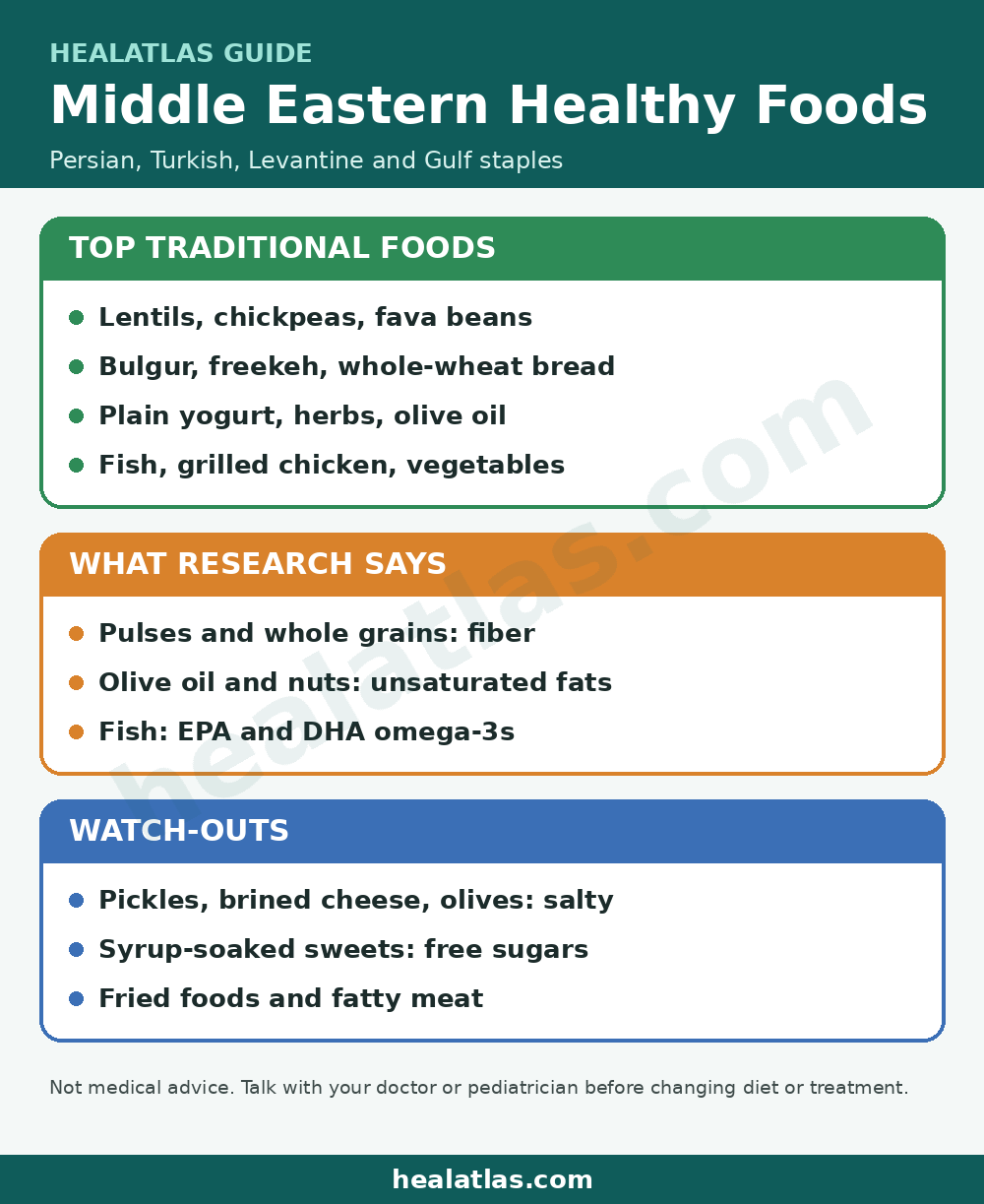
Infographic
Related on HealAtlas: World Healing Foods hub · Mediterranean diet foods list · Middle Eastern foods for kids · Legumes and beans
FAQ
What are healthy Middle Eastern foods?
Lentils, chickpeas, fava beans, bulgur, plain yogurt, fresh herbs, vegetables, fish and olive oil. WHO advises getting carbohydrates mainly from whole grains, vegetables, fruits and pulses. (WHO) (Mayo Clinic)
Is hummus healthy?
Hummus is made from chickpeas, a pulse that provides fiber, plus tahini (sesame). Watch the salt in store-bought versions and the portion of oil. (Mayo Clinic) (Mayo Clinic)
Is Middle Eastern food the same as Mediterranean food?
They overlap: Levantine cooking is part of the Mediterranean tradition. Persian, Turkish and Gulf kitchens share many staples, such as pulses, yogurt and herbs, and have their own dishes. (Mayo Clinic)
What should I limit?
Salty pickles, brined cheeses and olives, syrup-soaked sweets, and fried foods. WHO recommends adults keep sodium under 2,000 mg a day and free sugars under 10% of daily energy. (WHO) (WHO)
Are lentils a good source of iron?
Yes. NIH lists lentils, white beans, kidney beans and peas among food sources of iron, and the body absorbs plant iron better when it is eaten with vitamin C foods such as tomatoes and peppers. (NIH ODS)
How can I cut sugar when eating Middle Eastern sweets?
Keep syrup-soaked sweets such as baklava for occasional small portions. WHO advises limiting free sugars, including those in syrups and honey, to less than 10% of daily energy. (WHO)
Sources
- Mayo Clinic. Sodium: How to tame your salt habit. https://www.mayoclinic.org/healthy-lifestyle/nutrition-and-healthy-eating/in-depth/sodium/art-20045479 (accessed Oct 25, 2026)
- World Health Organization. Healthy diet fact sheet. https://www.who.int/news-room/fact-sheets/detail/healthy-diet (accessed Oct 25, 2026)
- World Health Organization. Sodium reduction fact sheet. https://www.who.int/news-room/fact-sheets/detail/sodium-reduction (accessed Oct 25, 2026)
- Mayo Clinic. Dietary fiber: Essential for a healthy diet. https://www.mayoclinic.org/healthy-lifestyle/nutrition-and-healthy-eating/in-depth/fiber/art-20043983 (accessed Oct 25, 2026)
- Mayo Clinic. Whole grains: Hearty options for a healthy diet. https://www.mayoclinic.org/healthy-lifestyle/nutrition-and-healthy-eating/in-depth/whole-grains/art-20047826 (accessed Oct 25, 2026)
- NIH Office of Dietary Supplements. Iron: Fact Sheet for Consumers. https://ods.od.nih.gov/factsheets/Iron-Consumer/ (accessed Oct 25, 2026)
- NIH Office of Dietary Supplements. Calcium: Fact Sheet for Consumers. https://ods.od.nih.gov/factsheets/Calcium-Consumer/ (accessed Oct 25, 2026)
- NIH Office of Dietary Supplements. Omega-3 Fatty Acids: Fact Sheet for Consumers. https://ods.od.nih.gov/factsheets/Omega3FattyAcids-Consumer/ (accessed Oct 25, 2026)
- Mayo Clinic. Mediterranean diet for heart health. https://www.mayoclinic.org/healthy-lifestyle/nutrition-and-healthy-eating/in-depth/mediterranean-diet/art-20047801 (accessed Oct 25, 2026)
- Mayo Clinic. Dietary fats: Know which types to choose. https://www.mayoclinic.org/healthy-lifestyle/nutrition-and-healthy-eating/in-depth/fat/art-20045550 (accessed Oct 25, 2026)
- Mayo Clinic. Nuts and your heart: Eating nuts for heart health. https://www.mayoclinic.org/diseases-conditions/heart-disease/in-depth/nuts/art-20046635 (accessed Oct 25, 2026)
- NCCIH (NIH). Garlic: Usefulness and Safety. https://www.nccih.nih.gov/health/garlic (accessed Oct 25, 2026)
- USDA FoodData Central. Cheese, feta, SR Legacy FDC ID 173420 (1,140 mg sodium per 100 g; 1 oz = 28.35 g). https://fdc.nal.usda.gov/food-search/?query=feta%20cheese (accessed Oct 25, 2026)
- USDA FoodData Central. Olives, ripe, canned (small-extra large), SR Legacy FDC ID 169094 (735 mg sodium per 100 g; 1 large olive = 4.4 g). https://fdc.nal.usda.gov/food-search/?query=olives%20ripe%20canned (accessed Oct 25, 2026)