
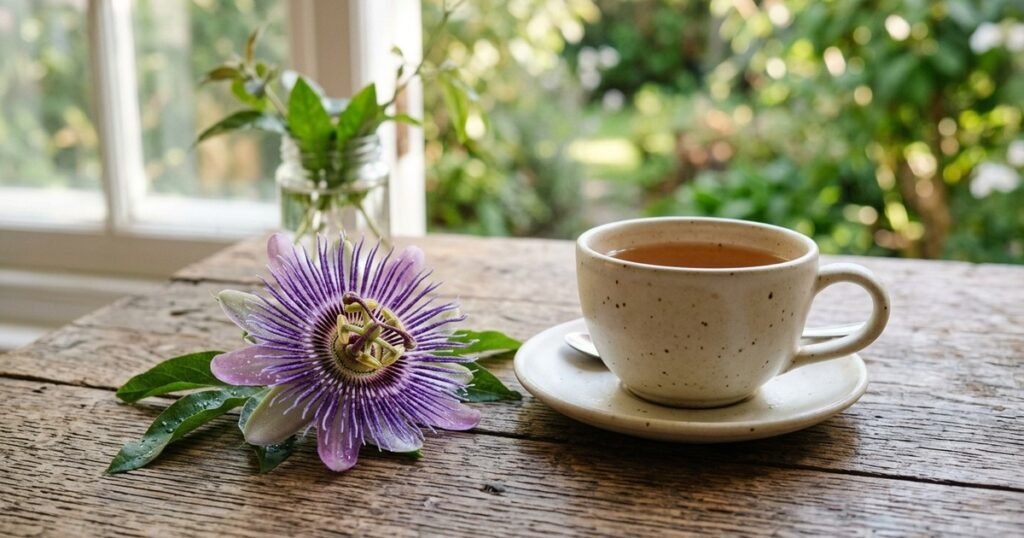
In the search for evidence-based botanical remedies to quiet nervous tension and support restful sleep, passionflower (Passiflora incarnata) stands out for its extensive pharmacological and clinical evaluation. Native to the Americas and long used in traditional herbal medicine, passionflower has been evaluated in randomized controlled trials, crossover sleep studies, and systematic reviews. Rather than relying solely on folklore, modern research has investigated its effects on generalized anxiety disorder (GAD), situational stress, and subjective sleep quality—focusing on how it interacts with the brain’s gamma-aminobutyric acid (GABA) system.
While clinical findings suggest passionflower offers meaningful calming properties without the heavy morning cognitive impairment typical of synthetic sedatives, it is not a cure-all. Understanding the clinical evidence, physiological mechanisms, and critical safety boundaries helps separate genuine therapeutic benefits from unsupported marketing claims.
How Passionflower Modulates GABA and Brain Excitability
The primary mechanism underlying passionflower’s anxiolytic and sleep-supportive actions centers on central nervous system inhibition. The aerial parts of Passiflora incarnata contain a diverse complex of bioactive secondary metabolites, including C-glycosyl flavonoids (vitexin, isovitexin, orientin), flavones such as chrysin, and trace amounts of indole alkaloids.
In a mechanistic study published in Phytotherapy Research, researchers investigated the receptor-binding properties of passionflower extracts across mammalian central nervous system tissues. The study demonstrated that bioactive compounds in passionflower bind directly to both GABA-A and GABA-B receptor complexes. Crucially, the extract acted as a positive allosteric modulator at GABA-A receptors, while concurrently inhibiting synaptosomal GABA reuptake.
By prolonging GABA availability within cortical synapses, passionflower dampens neuronal hyperarousal. This inhibitory signaling reduces the rapid, repetitive neurological firing associated with acute restlessness and cognitive hypervigilance, promoting relaxation without causing severe motor ataxia.
Clinical Evidence for Anxiety: The Oxazepam Comparison Trial
While laboratory receptor assays confirm biological plausibility, human randomized controlled trials determine therapeutic value. The most prominent clinical trial investigating passionflower in generalized anxiety disorder was conducted by Akhondzadeh and colleagues, published in the Journal of Clinical Pharmacy and Therapeutics.
In this 4-week, double-blind, randomized, active-controlled trial, 36 outpatients diagnosed with GAD received either 45 drops of standardized Passiflora incarnata liquid extract daily (plus a placebo pill) or 30 mg of oxazepam daily (a conventional prescription benzodiazepine, plus placebo drops). Clinical anxiety severity was monitored using the clinician-scored Hamilton Anxiety Rating Scale (HAM-A).
Both treatments produced equivalent, statistically significant reductions in HAM-A scores from baseline to day 28. However, two notable differences emerged:
- Onset of Action: Oxazepam worked faster, reducing anxiety scores significantly by day 4, whereas passionflower required 7 to 10 days to reach equivalent symptom relief.
- Occupational and Cognitive Side Effects: Oxazepam caused significantly higher daytime drowsiness and impaired job performance (P < 0.001). Passionflower produced equivalent therapeutic anxiolysis without impairing daytime cognitive function.
A primary limitation of this trial was its small sample size (n=36) and 28-day duration. While passionflower demonstrated therapeutic equivalence to a standard benzodiazepine, broader long-term confirmatory trials are still needed.
Situational Stress and Sleep Quality
In addition to chronic anxiety, passionflower has been evaluated in acute, situational stress models. A comprehensive systematic review published in Nutrients examined nine human clinical trials evaluating Passiflora incarnata across neuropsychiatric conditions. The review identified multiple trials where oral passionflower extract significantly blunted situational anxiety in patients awaiting surgical procedures, such as spinal anesthesia or dental surgery, without prolonging emergence from anesthesia or altering baseline hemodynamics.
Because anxiety and sleep disturbance share common neurobiological pathways of autonomic arousal, researchers have also examined passionflower’s role in sleep quality. A double-blind, placebo-controlled crossover trial published in Phytotherapy Research investigated the effect of passionflower herbal tea on subjective sleep in 41 healthy adults (aged 18–35). Participants consumed one freshly prepared cup of passionflower tea or a matched placebo tea nightly for seven consecutive days, followed by a one-week washout period before crossing over.
Daily sleep diaries measuring sleep quality parameters revealed a statistically significant improvement in overall subjective sleep quality in the passionflower group (t(40) = 2.70, P < 0.01). Participants experienced improved morning refreshment without residual grogginess. However, researchers caution that this study evaluated healthy adults with mild sleep complaints; passionflower should not be viewed as a standalone replacement for clinical treatments in severe chronic insomnia.
Key Clinical Trials on Passiflora Incarnata
| Study & Journal | Design & Cohort | Dose & Duration | Key Findings | Study Limitations |
|---|---|---|---|---|
| Akhondzadeh et al. (2001) J Clin Pharm Ther |
Double-blind RCT; 36 outpatients with GAD | 45 drops/day extract vs. 30 mg/day oxazepam; 4 weeks | Equivalent HAM-A reduction; significantly lower daytime sedation and zero job impairment vs. oxazepam | Small sample (n=36); slower onset (7–10 days vs. 4 days for oxazepam) |
| Ngan & Conduit (2011) Phytother Res |
Double-blind crossover trial; 41 healthy adults | 1 cup passionflower tea nightly vs. placebo; 7 days | Statistically significant improvement in sleep quality rating (P < 0.01); no morning sluggishness | Short 7-day duration; healthy volunteers with mild fluctuations rather than clinical insomnia |
| Janda et al. (2020) Nutrients |
Systematic review of 9 clinical human trials | Oral extracts (250–1000 mg dry extract or liquid equivalents) | Consistent reduction in acute and generalized anxiety; excellent tolerability profile | Heterogeneous study designs; varied extraction ratios across trials |
| Appel et al. (2011) Phytother Res |
In vitro receptor-binding & synaptosomal assay | Standardized Passiflora extract on GABA receptors | Demonstrated GABA-A/B affinity and inhibition of synaptosomal GABA reuptake | In vitro laboratory design; cannot measure real-world human blood-brain barrier transport |
Source: Compiled from peer-reviewed clinical trials and the European Medicines Agency Assessment Report on Passiflora incarnata.
Regulatory Standards and Formulations
In Europe, herbal medicines undergo formal evaluation by the European Medicines Agency (EMA). The EMA Committee on Herbal Medicinal Products (HMPC) publishes an official community herbal monograph for Passiflora incarnata L., herba.
The EMA classifies passionflower as an established Traditional Herbal Medicinal Product (THMP) indicated for two specific uses: the relief of mild symptoms of mental stress, and to aid sleep. The monograph identifies several common preparations:
- Herbal Tea (Infusion): 1 to 2 grams of dried aerial parts steeped in 150 ml boiling water for 10 minutes, taken 1 to 3 times daily or roughly 45 minutes before sleep.
- Standardized Dry Extract: Tablets or capsules standardized to flavonoid markers, commonly dosed at 250 mg to 500 mg daily.
- Liquid Tincture: Hydroethanolic extracts (1:5 to 1:8 ratio) taken at 20 to 45 drops diluted in water up to three times daily.
Reviewing clinical literature from the National Center for Biotechnology Information (NCBI) confirms that selecting third-party verified preparations ensures consistent flavonoid concentrations and avoids adulteration.
Safety Considerations, Contraindications, and Drug Interactions
Although clinical trials confirm a favorable safety record, passionflower is not suitable for everyone:
- Strict Pregnancy Contraindication: Passionflower must not be used during pregnancy. Certain constituents, particularly trace harmala alkaloids, can cause uterine stimulation and contractions. Nursing mothers should also avoid use due to insufficient safety data.
- Additive CNS Sedation: Because passionflower enhances GABA activity, it must not be combined with prescription sedatives, including benzodiazepines (such as lorazepam or alprazolam), barbiturates, sleep medications (such as zolpidem), or alcohol. Concurrent use risks excessive sedation or impaired coordination.
- Surgical Precaution: Because passionflower modulates central nervous system neurotransmission, discontinue supplementation at least two weeks before scheduled surgery involving general anesthesia.
Related Reading
- Holy Basil for Stress and Sleep: What Clinical Trials Reveal
- L-Theanine: Benefits for Anxiety, Sleep, and Focus, Per Science
- Glycine for Sleep: How This Amino Acid Drops Body Temperature
- Ashwagandha for Stress and Sleep: What Research Shows
Sources and Further Reading
- Janda K, Wojtkowska K, Jakubczyk K, Antoniewicz J, Skonieczna-Żydecka K. Passiflora incarnata in Neuropsychiatric Disorders—A Systematic Review. Nutrients. 2020;12(12):3894. Available from: https://doi.org/10.3390/nu12123894.
- Akhondzadeh S, Naghavi HR, Vazirian M, Shayeganpour A, Rashidi H, Khani M. Passionflower in the treatment of generalized anxiety: a double-blind randomized clinical trial with oxazepam. Journal of Clinical Pharmacy and Therapeutics. 2001;26(5):363-367. Available from: https://doi.org/10.1046/j.1365-2710.2001.00367.x.
- Ngan A, Conduit R. A double-blind, placebo-controlled investigation of the effects of Passiflora incarnata (passionflower) herbal tea on subjective sleep quality. Phytotherapy Research. 2011;25(8):1153-1159. Available from: https://doi.org/10.1002/ptr.3400.
- European Medicines Agency (EMA) Committee on Herbal Medicinal Products (HMPC). Assessment report on Passiflora incarnata L., herba. EMA/HMPC/669622/2013. Official Monograph Available from: https://www.ema.europa.eu/en/medicines/herbal/passiflorae-herba.
- Appel K, Rose T, Löser B, Grötzinger E, Jerkovic S, et al. Modulation of the γ-aminobutyric acid (GABA) system by Passiflora incarnata L. Phytotherapy Research. 2011;25(6):838-843. Available from: https://doi.org/10.1002/ptr.3352.
- National Center for Biotechnology Information (NCBI) / U.S. National Library of Medicine. Phytotherapeutic interventions in mental health: Evidence and safety analysis. PubMed Central. Available from: https://pubmed.ncbi.nlm.nih.gov/33333911/.
Disclosure: This content is for informational purposes only and is not medical advice. Always consult a qualified healthcare provider before making changes to your health regimen.