
Is Sichuan Food Healthy? Sichuan Healing Foods and What Science Says
Sichuan cuisine is famous for bold, numbing-spicy flavors from chili and Sichuan pepper, and also for high salt and oil. So is Sichuan food healthy? This World Healing Foods guide looks at traditional Sichuan foods and a trial that tested a lower-salt version of the cuisine. This page describes traditional foods and what research says about them. Foods support an overall healthy pattern; they do not treat any disease.
Food culture at a glance
Researchers describe Sichuan cuisine as characterized by high salt and oil content. (PubMed Central (NIH)) Yet it also uses many vegetables, tofu and beans; WHO advises basing meals on vegetables, whole grains and pulses such as beans. (WHO)
The lower-salt Sichuan diet trial
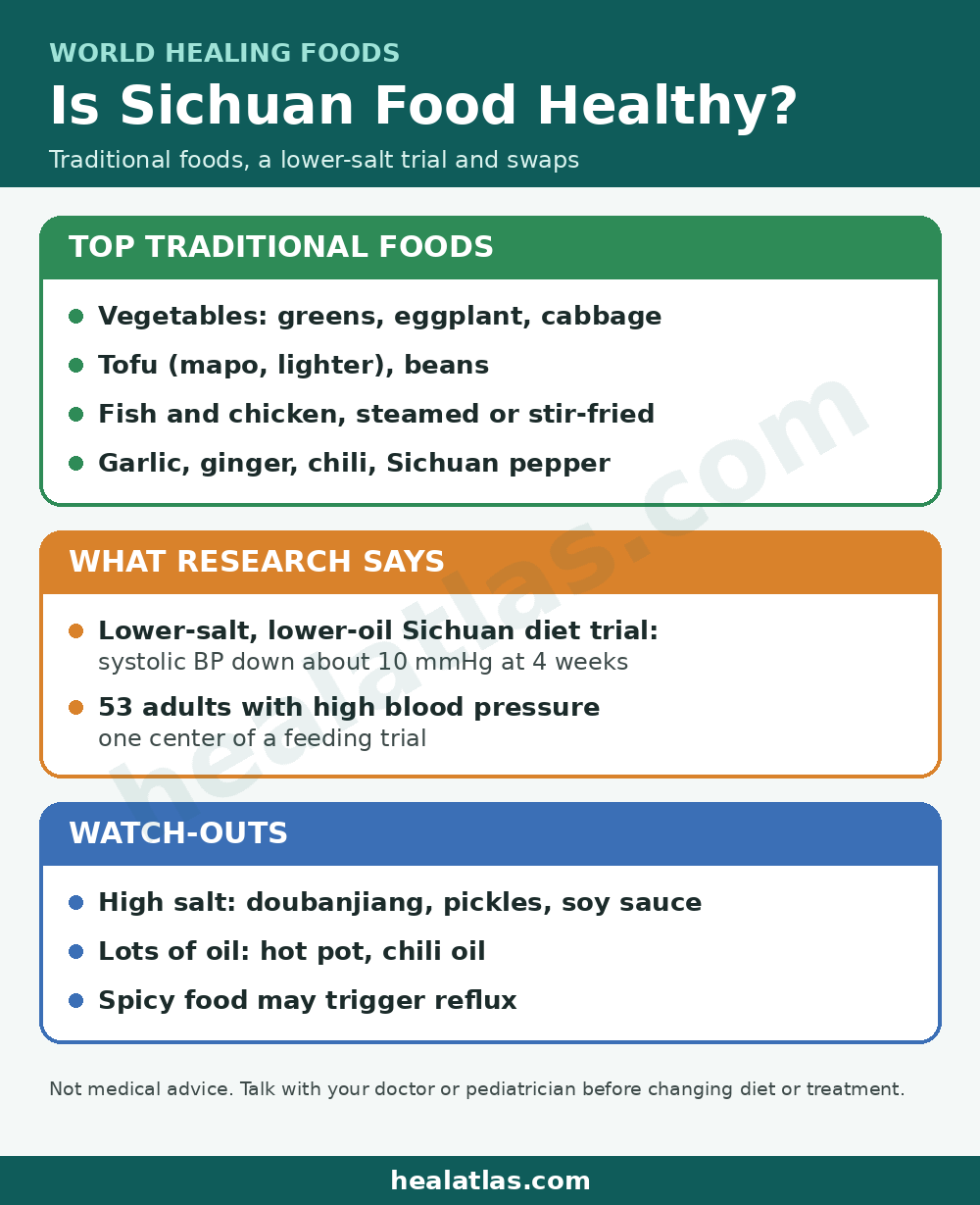
In a secondary analysis of the Sichuan center of the multicenter Chinese Heart-Healthy diet feeding trial, 53 adults aged 25 to 75 with high blood pressure (systolic 130 to 159 mmHg) were randomly assigned to a typical local diet or a heart-healthy Sichuan-style diet for 4 weeks. The heart-healthy version cut cooking salt, oil and red meat and added whole grains, fruits, seafood, low-fat dairy, soybeans and nuts. Systolic blood pressure fell by 10.1 mmHg and diastolic by 4.01 mmHg at week 4 compared with the control group, and more people reached blood pressure control. (PubMed Central (NIH))
This was a small, short trial, so it suggests that keeping Sichuan flavors while cutting salt and oil may help blood pressure; it does not show long-term outcomes. High blood pressure needs care from your healthcare provider, and lifestyle changes work alongside, not instead of, prescribed treatment. (NHLBI (NIH)) See our high blood pressure Heal Story.
Top healing foods and what research says
| Food | What it offers | Evidence strength |
|---|---|---|
| Leafy greens and cabbage | fiber-rich vegetables (Mayo Clinic) | Strong (vegetables) |
| Tofu | soy protein in place of other proteins may lower cholesterol slightly (NIH NCCIH) | Moderate |
| Fish | EPA and DHA omega-3s (NIH ODS) | Strong (nutrient source) |
| Beans and soybeans | fiber (Mayo Clinic) | Strong |
| Eggplant, bamboo shoots, mushrooms | fiber-rich vegetables (Mayo Clinic) | Strong (vegetables) |
| Ginger | may help pregnancy nausea (supplement studies) (NIH NCCIH) | Moderate for that use |
| Whole grains (in the trial diet) | part of the heart-healthy Sichuan diet tested (PubMed Central (NIH)) | Moderate (one trial) |
| Garlic and scallions | flavor without extra salt (Mayo Clinic) | Limited |
| Chili and Sichuan pepper | flavor; no strong health evidence (Mayo Clinic) | Limited |
| Green tea | linked to lower heart risk in Asian populations (NIH NCCIH) | Mixed |
Signature dishes, made lighter
- Mapo tofu with less oil and doubanjiang, more vegetables
- Stir-fried greens with garlic (dry-fried style, light oil)
- Steamed or poached fish with chili and Sichuan pepper instead of extra salt
- Hot pot with a clear broth, lots of vegetables and tofu, and a light dipping sauce
- Smashed cucumber salad with vinegar and garlic, light on salt
Watch-outs
- Salt: chili bean paste, pickles and soy sauce are salty; one tablespoon of soy sauce can have more than 800 mg of sodium. WHO advises adults keep sodium under 2,000 mg a day. (Mayo Clinic) (WHO)
- Oil: hot pot and chili oil add a lot of fat; WHO advises keeping saturated fat under 10% of energy and favoring unsaturated oils. (WHO)
- Spice and reflux: if spicy foods trigger heartburn for you, see our acid reflux Heal Story.
Conditions it may support
A lower-salt Sichuan pattern may support our high blood pressure and high cholesterol Heal Stories. Related: herbs and spices and potassium-rich foods.
Cooking for kids? See healthy Chinese food for kids (keep chili mild for young children).
Nearby cuisines: Cantonese healing foods · Thai healing foods · Japanese healing foods · World Healing Foods hub
Infographic
Related on HealAtlas: World Healing Foods hub · High Blood Pressure Heal Story · Healthy Chinese food for kids · Herbs and spices · Acid Reflux Heal Story
FAQ
Is Sichuan food healthy or unhealthy?
It can be either. Sichuan cuisine is typically high in salt and oil, but in a 4-week feeding trial a heart-healthy Sichuan diet with less salt, oil and red meat lowered systolic blood pressure by about 10 mmHg in adults with high blood pressure. (PubMed Central (NIH))
Can a Sichuan diet lower blood pressure?
One small randomized trial found that a lower-salt, lower-oil Sichuan-style diet reduced blood pressure over 4 weeks. It may help as part of a healthy lifestyle, but it is not a replacement for treatment from your provider. (PubMed Central (NIH)) (NHLBI (NIH))
What makes Sichuan food salty?
Chili bean paste (doubanjiang), pickled vegetables and soy sauce are major sources. One tablespoon of soy sauce can have more than 800 mg of sodium. (Mayo Clinic)
Are Sichuan peppercorns good for you?
They add flavor that can help you use less salt, but there is no strong evidence for specific health benefits. Mayo Clinic suggests herbs and spices in place of salt. (Mayo Clinic)
Sources
- Mayo Clinic. Sodium: How to tame your salt habit. https://www.mayoclinic.org/healthy-lifestyle/nutrition-and-healthy-eating/in-depth/sodium/art-20045479 (accessed Oct 25, 2026)
- World Health Organization. Healthy diet fact sheet. https://www.who.int/news-room/fact-sheets/detail/healthy-diet (accessed Oct 25, 2026)
- World Health Organization. Sodium reduction fact sheet. https://www.who.int/news-room/fact-sheets/detail/sodium-reduction (accessed Oct 25, 2026)
- Mayo Clinic. Dietary fiber: Essential for a healthy diet. https://www.mayoclinic.org/healthy-lifestyle/nutrition-and-healthy-eating/in-depth/fiber/art-20043983 (accessed Oct 25, 2026)
- NIH Office of Dietary Supplements. Omega-3 Fatty Acids: Fact Sheet for Consumers. https://ods.od.nih.gov/factsheets/Omega3FattyAcids-Consumer/ (accessed Oct 25, 2026)
- NCCIH (NIH). Ginger: Usefulness and Safety. https://www.nccih.nih.gov/health/ginger (accessed Oct 25, 2026)
- NCCIH (NIH). Green Tea: Usefulness and Safety. https://www.nccih.nih.gov/health/green-tea (accessed Oct 25, 2026)
- Chen H, Su D, Guo Y, et al. Effects of the Chinese heart-healthy diet (Sichuan cuisine) on lowering blood pressure in adults with hypertension: a randomized controlled feeding trial. Asia Pac J Clin Nutr. 2024. PMID 38494683. https://pmc.ncbi.nlm.nih.gov/articles/PMC11170007/ (accessed Oct 25, 2026)
- NHLBI. High Blood Pressure. https://www.nhlbi.nih.gov/health/high-blood-pressure (accessed Oct 25, 2026)
- NCCIH (NIH). Soy: Usefulness and Safety. https://www.nccih.nih.gov/health/soy (accessed Oct 25, 2026)