
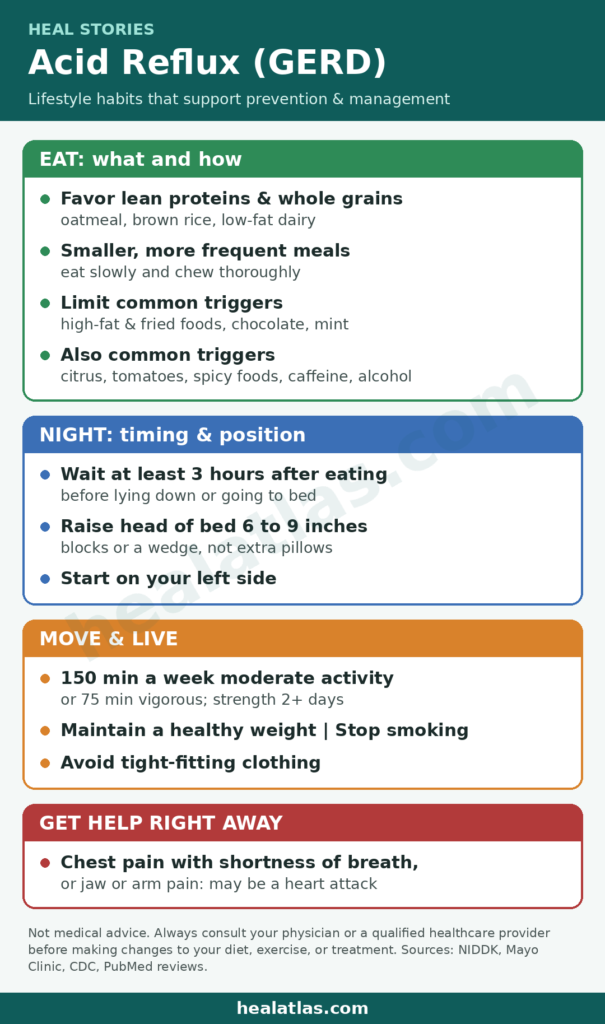
Acid reflux is common, and frequent reflux can be managed. This Heal Stories guide pulls together what trusted health organizations say about everyday habits that support prevention and management of GERD, alongside the care plan you build with your healthcare provider.
What it is
Gastroesophageal reflux (GER) happens when your stomach contents come back up into your esophagus. Gastroesophageal reflux disease (GERD) is a more severe and long-lasting condition in which GER causes repeated symptoms that are bothersome or leads to complications over time. Researchers estimate that about 20 percent of people in the United States have GERD. (NIDDK)
Common symptoms are heartburn (a painful, burning feeling in the middle of the chest, behind the breastbone) and regurgitation of stomach contents into the throat or mouth. Other symptoms may include chest pain, nausea, problems or pain when swallowing, and chronic cough or hoarseness. (NIDDK)
You are more likely to have GERD if you have overweight or obesity, are pregnant, take certain medicines, or smoke or are regularly exposed to secondhand smoke. (NIDDK) Without treatment, GERD can sometimes cause serious complications over time, such as esophagitis, esophageal stricture, and Barrett’s esophagus. (NIDDK)
Signs that mean see a doctor now
- Seek medical help right away if you have chest pain, especially with shortness of breath or jaw or arm pain. These may be symptoms of a heart attack. (Mayo Clinic)
- See a doctor if you have loss of appetite, persistent vomiting, problems or pain when swallowing, vomit that contains blood or looks like coffee grounds, stool that contains blood or looks black and tarry, or unexplained weight loss. (NIDDK)
- Make an appointment if you have severe or frequent GERD symptoms, or take nonprescription heartburn medicines more than twice a week. (Mayo Clinic) See a doctor if your symptoms don’t get better with over-the-counter medicines or lifestyle changes. (NIDDK)
Prevention
Lifestyle changes may reduce GERD symptoms and the frequency of acid reflux. (NIDDK) (Mayo Clinic)
- Maintain a healthy weight. Excess pounds put pressure on the abdomen. (Mayo Clinic) In a review of the evidence, weight loss was followed by less esophageal acid exposure in 2 randomized trials. (PubMed review)
- Stop smoking. Smoking decreases the lower esophageal sphincter’s ability to function properly. (Mayo Clinic)
- Wait at least 3 hours after eating before lying down or going to bed. (Mayo Clinic) (NIDDK) In randomized trials, late evening meals increased acid exposure when lying down. (PubMed review)
- Elevate the head of your bed by 6 to 9 inches with blocks or a wedge if heartburn affects your sleep; Mayo Clinic notes that raising your head with extra pillows isn’t effective. (Mayo Clinic) Head-of-the-bed elevation decreased acid exposure when lying down in randomized trials. (PubMed review)
- Start on your left side when you go to bed. (Mayo Clinic)
- Eat food slowly and chew thoroughly, and don’t wear tight-fitting clothing around the waist. (Mayo Clinic)
Food practices
Some people with GERD find that certain foods or drinks trigger symptoms or make them worse. Talk with your doctor about foods or drinks that seem to increase your symptoms. (NIDDK)
Foods to favor
- Lean proteins (PubMed review)
- Whole grains and fiber-rich foods, such as oatmeal and brown rice (PubMed review)
- Low-fat dairy products (PubMed review)
- Smaller, more frequent meals (PubMed review), eaten slowly (Mayo Clinic)
Foods to limit
- Foods and drinks commonly linked to GERD symptoms: acidic foods such as citrus fruits and tomatoes, alcoholic drinks, chocolate, coffee and other sources of caffeine, high-fat foods, mint, and spicy foods (NIDDK)
- Fatty or fried foods, large meals, and eating late at night (Mayo Clinic)
- High-fat foods, oils, and fried foods (PubMed review)
A sample day of meals
An example day built from the foods above. Triggers differ from person to person, so your doctor may recommend reducing or avoiding specific foods to see if symptoms improve. (NIDDK)
| Meal | Example |
|---|---|
| Breakfast | Oatmeal with low-fat milk or low-fat yogurt |
| Lunch | Grilled skinless chicken with brown rice; a modest portion |
| Snack | Low-fat yogurt |
| Dinner | Baked fish with a whole grain, eaten slowly, at least 3 hours before bed; no tomato sauce, citrus, or spicy seasoning if they trigger symptoms |
| Drinks | Water; limit coffee, caffeine, and alcohol if they trigger symptoms |
Exercise and lifestyle habits
If you have overweight or obesity, your doctor may suggest losing weight to reduce your GERD symptoms. (NIDDK) Regular activity follows the general adult guidelines below. (CDC)
| Habit | How often | How intense |
|---|---|---|
| Moderate aerobic activity, such as brisk walking | At least 150 minutes a week, e.g. 30 minutes a day, 5 days a week | Moderate intensity |
| Or vigorous aerobic activity, such as jogging or running | 75 minutes a week, or an equivalent mix | Vigorous intensity |
| Muscle strengthening (all major muscle groups) | 2 or more days a week | — |
| Diaphragmatic (deep) breathing, ideally taught by a trained medical professional | After eating | Breathe deeply into the diaphragm |
| Meal timing | Every day: at least 3 hours between eating and lying down | — |
| Bed position | Nightly: head of bed raised 6 to 9 inches; start on your left side | — |
Sources for the table: (CDC) (Mayo Clinic)
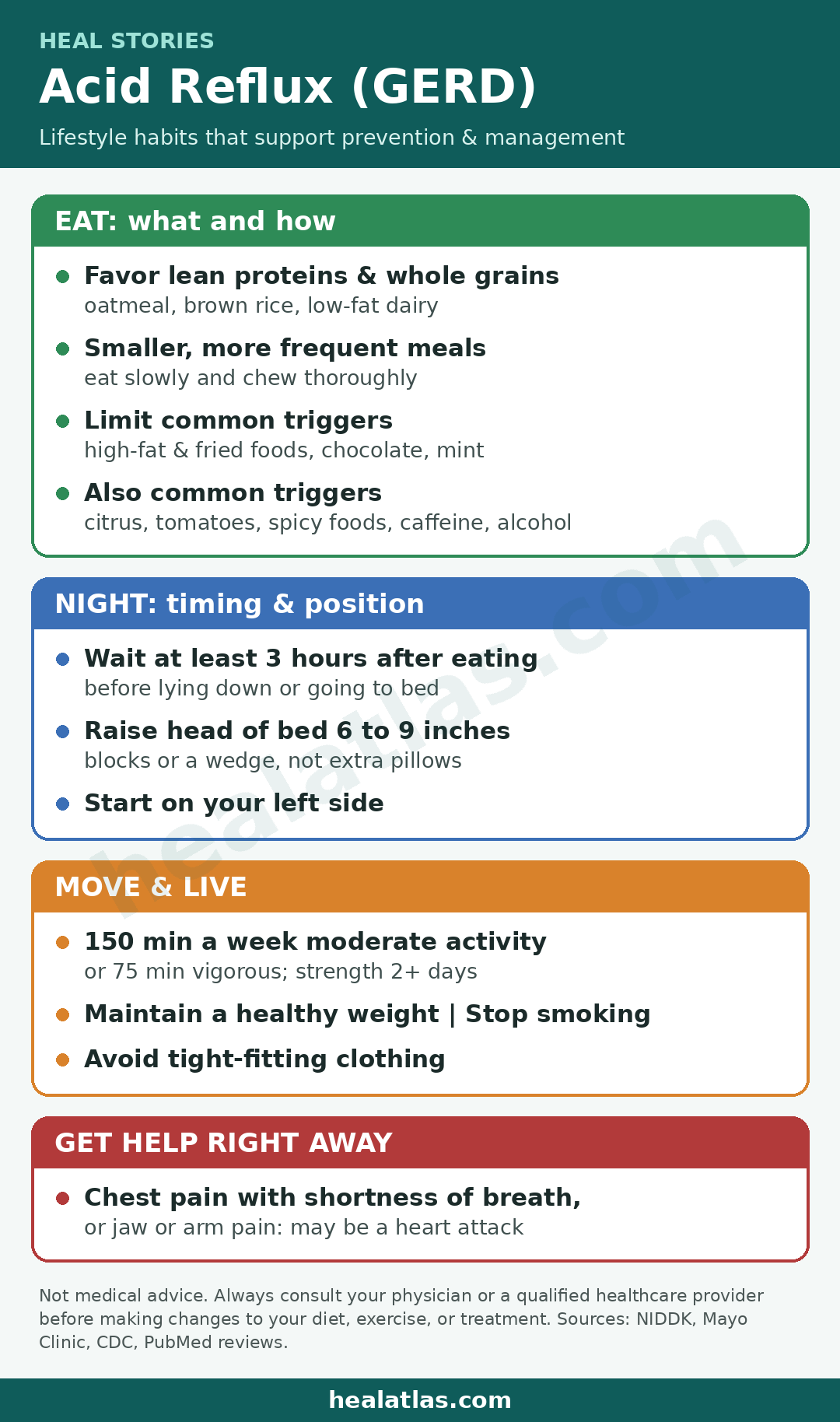
Infographic
Related on HealAtlas: Ginger for nausea, inflammation, and gut health · Trapped gas and bloating: what research shows about relief
FAQ
Can lifestyle changes alone manage acid reflux?
Lifestyle changes may reduce GERD symptoms and support management, and most people manage GERD with lifestyle changes and medicines. If you start a nonprescription GERD medicine, tell your care provider, and don’t use antacids every day or for severe symptoms except after discussing it with your doctor. (NIDDK) (Mayo Clinic) (Mayo Clinic)
Which foods commonly trigger GERD symptoms?
Foods and drinks commonly linked to GERD symptoms include citrus fruits, tomatoes, alcoholic drinks, chocolate, coffee and other sources of caffeine, high-fat foods, mint, and spicy foods. Triggers vary, so talk with your doctor about what seems to affect you. (NIDDK)
How long should I wait to lie down after eating?
Wait at least 3 hours after eating before lying down or going to bed. (Mayo Clinic) (NIDDK)
Should I raise the head of my bed?
If heartburn affects your sleep, Mayo Clinic suggests raising the head end of the bed by 6 to 9 inches with blocks or using a wedge. Raising your head with extra pillows isn’t effective. (Mayo Clinic)
When is heartburn an emergency?
Seek medical help right away if you have chest pain, especially with shortness of breath or jaw or arm pain, because these may be symptoms of a heart attack. (Mayo Clinic)
Does losing weight help acid reflux?
If you have overweight or obesity, your doctor may suggest losing weight to reduce GERD symptoms. In a review of the evidence, weight loss was followed by less esophageal acid exposure in 2 randomized trials. (NIDDK) (PubMed review)
Sources
- CDC. Adult Activity: An Overview. https://www.cdc.gov/physical-activity-basics/guidelines/adults.html (accessed Oct 25, 2026)
- NIDDK (NIH). Definition & Facts for GER & GERD. https://www.niddk.nih.gov/health-information/digestive-diseases/acid-reflux-ger-gerd-adults/definition-facts (accessed Oct 25, 2026)
- NIDDK (NIH). Symptoms & Causes of GER & GERD. https://www.niddk.nih.gov/health-information/digestive-diseases/acid-reflux-ger-gerd-adults/symptoms-causes (accessed Oct 25, 2026)
- NIDDK (NIH). Treatment for GER & GERD. https://www.niddk.nih.gov/health-information/digestive-diseases/acid-reflux-ger-gerd-adults/treatment (accessed Oct 25, 2026)
- NIDDK (NIH). Eating, Diet, & Nutrition for GER & GERD. https://www.niddk.nih.gov/health-information/digestive-diseases/acid-reflux-ger-gerd-adults/eating-diet-nutrition (accessed Oct 25, 2026)
- Mayo Clinic. GERD – Symptoms and causes. https://www.mayoclinic.org/diseases-conditions/gerd/symptoms-causes/syc-20361940 (accessed Oct 25, 2026)
- Mayo Clinic. GERD – Diagnosis and treatment. https://www.mayoclinic.org/diseases-conditions/gerd/diagnosis-treatment/drc-20361959 (accessed Oct 25, 2026)
- Ness-Jensen E, et al. Lifestyle Intervention in Gastroesophageal Reflux Disease. Clin Gastroenterol Hepatol. 2016. PMID 25956834. https://pubmed.ncbi.nlm.nih.gov/25956834/ (accessed Oct 25, 2026)
- Herdiana Y. Functional Food in Relation to Gastroesophageal Reflux Disease (GERD). Nutrients. 2023. PMID 37630773. https://pmc.ncbi.nlm.nih.gov/articles/PMC10458865/ (accessed Oct 25, 2026)