
For decades, nutritional biochemistry has viewed L-arginine primarily through the lens of cardiovascular health—as the natural precursor for nitric oxide, which dilates arteries and supports circulation. However, a major discovery published in Nature Metabolism reveals that this common amino acid possesses an unexpected power: acting as a direct physical brake on one of the body’s most destructive inflammatory pathways.
When chronic inflammation simmers uncontrolled, it drives degenerative conditions ranging from painful gout flares and rheumatoid joint erosion to neurodegenerative decline. At the core of this inflammatory cascade sits a multiprotein sensor called the NLRP3 inflammasome. While pharmaceutical research has long sought synthetic compounds to inhibit this complex, new findings show that cellular levels of L-arginine naturally dictate whether the NLRP3 inflammasome fires or remains silent.
Understanding this breakthrough requires examining how the inflammasome operates, how L-arginine physically blocks its assembly, and what these findings mean for nutrition, recovery, and immune health.
The NLRP3 Inflammasome: The Master Switch of Inflammation
To protect tissues from injury and pathogens, innate immune cells such as macrophages deploy specialized surveillance complexes termed inflammasomes. The most extensively studied is NLRP3 (NOD-, LRR-, and pyrin domain-containing protein 3). As detailed in a review in Nature Reviews Drug Discovery (Vande Walle & Lamkanfi, 2024), NLRP3 acts as a molecular alarm, detecting cellular stress signals like uric acid crystals, cholesterol plaques, and cellular debris.
Under resting conditions, NLRP3 remains inactive. When triggered by danger signals, it recruits an essential adaptor protein called ASC (apoptosis-associated speck-like protein containing a CARD). This interaction initiates a rapid cascade:
- NLRP3 and ASC link together into large macromolecular complexes termed “specks.”
- These specks recruit procaspase-1 and cleave it into active caspase-1.
- Active caspase-1 subsequently processes precursor proteins into mature interleukin-1β (IL-1β) and interleukin-18 (IL-18), releasing potent inflammatory cytokines.
- Caspase-1 can also trigger pyroptosis—a form of inflammatory cell death that damages local tissues.
While acute activation helps resolve infections, chronic or excessive NLRP3 signaling contributes directly to joint destruction in arthritis, vascular injury in cardiovascular disease, and neuronal loss in neurodegenerative disorders.
The Discovery: L-Arginine Binds Directly to Asp31
In a study published in Nature Metabolism (Liu et al., 2026), researchers explored how amino acid availability influences innate immune signaling. When macrophages were supplied with L-arginine, NLRP3 activation decreased dramatically. Conversely, depriving macrophages of arginine caused intense inflammasome firing, even in response to mild triggers.
Using structural biology and site-directed mutagenesis, the team identified the exact mechanism: L-arginine binds directly to a specific pocket on the pyrin domain (PYD) of NLRP3 at the Asp31 (aspartate 31) amino acid residue.
As highlighted in an accompanying commentary in Nature Metabolism (Truong, Trainor, & Penney, 2026), this direct binding sterically blocks the ASC adaptor protein from attaching to NLRP3. Without ASC recruitment, the inflammasome cannot assemble, caspase-1 remains inactive, and the release of IL-1β and IL-18 is halted at the source.
| Inflammatory Parameter | Arginine Depleted State | L-Arginine Bound State (Asp31) | Biological Outcome |
|---|---|---|---|
| NLRP3 Sensor Conformation | Open, receptive to adaptor | Sterically masked by L-arginine | Inhibits initiation of complex assembly |
| ASC Adaptor Recruitment | Rapid speck formation | Blocked completely | Prevents platform assembly |
| Caspase-1 Activation | High enzymatic cleavage | Suppressed to basal levels | Eliminates cytokine maturation trigger |
| Downstream Cytokines (IL-1β) | Elevated secretion | Markedly reduced | Protects surrounding tissue from damage |
| Cell Survival | Risk of pyroptotic death | Cell membrane preserved | Prevents inflammatory tissue necrosis |
Source: Adapted from experimental findings in Nature Metabolism (Liu et al., doi:10.1038/s42255-026-01636-3; Truong et al., doi:10.1038/s42255-026-01638-1).
What Preclinical Disease Models Demonstrated
To assess whether this mechanism provides functional protection in living organisms, the researchers evaluated L-arginine in several animal disease models driven by NLRP3 hyperactivity:
1. Gouty Arthritis
Gout is characterized by monosodium urate (MSU) crystals triggering severe joint inflammation. In mice exposed to MSU crystals, L-arginine administration significantly reduced joint swelling, macrophage infiltration, and local IL-1β levels compared to untreated controls.
2. Sterile Peritonitis
In a model of acute aluminium-induced peritonitis, L-arginine treatment substantially decreased neutrophil recruitment and cytokine production in the peritoneal cavity, confirming widespread in vivo efficacy.
3. Neuroinflammation and Parkinson’s Disease
In mouse models of Parkinson’s disease—where microglial NLRP3 activation accelerates dopaminergic neuron loss—L-arginine supplementation reduced neuroinflammation, preserved brain cells, and improved motor performance. Conversely, arginine deprivation worsened neurodegeneration.
Importantly, the researchers also examined human clinical serum samples: patients with Parkinson’s disease had significantly lower circulating L-arginine levels compared to age-matched healthy individuals, showing an observational link between systemic arginine availability and neuroinflammatory susceptibility.
Independent of Nitric Oxide Production
As outlined by the National Center for Biotechnology Information (NCBI), L-arginine is widely recognized as the starting substrate for nitric oxide synthases (NOS). However, the study verified that NLRP3 inhibition occurs entirely independent of nitric oxide synthesis. Even when nitric oxide enzymes were pharmacologically inhibited or absent, L-arginine bound directly to Asp31 and prevented inflammasome assembly. Research in Frontiers in Immunology further corroborates that arginine serves as a primary nutrient checkpoint controlling macrophage polarization and immune defense.
Dietary Sources vs. High-Dose Supplements
L-arginine is conditionally essential: while healthy bodies synthesize baseline quantities, dietary intake provides crucial reserves during recovery, stress, and physical training. Whole foods offer rich, bioavailable arginine alongside vital minerals and antioxidants:
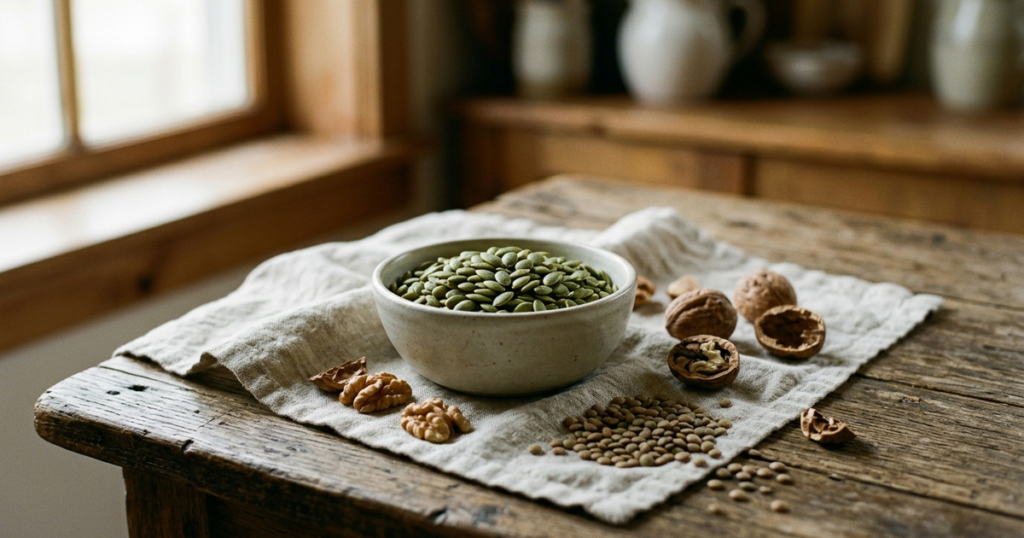
- Pumpkin Seeds (Pepitas): Approximately 5 grams of arginine per 100 grams, plus zinc and magnesium.
- Poultry: Turkey breast and chicken provide 4 to 4.5 grams per serving.
- Legumes: Lentils, chickpeas, and soybeans offer generous plant protein and arginine.
- Nuts: Walnuts and almonds provide 2.5 to 3 grams per 100 grams, alongside anti-inflammatory fats.
While whole-food sources are safe and nourishing, high-dose commercial supplements (3,000 to 6,000 mg) require caution. High supplemental doses can cause digestive discomfort, lower blood pressure excessively when combined with antihypertensives, or trigger viral outbreaks in individuals prone to herpes simplex, as herpes viruses utilize arginine to replicate.
Study Limitations and Evidence Quality
While these findings represent a significant scientific advance, several limitations are important to note:
- Preclinical Models: Direct anti-inflammatory protection was established in laboratory cell cultures and rodent disease models. Rigorous randomized human clinical trials are still needed before L-arginine can be recommended as a targeted clinical therapy for gout or neurodegenerative disease.
- Bioavailability and Dosing: Oral arginine is metabolized extensively by liver arginase enzymes. Determining optimal human oral dosages that reach inflamed peripheral tissues and cross the blood-brain barrier remains an open research priority.
- Observational Human Cohort: Lower serum arginine in Parkinson’s patients represents a correlation, not proof that low arginine caused the condition.
- Not a Standalone Treatment: Dietary changes or supplements cannot replace prescribed medical care for autoimmune or inflammatory disorders.
Sources and Further Reading
- Liu F, et al. (2026). l-Arginine inhibits NLRP3 inflammasome activation. Nature Metabolism, Published online October 6, 2026. doi:10.1038/s42255-026-01636-3.
- Truong QN, Trainor AR, Penney J. (2026). Arginine inhibits a key innate immune signalling hub. Nature Metabolism, Published online October 6, 2026. doi:10.1038/s42255-026-01638-1.
- Vande Walle L, Lamkanfi M. (2024). Novel therapeutic strategies targeting the NLRP3 inflammasome. Nature Reviews Drug Discovery, 23(1), 43–66. doi:10.1038/s41573-023-00822-2.
- National Center for Biotechnology Information. Physiology, Arginine and Nitric Oxide Pathways. StatPearls Publishing; Updated 2024.
- Rodriguez PC, Ochoa AC, Al-Khami AA. (2017). Arginine Metabolism in Immune Regulation and Disease. Frontiers in Immunology, 8, 93. doi:10.3389/fimmu.2017.00093.
Related Reading
- L-Arginine Benefits: Heart, Immunity, and Recovery Guide
- GlyNAC for Cellular Aging: What Clinical Trials Show
- Ginger for Nausea, Inflammation, and Gut Health: What Research Shows
Disclosure: This content is for informational purposes only and is not medical advice. Always consult a qualified healthcare provider before making changes to your health regimen.