
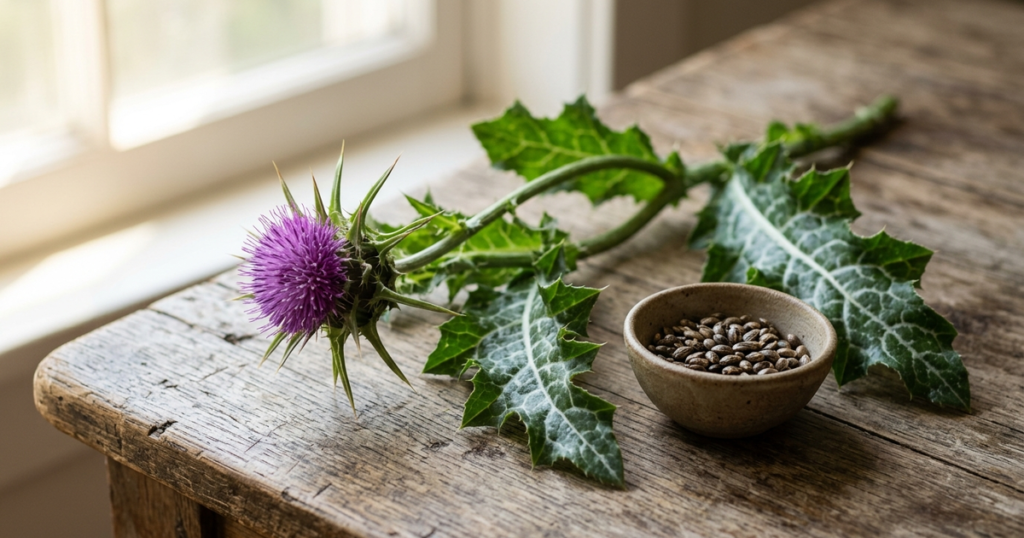
For centuries, European herbalists gathered the seeds of Silybum marianum—commonly known as milk thistle—to soothe digestive complaints and support liver wellness. Today, milk thistle ranks among the most popular herbal supplements worldwide, frequently marketed as a rapid liver cleanse and protective shield against toxins.
Yet for individuals navigating elevated liver enzymes, non-alcoholic fatty liver disease (now classified as metabolic dysfunction-associated steatotic liver disease, or MASLD), or sluggish digestion, an essential question arises: What does clinical science demonstrate about milk thistle’s primary bioactive complex, silymarin? Can a botanical extract reliably lower transaminases, reduce hepatic fat accumulation, or protect liver tissue—and where do the scientific boundaries lie?
What Is Silymarin? Botanical Chemistry and Bioactive Compounds
The therapeutic properties of milk thistle reside within its dark seeds (achenes). When concentrated, these seeds yield a standardized extract known as silymarin, comprising 65% to 80% of clinical preparations. Silymarin is not a single compound, but a complex mixture of flavonolignans and flavonoids.
The primary bioactive constituents include:
- Silybin (Silibinin) A and B: The most abundant diastereomers, accounting for 50% to 70% of silymarin and driving most of its documented actions.
- Isosilybin A and B: Closely related isomers with established antioxidant properties.
- Silychristin and Silydianin: Secondary flavonolignans providing radical-scavenging and membrane-stabilizing effects.
- Taxifolin: A flavonoid precursor offering potent free-radical neutralization.
According to an official monograph from the European Medicines Agency (EMA) Committee on Herbal Medicinal Products, standardized preparations of Silybi mariani fructus possess recognized traditional status for relieving digestive discomfort and supporting hepatic function once serious conditions have been evaluated by a physician.
Cellular Mechanisms: How Silymarin Protects Hepatocytes
Cellular investigations reviewed in Molecules demonstrate four principal molecular pathways through which silymarin protects hepatic architecture:
1. Free-Radical Quenching and Glutathione Preservation
Hepatocytes endure continuous oxidative stress during lipid metabolism. Silibinin neutralizes reactive oxygen species (ROS), suppresses lipid peroxidation, and replenishes intracellular stores of reduced glutathione (GSH)—the liver’s essential antioxidant buffer. By preserving mitochondrial integrity, silymarin shields hepatocytes from oxidative damage.
2. Hepatocyte Membrane Stabilization
Silymarin alters the lipid architecture of hepatocyte membranes, preventing toxins from accessing cellular transport receptors. In clinical toxicology, intravenous silibinin serves as an emergency antidote against amanitin poisoning from the death cap mushroom (Amanita phalloides), actively obstructing toxin uptake through organic anion transporting polypeptides (OATPs).
3. Downregulation of Inflammatory Cascades
Chronic liver conditions progress through sustained inflammatory signaling. Silymarin inhibits nuclear factor kappa B (NF-κB) activation, decreasing transcription of pro-inflammatory cytokines such as TNF-α and IL-6. This suppression helps mitigate inflammatory stress driving steatosis toward progressive steatohepatitis.
4. Antifibrotic and Regenerative Signaling
When liver tissue experiences injury, hepatic stellate cells (HSCs) activate into myofibroblasts, depositing excess collagen that forms scar tissue. In laboratory models, silibinin suppresses HSC activation and downregulates procollagen expression. Concurrently, silymarin stimulates nucleolar RNA polymerase I, accelerating ribosomal RNA synthesis and supporting protein synthesis necessary for hepatocyte repair.
Clinical Trial Evidence: Fatty Liver and Enzyme Reductions
Translating laboratory mechanisms into patient outcomes requires randomized controlled trials (RCTs). Researchers have evaluated silymarin in patients with metabolic dysfunction-associated steatotic liver disease (MASLD/NAFLD) and elevated transaminases.
In a systematic review and meta-analysis published in Medicine, investigators synthesized eight randomized controlled trials comprising 587 adult patients with non-alcoholic fatty liver disease. The meta-analysis revealed that patients receiving silymarin experienced statistically significant reductions in serum liver enzymes compared to controls:
- Alanine Aminotransferase (ALT): Supplementation produced a significant reduction in serum ALT, with weighted mean difference drops between -4.43 IU/L and -9.0 IU/L across trial cohorts.
- Aspartate Aminotransferase (AST): Serum AST demonstrated comparable reductions, reflecting decreased hepatocyte membrane permeability and cellular stress.
- Ultrasonographic Steatosis: Several trials observed modest improvements in qualitative liver echogenicity and ultrasound-graded fat accumulation.
However, an essential clinical distinction must be drawn: biochemical transaminase reductions do not prove histological fibrosis regression. While clinical trials confirm that silymarin moderates inflammatory liver enzymes, human paired-biopsy data evaluating hard histological endpoints—such as the resolution of steatohepatitis or reversal of established fibrosis—remain limited and mixed. As the National Center for Complementary and Integrative Health (NCCIH) emphasizes, current evidence does not prove that milk thistle cures chronic hepatitis or halts advanced liver cirrhosis.
Bioavailability Advances: Standard Extracts vs. Phytosome Formulations
A primary historical limitation of milk thistle research is poor gastrointestinal absorption. Native silymarin has poor water solubility (under 50 μg/mL), yielding oral bioavailability between 20% and 50% in pharmacokinetic trials.
To address this hurdle, pharmaceutical researchers developed silybin-phospholipid complexes, known as silybin phytosomes or siliphos. As documented in PMC Pharmacological Assessments, binding silybin to phosphatidylcholine forms a complex that readily crosses intestinal lipid bilayers. Pharmacokinetic trials confirm that phytosome formulations deliver four- to ten-fold higher peak plasma levels (Cmax) and biliary exposure compared to unformulated extracts.
| Clinical Parameter | Observed Effect | Evidence Strength | Key Takeaway |
|---|---|---|---|
| Serum ALT & AST Enzymes | Significant reduction (mean drop: -4 to -9 IU/L) | High (Meta-analysis of 8 RCTs, 587 participants) | Reflects reduced acute hepatocyte inflammation. |
| Liver Steatosis (Fat Content) | Modest improvements on ultrasound grading | Moderate (Randomized human trials vs. placebo) | Best paired with diet and exercise. |
| Fibrosis Reversal (Scar Tissue) | No consistent histological reversal confirmed | Preliminary / Inconclusive (Limited biopsy RCTs) | Cannot replace medical care for advanced cirrhosis. |
| Oral Bioavailability | 4- to 10-fold enhancement via silybin phytosomes | High (Pharmacokinetic crossover studies) | Formulation quality influences tissue delivery. |
| Adverse Events & Safety | Mild, transient looseness in <2% of subjects | High (Long-term human safety trials) | Excellent tolerability across therapeutic doses. |
Source: Compiled from systematic reviews and randomized controlled trials in Medicine (Kalopitas et al., 2021) and PMC pharmacological assessments (Federico et al., 2020).
Safety, Tolerability, and Medication Interactions
Clinical trials indicate that milk thistle extract possesses a high safety threshold. At standard dosages of 140 mg to 420 mg of standardized silymarin daily, adverse effects are rare and primarily limited to mild gastrointestinal looseness due to silymarin’s mild bile-stimulating action.
However, patients should note several pharmacologic precautions:
- Cytochrome P450 Modulation: Laboratory studies indicate silymarin weakly inhibits CYP2C9 and CYP3A4 enzymes. While serious clinical interactions in human trials are rare, individuals taking narrow-therapeutic-index drugs—such as warfarin, certain anticonvulsants, or tamoxifen—should consult their physician before starting supplementation.
- Asteraceae Family Allergies: Milk thistle belongs to the Asteraceae plant family. Individuals with known allergies to ragweed, marigolds, or daisies should proceed cautiously.
- Hormone-Sensitive Conditions: In vitro assays show silibinin binds weakly to estrogen receptors. While clinical hormonal disturbances have not been reported in human trials, individuals with hormone-sensitive conditions should consult their healthcare provider.
Clinical Perspective: Contextualizing Milk Thistle in Liver Care
Medical evidence demonstrates that silymarin is an authentic botanical extract with proven antioxidant and enzyme-modulating properties. It is neither an inert supplement nor an overnight detox capable of reversing years of metabolic stress independently.
For individuals optimizing hepatic health, milk thistle functions best as an adjunctive nutritional tool integrated within proven lifestyle foundations: reducing refined carbohydrates, resolving insulin resistance, maintaining healthy weight, and limiting alcohol. When considering silymarin supplementation, discuss dosage, extract standardization, and medication compatibility with your healthcare provider for an individualized approach.
Sources and Further Reading
- National Center for Complementary and Integrative Health (NCCIH): Milk Thistle Fact Sheet and Clinical Overview
- Medicine (Baltimore): Impact of Silymarin in Patients with Nonalcoholic Fatty Liver Disease — A Systematic Review and Meta-Analysis of Randomized Controlled Trials
- Molecules: Silymarin, a Promising Pharmacological Agent for Treatment of Metabolic Liver Diseases
- European Medicines Agency (EMA): Monograph on Silybi mariani fructus (Milk Thistle Fruit)
- PMC Pharmacological Assessments: Bioavailability Enhancement Strategies and Silybin-Phospholipid Complexes
Related Reading
- Fatty Liver and MASLD: Evidence-Based Dietary Protocols and Treatment Strategies
- Neutrophil-to-Lymphocyte Ratio in Fatty Liver: How Dietary Antioxidants Influence Systemic Inflammation
- Berberine for Blood Sugar and Metabolic Weight: Clinical Trial Findings
- Specialized Pro-Resolving Mediators: How Resolvins and Protectins Resolve Chronic Inflammation
Disclosure: This content is for informational purposes only and is not medical advice. Always consult a qualified healthcare provider before making changes to your health regimen.