
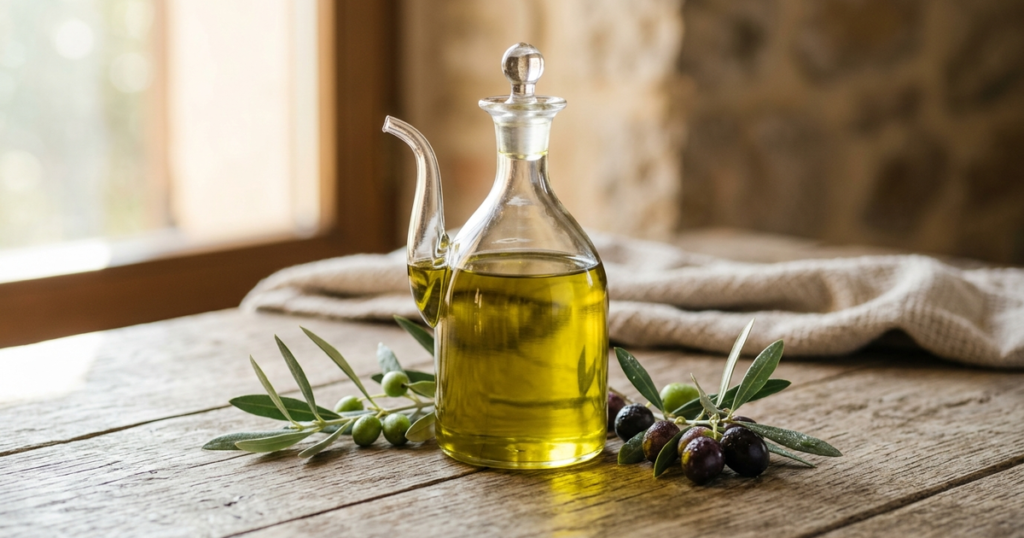
For generations, extra virgin olive oil has anchored the traditional Mediterranean diet. Early nutrition science credited its cardiovascular perks solely to monounsaturated oleic acid. Recent clinical trials and biochemical assays reveal that the true cellular defenders within olive oil are its phenolic micro-constituents.
Chief among these compounds are oleocanthal and hydroxytyrosol. Rather than acting as passive antioxidants, research suggests they actively regulate inflammatory enzymatic cascades, protect circulating lipids from oxidative damage, and support endothelial elasticity.
The Discovery of Oleocanthal: A Natural COX Inhibitor
The scientific journey into olive oil’s anti-inflammatory properties began with an unexpected observation. In the late 1990s, Dr. Gary Beauchamp tasted freshly pressed extra virgin olive oil in Sicily and noted a sharp sting in the throat that induced a mild cough. The sensation was identical to the throat catch he had experienced evaluating liquid ibuprofen formulations during pharmaceutical sensory research.
This prompted a landmark 2005 study published in Nature. Beauchamp’s team isolated the secoiridoid responsible for this sting, naming it (-)-oleocanthal. Biochemical assays confirmed it acts as a natural anti-inflammatory agent, inhibiting COX-1 and COX-2 enzymes in a dose-dependent manner mirroring ibuprofen.
Follow-up research in the Journal of Neuroscience demonstrated that oleocanthal triggers this sting by binding TRPA1 ion channels in sensory nerve fibers of the pharynx. Because TRPA1 channels modulate neurogenic inflammation, this peppery throat tickle serves as an accurate culinary indicator of active, unoxidized oleocanthal.
Hydroxytyrosol and the Defense Against Oxidized LDL
While oleocanthal targets inflammatory enzymes, hydroxytyrosol provides critical defense against atherogenic lipid damage. Circulating low-density lipoprotein (LDL) becomes atherogenic primarily when oxidized into oxLDL. Oxidized LDL penetrates arterial walls, prompting macrophages to engulf damaged lipids and transform into foam cells.
Hydroxytyrosol and its derivatives act as potent radical scavengers. Thanks to their amphiphilic structure, they integrate into circulating lipoproteins and vascular membranes, intercepting peroxyl radicals before they degrade apolipoprotein B-100.
The European Food Safety Authority (EFSA) substantiated this mechanism with an authorized health claim: consuming at least 5 milligrams of hydroxytyrosol and its derivatives per 20 grams of olive oil daily protects blood lipids from oxidative stress. This represents one of the few official regulatory health claims granted to a whole-food matrix.
Clinical Evidence: The EUROLIVE and PREDIMED Trials
The physiological efficacy of olive oil polyphenols is supported by landmark clinical trials:
- The EUROLIVE Trial (2006): In a randomized, double-blind crossover study in the Annals of Internal Medicine, 200 healthy European men consumed 25 milliliters daily of three olive oils with identical fatty acids but low, medium, or high polyphenol concentrations. High-polyphenol oil produced linear, statistically significant decreases in oxidized LDL and urinary 8-isoprostanes, alongside linear increases in HDL cholesterol, proving that polyphenols drive the cardiovascular lipid improvements.
- The PREDIMED Trial (2018): In this multicenter trial in the New England Journal of Medicine, 7,447 participants at high cardiovascular risk were followed for 4.8 years. Those assigned to a Mediterranean diet supplemented with extra virgin olive oil achieved a 31% reduction in major cardiovascular events (stroke, myocardial infarction, and cardiovascular death) compared to a reduced-fat control diet. Sub-studies confirmed marked reductions in cellular adhesion molecules, including VCAM-1 and ICAM-1.
Overview of Major Olive Oil Polyphenols and Biological Targets
Authentic extra virgin olive oil delivers a synergistic complex of phenolic compounds. The table below details the primary phenolic classes, their biological targets, and documented physiological outcomes.
| Phenolic Compound | Chemical Class | Primary Biological Target | Physiological Effect | Key Clinical & Regulatory Evidence |
|---|---|---|---|---|
| Oleocanthal | Secoiridoid dialdehyde | COX-1 and COX-2 enzymes; TRPA1 channels | Suppresses pro-inflammatory prostaglandins; blunts neurogenic inflammation | Beauchamp et al., Nature (2005); natural dose-dependent COX inhibition |
| Hydroxytyrosol | Phenylethanoid | Apolipoprotein B-100; peroxyl radicals | Neutralizes free radicals; prevents oxidation of circulating LDL particles | EFSA Journal (2011); authorized claim for 5 mg/20 g daily against oxidative stress |
| Oleuropein Aglycone | Secoiridoid glucoside | Endothelial nitric oxide synthase (eNOS) | Promotes arterial vasodilation; lowers vascular cell adhesion molecules | PREDIMED trial sub-analyses; improves flow-mediated dilation and vascular compliance |
| Tyrosol | Monophenol | Endogenous antioxidant enzymes | Enhances intracellular defense against oxidative stress; protects cellular DNA | EUROLIVE trial (2006); contributes to systemic antioxidant capacity |
| Luteolin & Apigenin | Flavones | Interleukin-6 (IL-6); TNF-α | Modulates vascular cell signaling and capillary integrity | Molecules / PMC review (2016); complementary anti-inflammatory modulation |
Source: Adapted from Covas et al., Annals of Internal Medicine (2006), Beauchamp et al., Nature (2005), and EFSA Journal (2011).
Endothelial Health: Nitric Oxide and Vessel Elasticity
The vascular endothelium is the inner cell layer of arteries that releases nitric oxide to maintain healthy blood pressure and vascular tone. When inflammatory cytokines and oxidized LDL damage endothelial cells, nitric oxide bioavailability declines, leading to arterial stiffness.
Studies indicate that extra virgin olive oil polyphenols support endothelial health through complementary mechanisms: oleuropein aglycone and hydroxytyrosol stimulate endothelial nitric oxide synthase (eNOS) phosphorylation, boosting nitric oxide production, while scavenging reactive oxygen species that would otherwise convert nitric oxide into toxic peroxynitrite radicals. Clinical measurements of flow-mediated dilation demonstrate improved arterial responsiveness following polyphenol-rich olive oil intake.
The Cooking Myth: Does Heat Destroy Olive Oil Polyphenols?
A persistent culinary myth claims extra virgin olive oil should never be heated. Food science research demonstrates that thermal stability depends on an oil’s resistance to oxidation rather than smoke point alone. Because extra virgin olive oil is predominantly monounsaturated oleic acid (with only one double bond), it is far more stable than polyunsaturated seed oils.
Furthermore, its polyphenols act as natural thermal shields, sacrificing themselves to neutralize free radicals during cooking temperatures between 300°F and 375°F. While extended deep-frying reduces phenolic concentration, gentle sautéing and roasting preserve significant quantities of oleocanthal and hydroxytyrosol while enhancing absorption of fat-soluble nutrients from accompanying vegetables.
Selecting and Storing High-Polyphenol Olive Oil
Industrial refining eliminates polyphenols. To ensure your oil provides meaningful bioactivity, look for these quality markers:
- Check Harvest Date: Phenolics degrade over 18 to 24 months. Choose bottles harvested within the past 12 months.
- Select Dark Glass or Tin: Light exposure accelerates photo-oxidation; avoid clear glass or plastic containers.
- Choose High-Phenolic Varietals: Cultivars such as Coratina, Picual, and Moraiolo naturally yield higher polyphenol counts, often exceeding 400 mg/kg.
- Test the Peppery Throat Sting: Bioactive oleocanthal creates a distinct tickle in the throat, while oleuropein provides a mild bitter note. Bland, greasy oils lack active phenolics.
Limitations and Practical Considerations
Extra virgin olive oil is calorie-dense, providing roughly 120 calories and 14 grams of fat per tablespoon; overall caloric balance remains essential for metabolic health. Furthermore, while oleocanthal inhibits inflammatory enzymes in laboratory assays, dietary consumption provides subtle physiological modulation—not an immediate replacement for prescribed medications during acute pain or diagnosed cardiovascular disease. Always consult a qualified healthcare provider before altering your dietary regimen.
Sources and Further Reading
- Beauchamp GK, Keast RS, Morel D, et al. Phytochemistry: Ibuprofen-like activity in extra-virgin olive oil. Nature. 2005;437(7055):45-46.
- Covas MI, Nyyssönen K, Poulsen HE, et al. The effect of polyphenols in olive oil on heart disease risk factors: a randomized trial (EUROLIVE). Annals of Internal Medicine. 2006;145(5):333-341.
- Estruch R, Ros E, Salas-Salvadó J, et al. Primary Prevention of Cardiovascular Disease with a Mediterranean Diet Supplemented with Extra-Virgin Olive Oil or Nuts. New England Journal of Medicine. 2018;378(25):e34.
- European Food Safety Authority (EFSA). Scientific Opinion on the substantiation of health claims related to polyphenols in olive and protection of LDL particles from oxidative damage. EFSA Journal. 2011;9(4):2033.
- Parkinson L, Cicerale S. The Health Benefiting Mechanisms of Virgin Olive Oil Phenolic Compounds. Molecules / PubMed Central. 2016;21(12):1734.
Related Reading
- Specialized Pro-Resolving Mediators: How Resolvins Heal
- GlycA: What 488,000 People Reveal About Heart Inflammation
- Intermittent Fasting and Inflammation: What the Research Shows
Disclosure: This content is for informational purposes only and is not medical advice. Always consult a qualified healthcare provider before making changes to your health regimen.