
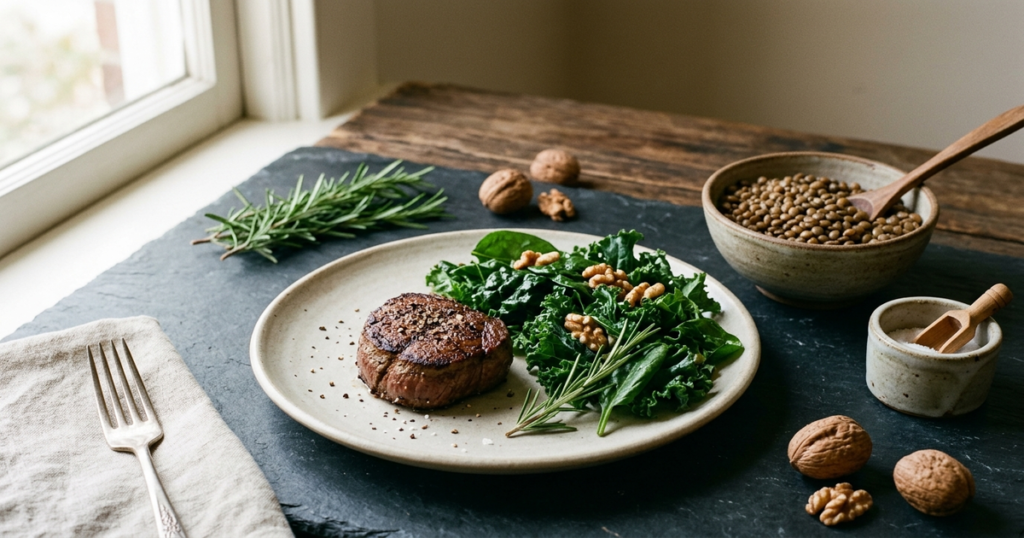
For decades, nutritional epidemiology has linked high red meat intake with elevated risks of type 2 diabetes. Prospective cohorts from the Harvard Chan School of Public Health consistently show higher incidence among heavy meat consumers. Yet, identifying the primary molecular trigger has remained an unresolved puzzle.
While traditional explanations focused on saturated fats, caloric excess, or high-heat cooking compounds, preliminary research presented at the European Association for the Study of Diabetes (EASD) highlights a novel culprit: a non-human sugar molecule called N-glycolylneuraminic acid (Neu5Gc). Because humans cannot synthesize Neu5Gc, dietary exposure sparks an immune reaction that may foster chronic metabolic inflammation and impair glycemic control.
The Evolutionary Divergence: Why Neu5Gc Is Foreign to Humans
Sialic acids are nine-carbon sugars coating vertebrate cell surfaces as part of the protective glycocalyx. In non-human mammals—such as cows, pigs, and sheep—Neu5Gc is abundant. Great apes likewise produce Neu5Gc across their tissues.
Humans, however, are a biological exception. As revealed in research published in PNAS, our ancestors experienced an inactivating mutation in the CMAH gene roughly two to three million years ago. This enzyme synthesizes Neu5Gc from N-acetylneuraminic acid (Neu5Ac). Without functional CMAH, human cells produce only Neu5Ac.
Because Neu5Gc is biologically foreign, our immune system treats it as an antigen. When humans consume red meat, cellular assays show that intestinal cells absorb Neu5Gc, metabolically incorporating it directly onto human vascular, glandular, and epithelial cell surfaces.
The Xenosialitis Hypothesis: How Immune Collisions Drive Inflammation
Once embedded in human tissues, Neu5Gc triggers an immunologic conflict. Most humans carry circulating anti-Neu5Gc antibodies formed early in life. When these antibodies bind foreign Neu5Gc on endothelial or endocrine cells, an inflammatory cascade ensues.
This process—termed xenosialitis—stimulates cytokine release, macrophage recruitment, and oxidative stress. In metabolic tissues, chronic low-grade inflammation disrupts insulin receptor signaling, promoting peripheral insulin resistance. Over time, localized inflammation in pancreatic islets may place unsustainable strain on beta cells, degrading insulin secretion.
The NutriNet-Santé Study: Findings Presented at EASD 2026
To evaluate whether Neu5Gc correlates with real-world metabolic outcomes, Dr. Léopold Fezeu and colleagues at Université Sorbonne Paris Nord analyzed data from 89,953 adults in the French NutriNet-Santé cohort. Participants (mean age 42, 79% female) were free of diabetes and cancer at baseline and completed repeated 24-hour dietary records linked to food composition databases.
Over a median 7.2-year follow-up, 966 participants developed incident type 2 diabetes. After adjusting for lifestyle, caloric intake, and sociodemographic variables, the researchers observed significant associations:
- 63% Higher Relative Risk: Adults in the highest fifth of meat-derived Neu5Gc intake had a 63% higher relative risk of type 2 diabetes compared to the lowest fifth.
- Dose-Response Gradient: The second-highest intake group exhibited a 41% increased risk, showing that elevated risk clustered primarily in heavy consumers.
- Overall Dietary Neu5Gc: Total Neu5Gc from meat and dairy was linked to a 37% increased risk, largely driven by meat.
Crucially, Dr. Fezeu highlighted that because overall diabetes incidence was roughly 1% across the cohort, an individual’s absolute risk increase is far smaller than the 63% relative risk implies.
Does Body Weight Explain the Link?
Because meat consumption frequently tracks with higher body mass index, researchers tested whether weight gain drove the association. Statistical mediation analysis revealed that obesity explained only approximately 13% of the relationship between meat-derived Neu5Gc and diabetes. This indicates that if causal, the mechanism operates primarily through direct inflammatory and immunological signaling rather than body fat accumulation alone.
Comparing Sialic Acids and Dietary Meat Compounds
The table below summarizes key differences between human sialic acids, mammalian Neu5Gc, and other compounds found in red meat.
| Compound / Factor | Dietary Sources | Human Synthesis | Immune Reaction | Documented Metabolic Impact | Key Reference |
|---|---|---|---|---|---|
| Neu5Ac | Human cells; breast milk | Yes (intact pathway) | None (self-antigen) | Normal cellular hydration and intercellular signaling | Chou et al., PNAS (1998) |
| Neu5Gc | Red meat (beef, pork, lamb) | No (mutated CMAH) | Incites anti-Neu5Gc antibodies and xenosialitis | Associated with 63% higher relative type 2 diabetes risk | Fezeu et al., EASD (2026); Samraj et al., PNAS (2015) |
| Heme Iron | Red meat, poultry, seafood | No (dietary mineral) | Fenton oxidative stress | Promotes free radical injury in pancreatic beta cells | Gu et al., AJCN (2023) |
| AGEs | Charred or seared meats | Slow endogenous formation | Binds RAGE receptors | Amplifies systemic inflammatory signaling via NF-κB | NutriNet-Santé reports |
Source: Adapted from Chou et al., PNAS (1998), Tangvoranuntakul et al., PNAS (2003), Gu et al., AJCN (2023), and Fezeu et al., EASD (2026).
Critical Study Limitations and Uncertainties
While intriguing, the NutriNet-Santé data must be viewed through an objective scientific lens:
- Preliminary Status: Findings were presented as an abstract at EASD 2026 and have not yet completed formal peer review in an academic journal.
- Observational Nature: Cohort studies identify associations, not direct causation. Residual confounding from unmeasured lifestyle factors remains possible.
- Collinearity with Total Meat: When researchers adjusted for total red meat consumption, the statistical significance of Neu5Gc attenuated. Isolating Neu5Gc from heme iron, saturated fats, and cooking compounds remains challenging.
- No Direct Antibody Assays: The study estimated dietary intake rather than measuring circulating anti-Neu5Gc antibody titers or tissue deposition in participants.
Practical Dietary Guidance: What Should You Eat?
The Neu5Gc hypothesis reinforces established nutritional patterns rather than requiring radical elimination diets. Shifting protein sources toward whole plant foods offers well-documented metabolic protection.
Replacing one daily serving of red meat with lentils, beans, tofu, or nuts significantly lowers diabetes risk. Plant proteins contain zero Neu5Gc, zero heme iron, and deliver prebiotic fiber that enhances metabolic sensitivity. Additionally, poultry and wild-caught seafood contain virtually undetectable levels of Neu5Gc, offering favorable animal protein alternatives. Dairy Neu5Gc was not significantly associated with diabetes, likely due to lower concentrations and protective dairy peptides. Emphasize a diverse, whole-food dietary pattern rich in plants and fiber.
Sources and Further Reading
- Morales-Brown P. Sugar molecule in beef and lamb may be linked to type 2 diabetes risk. Medical News Today. Published October 2, 2026. Reporting on Fezeu L et al., EASD 2026.
- Samraj AN, Pearce OM, Läubli H, et al. A red meat-derived glycan promotes inflammation and cancer progression in a model of xenosialitis. Proc Natl Acad Sci USA. 2015;112(2):542-547.
- Tangvoranuntakul P, Gagneux P, Diaz S, et al. Human uptake and incorporation of an immunogenic nonhuman dietary sialic acid. Proc Natl Acad Sci USA. 2003;100(21):12045-12050.
- Gu X, Drouin-Chartier JP, Satija A, et al. Red meat intake and risk of type 2 diabetes in a prospective cohort study of United States females and males. American Journal of Clinical Nutrition. 2023;118(6):1153-1163.
- Chou HH, Takematsu H, Diaz S, et al. A mutation in human CMP-sialic acid hydroxylase occurred after the Homo-Pan divergence. Proc Natl Acad Sci USA. 1998;95(20):11751-11756.
Related Reading
- Keto Diet and Type 2 Diabetes: Can It Trigger Remission?
- Insulin Resistance: The Silent Driver of Chronic Disease
- Pancreas Atlas Reveals Why Some People Get Diabetes
Disclosure: This content is for informational purposes only and is not medical advice. Always consult a qualified healthcare provider before making changes to your health regimen.