
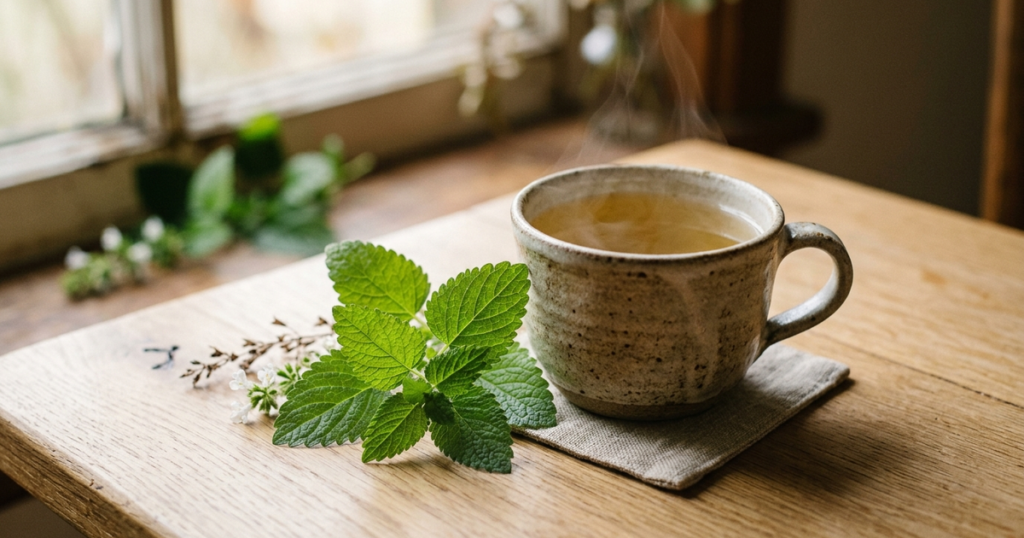
For centuries, European and Persian herbalists recommended Melissa officinalis, commonly known as lemon balm, for nervous agitation, low mood, and sleepless nights. Today, this fragrant member of the mint family (Lamiaceae) is drawing renewed interest from clinical researchers. Does lemon balm genuinely calm an overactive nervous system, or is its reputation merely historical folklore?
Recent human clinical trials and pharmacological analyses indicate that standardized lemon balm extracts exert measurable neurochemical actions. Rather than functioning as a blunt sedative, lemon balm supports inhibitory neurotransmission by modulating gamma-aminobutyric acid (GABA) breakdown and cholinergic receptors. While not a replacement for psychiatric treatment in mood disorders, research suggests it offers meaningful relief for mild-to-moderate anxiety, somatic tension, and sleep disturbances.
The Biological Mechanism: GABA Transaminase and Calming Pathways
Neuroscientists investigating lemon balm focus primarily on the GABAergic pathway. Gamma-aminobutyric acid (GABA) serves as the brain’s principal inhibitory neurotransmitter, dampening neuronal excitability and quieting mental hyperarousal. When synaptic GABA availability declines, psychological tension, somatic restlessness, and sleep disruptions frequently follow.
In a study published in Phytotherapy Research, researchers identified that hydroxycinnamic acids in lemon balm—principally rosmarinic acid—act as potent inhibitors of gamma-aminobutyric acid transaminase (GABA-T). GABA-T degrades synaptic GABA. By slowing this breakdown, rosmarinic acid helps sustain active GABA concentrations in the synaptic cleft, prolonging natural inhibitory signaling.
This enzymatic mechanism differs fundamentally from pharmaceutical benzodiazepines. Prescription sedatives forcibly lock GABA-A receptors open, frequently causing daytime lethargy, cognitive fog, and dependence risks. In contrast, lemon balm moderately slows enzyme catabolism. Furthermore, laboratory assays demonstrate that lemon balm compounds bind nicotinic and muscarinic acetylcholine receptors, explaining why trial participants report feeling tranquil yet clear-headed without heavy sedation.
Clinical Evidence: Anxiety, Psychosocial Stress, and Palpitations
Controlled trials demonstrate real-world efficacy in humans. A systematic review and meta-analysis in Phytotherapy Research pooled data from randomized controlled trials evaluating lemon balm for anxiety and depressive symptoms. The authors documented statistically significant reductions in standardized anxiety scores compared to control groups, with pronounced benefits for acute psychosocial stress and somatic tension.
A notable clinical trial examining somatic distress was conducted by Alijaniha and colleagues in the Journal of Ethnopharmacology. In this double-blind, randomized, placebo-controlled trial, investigators evaluated 55 adult outpatients experiencing benign cardiac palpitations accompanied by anxiety. Participants took 500 mg of a lyophilized aqueous extract of Melissa officinalis leaves or an identical placebo twice daily for 14 days. Participants receiving lemon balm experienced a 46.8% mean reduction in palpitation episodes alongside marked reductions in psychiatric symptom scores, with no serious adverse events reported.
Furthermore, a 2023 randomized, double-blind, placebo-controlled trial in Frontiers in Pharmacology evaluated adults with moderate emotional distress. Investigators found that subchronic supplementation with a standardized phospholipid-carrier lemon balm extract significantly attenuated perceived stress levels and lowered self-reported trait anxiety relative to placebo.
Sleep Quality and Restless Insomnia: What Recent Trials Show
Sleep disruptions are commonly driven by evening cognitive rumination and elevated sympathetic tone. Because lemon balm supports inhibitory tone without inducing forced hypnotic stupor, clinical researchers have evaluated its efficacy for sleep initiation and continuity.
In a randomized, double-blind, cross-over trial published in Nutrients in late 2024, researchers assessed a standardized Melissa officinalis phytosome formulation in adults with insomnia complaints. Participants taking the botanical extract demonstrated a statistically significant decrease in Insomnia Severity Index (ISI) scores (falling to 6.8 ± 4.1 in the active group compared to 11.2 ± 3.8 on placebo, p < 0.05). Polysomnographic tracking and questionnaires confirmed improved sleep efficiency and fewer nocturnal awakenings without morning sedation.
These findings corroborate earlier clinical data indicating that standardized lemon balm extracts reduce sleep-related restlessness by up to 42%. Rather than acting as a hypnotic drug, the herb quietens somatic hyperarousal, allowing normal circadian sleep drives to proceed unhindered.
Summary of Controlled Clinical Trials on Lemon Balm
The following table synthesizes key human clinical trials investigating standardized Melissa officinalis for stress, palpitations, and sleep quality.
| Study & Year | Design & Cohort | Dosage & Form | Primary Findings | Key Limitations |
|---|---|---|---|---|
| Cicero et al. (2024) Nutrients |
Double-blind cross-over trial (insomnia) | Phytosome extract (300 mg/day) | Significant drop in ISI scores (6.8 vs. 11.2 on placebo); improved sleep efficiency. | Short-to-medium duration; long-term data unstudied. |
| Scholey et al. (2023) Front. Pharmacol. |
Double-blind, placebo-controlled trial (distressed adults) | Phospholipid extract (300 mg/day) | Significant reduction in perceived stress and trait anxiety; enhanced rest. | Subjective scoring; mild distress only. |
| Alijaniha et al. (2015) J. Ethnopharmacol. |
Double-blind, placebo-controlled trial (55 adults) | Lyophilized extract (500 mg twice daily) | 46.8% reduction in palpitation episodes; reduced anxiety scores. | Modest cohort (n=55); excluded heart disease. |
| Ghazizadeh et al. (2021) Phytother. Res. |
Systematic review and meta-analysis of RCTs | Standardized extracts (300–1,200 mg/day) | Significant pooled reduction in anxiety and depressive scores versus controls. | Heterogeneity in extraction methods and trial durations. |
Source: Compiled from peer-reviewed clinical trial reports indexed in PubMed and the National Library of Medicine.
Optimal Preparation Methods and Evidence-Based Dosages
According to the herbal monograph published by the European Medicines Agency (EMA) Committee on Herbal Medicinal Products (HMPC), lemon balm is recognized as an established traditional herbal medicine for mild mental stress and sleep support.
In clinical trials, researchers utilize dry hydroalcoholic extracts standardized to rosmarinic acid (typically 2% to 7%) or phospholipid-bound phytosome formulations. The evidence-backed dosage ranges between 300 mg and 600 mg daily, taken in the evening for sleep support or divided into two daytime doses for anxiety.
For home preparation, the EMA monograph recommends steeping 1.5 to 4.5 grams of dried cut leaves in 150 milliliters of boiled water. Cover the cup during brewing for 10 to 15 minutes to prevent active volatile terpenes—such as citral and citronellal—from escaping with steam. This tea may be consumed up to three times daily.
Safety Profile, Limitations, and Interactions
Across human trials, lemon balm exhibits a favorable safety profile with adverse events occurring at rates similar to placebo. It does not produce chemical dependency, tolerance, or rebound insomnia upon cessation.
However, specific physiological considerations apply:
- Thyroid Considerations: Preclinical research indicates that freeze-dried lemon balm extracts can inhibit thyroid-stimulating hormone (TSH) binding to receptors and slow peripheral deiodinase activity. Individuals with hypothyroidism or those taking levothyroxine should consult their physician before using concentrated extracts.
- Additive Sedation: Because lemon balm augments GABA activity, it may enhance the effects of other CNS depressants, including prescription sedatives, alcohol, or botanicals like valerian.
- Surgical Precaution: Clinicians advise discontinuing concentrated botanical supplements at least two weeks before elective surgery to prevent interactions with anesthesia.
In summary, lemon balm represents a well-tolerated, evidence-based botanical ally. By supporting GABAergic inhibition and dampening sympathetic hyperarousal, it offers a gentle, science-backed approach to easing nervous tension and restoring restorative sleep.
Related Reading
- Ashwagandha: Health Benefits Backed by Science
- Sleep and Mental Health: The Two-Way Science
- Breathwork for Stress and Anxiety: Science-Backed Techniques
Sources and Further Reading
- Cicero AFG, Fogacci F, Bove M, Veronesi M, Borghi C. Effects of Melissa officinalis Phytosome on Sleep Quality. Nutrients. 2024;16(23):4185. PubMed
- Ghazizadeh J, Sadigh-Eteghad S, Marx W, et al. The effects of lemon balm on depression and anxiety: A systematic review and meta-analysis. Phytother Res. 2021;35(12):6690-6705. PubMed
- Scholey A, et al. The possible “calming effect” of standardised Melissa officinalis L. extract in adults with emotional distress. Front Pharmacol. 2023;14:1250560. PubMed
- Alijaniha F, Naseri M, Fallahi SZ, et al. Heart palpitation relief with Melissa officinalis leaf extract: double blind, randomized trial. J Ethnopharmacol. 2015;164:182-187. PubMed
- Awad R, Muhammad A, Durst T, Trudeau VL, Arnason JT. Bioassay-guided fractionation of lemon balm using an in vitro measure of GABA-transaminase activity. Phytother Res. 2009;23(8):1075-1081. PubMed
- European Medicines Agency. Community herbal monograph on Melissa officinalis L., folium. EMA/HMPC/196745/2012. European Medicines Agency
Disclosure: This content is for informational purposes only and is not medical advice. Always consult a qualified healthcare provider before making changes to your health regimen.