
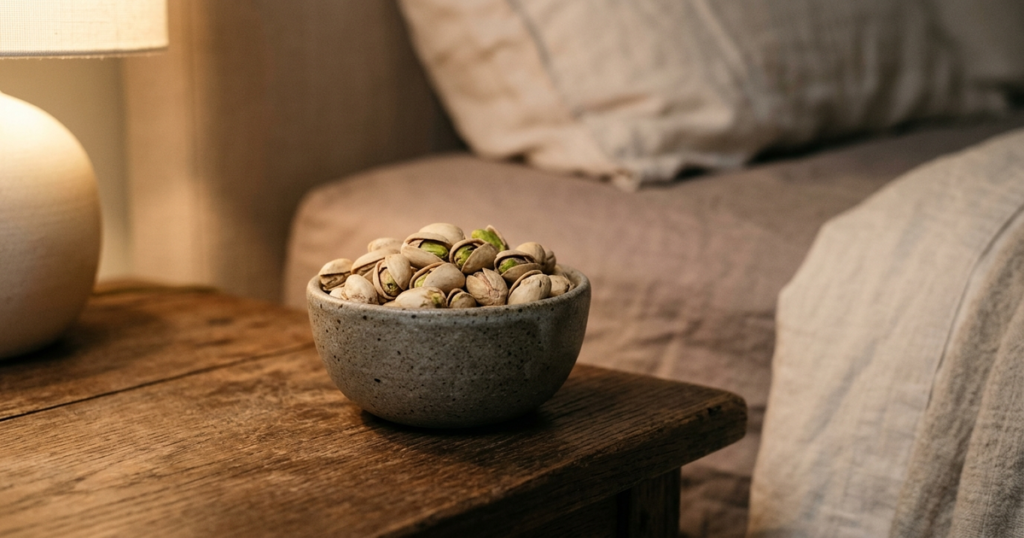
Late-night snacking is often viewed as an obstacle to restorative sleep. Sugary snacks and ultra-processed treats cause rapid blood glucose swings, promote reflux, and fragment rest. Yet recently, a whole food has captured interest across nutritional science: the pistachio.
Advocates claim that eating a handful of pistachios before bed supports sleep onset and deeper rest, citing their tryptophan and plant-derived melatonin (phytomelatonin). But how much of this reflects clinical data versus viral enthusiasm? A narrative review published in Nutrition Research Reviews, led by sleep researchers at Columbia University Irving Medical Center, evaluated how nutrients in pistachios interact with sleep physiology.
The findings offer a nuanced view: while pistachios are not a sedative, their whole-food matrix provides circadian-supportive compounds that function differently than isolated supplements.
The Tryptophan Pathway and Neurotransmitter Synthesis
To evaluate how diet influences rest, scientists examine tryptophan. Tryptophan is an essential amino acid that the body cannot manufacture endogenously. In the central nervous system, it serves as the precursor for serotonin, an inhibitory neurotransmitter promoting relaxation, which the pineal gland converts into melatonin in darkness.
Data reviewed in Nutrition Research Reviews and documented in the International Journal of Tryptophan Research shows that a 1-ounce (28.3-gram) serving of shelled pistachios provides approximately 71 milligrams of tryptophan. While animal proteins offer higher concentrations per gram, pistachios are a standout plant source.
Furthermore, dietary tryptophan crosses the blood-brain barrier via the shared LAT1 transporter, competing against large neutral amino acids (LNAAs) like leucine, valine, and isoleucine. High-protein foods elevate circulating LNAAs, restricting brain tryptophan uptake. In contrast, pistachios offer a balanced composition—6 grams of protein, 3 grams of fiber, and 13 grams of unsaturated fats—that avoids excessive amino acid competition, supporting steady delivery.
Phytomelatonin: Distinguishing Micrograms from Megadoses
A widespread claim is that pistachios are loaded with melatonin. Plant-derived melatonin, or phytomelatonin, is structurally identical to the human hormone governing circadian timing.
Chromatographic studies synthesized in the Columbia review show that pistachios contain measurable phytomelatonin, ranging between 0.074 micrograms and 18.7 micrograms per 1-ounce serving. Concentrations vary based on tree genetics, geography, and roasting temperatures. While unverified media claims reported milligram quantities, peer-reviewed analyses confirm levels exist within the microgram range.
For comparison, typical over-the-counter melatonin pills deliver 1 to 10 milligrams—doses 50 to 500 times higher than an ounce of nuts. As documented in CNS Spectrums, high-dose melatonin supplements can induce morning grogginess or receptor desensitization in sensitive individuals. The microgram amounts in whole foods assist natural circadian signaling without overwhelming neuroendocrine pathways.
The Whole-Food Matrix: Synergistic Nutrient Cofactors
Nutritional science emphasizes the “food matrix,” where intact whole foods exert greater biological effects than isolated components. A 2025 review in Food Science & Nutrition notes that nutrients consumed in natural combinations benefit from complementary biochemical cofactors.
Pistachios supply several micronutrients required for endogenous sleep chemistry:
- Vitamin B6 (Pyridoxine): Supplying 0.48 milligrams per ounce (over 25% of the daily value), vitamin B6 acts as an essential coenzyme converting 5-HTP into serotonin. Without adequate B6, tryptophan metabolism is impaired.
- Magnesium: Delivering roughly 34 milligrams per ounce, magnesium activates GABA receptors, calming central nervous system excitation before sleep.
- Carotenoid Antioxidants: The distinctive green and purple shades in pistachios stem from lutein, zeaxanthin, and anthocyanins. Nocturnal neuroinflammation can disrupt slow-wave sleep; these fat-soluble antioxidants neutralize cellular free radicals.
- Prebiotic Fiber: Offering 3 grams of fiber per serving, pistachios nourish gut microbes that produce short-chain fatty acids (SCFAs), communicating through the gut-brain axis to support autonomic balance.
Nutrient Comparison Across Evening Snacks
The table below compares sleep-associated nutrients across common nuts and seeds per standard 1-ounce (28.3-gram) serving:
| Evening Whole Food | Tryptophan | Phytomelatonin | Magnesium | Primary Sleep Mechanism |
|---|---|---|---|---|
| Pistachios | ~71 mg | 0.07–18.7 mcg | ~34 mg | Food matrix synergy: tryptophan + B6 cofactors + gentle phytomelatonin |
| Walnuts | ~48 mg | 0.02–0.35 mcg | ~45 mg | ALA omega-3 fatty acids and polyphenols supporting nocturnal cellular health |
| Almonds | ~60 mg | Trace | ~77 mg | High magnesium fostering muscular relaxation and GABA receptor activation |
| Pumpkin Seeds | ~160 mg | Trace / variable | ~156 mg | Dense tryptophan and mineral concentration supporting neurochemical synthesis |
Source: Synthesized from data in Nutrition Research Reviews (2026), Food Science & Nutrition (2025), and USDA FoodData Central.
Glycemic Control and Nighttime Awakenings
Pistachios also help address a frequent cause of interrupted sleep: nocturnal glucose instability. Consuming high-glycemic carbohydrates late in the evening triggers an insulin spike followed by a rapid blood glucose crash. This nocturnal hypoglycemia can stimulate cortisol and epinephrine release, waking individuals abruptly during the night.
Because pistachios have a low glycemic index and combine fiber, protein, and unsaturated lipids, they digest gradually. Consuming a small portion helps maintain stable blood sugar throughout the night without triggering reactive stress hormones.
Study Limitations and Evidence Gaps
Maintaining scientific rigor requires recognizing what the evidence demonstrates and where uncertainties remain. The Columbia University review in Nutrition Research Reviews synthesizes nutrient profiling, biochemical mechanisms, and metabolic studies, but it is not a randomized controlled trial.
To date, there is an absence of completed, double-blind human clinical trials demonstrating that pistachios reduce sleep onset latency or improve polysomnographic sleep efficiency in individuals with chronic insomnia. Ongoing clinical studies supported by the National Institutes of Health are currently investigating whether regular pistachio intake produces measurable shifts in objective sleep architecture.
Pistachios represent a wholesome, sleep-friendly dietary choice, not a medical cure or pharmaceutical alternative for chronic sleep disorders like insomnia or obstructive sleep apnea.
Practical Tips for an Evening Routine
If you choose to incorporate pistachios into your nighttime routine, consider these evidence-based practices:
- Keep Portions Moderate: Stick to a 1-ounce serving (about 49 kernels). Overeating nuts before lying down can slow digestion or trigger gastroesophageal reflux.
- Choose In-Shell Varieties: De-shelling each nut slows eating speed, encouraging mindful snacking and natural portion control.
- Select Dry-Roasted, Unsalted Nuts: High sodium before sleep can raise blood pressure and cause nighttime thirst that interrupts rest.
- Time Your Snack: Eat your serving approximately 60 to 90 minutes before bed to allow initial gastric transit before lying down.
Related Reading
- Caffeine and Deep Sleep: How 100 mg Disrupts Slow Waves
- Magnesium: Why This Mineral Is Key to Sleep and Heart Health
- Lemon Balm for Anxiety and Sleep: What the Science Shows
Sources and Further Reading
- Mixon, A., Pérez-Jiménez, J., & St-Onge, M.-P. (2026). Exploring the role of pistachio nutrients and bioactive components in sleep health: a narrative review. Nutrition Research Reviews. https://doi.org/10.1017/S0954422426100511
- Zhao, M., et al. (2025). Nutritional Interventions for Enhancing Sleep Quality: The Role of Diet and Key Nutrients in Regulating Sleep Patterns and Disorders. Food Science & Nutrition. https://pmc.ncbi.nlm.nih.gov/articles/PMC12678061/
- Sletten, T. L., et al. (2025). Melatonin dose and timing: Do we have it right? CNS Spectrums. https://pmc.ncbi.nlm.nih.gov/articles/PMC13064696/
- Friedman, M. (2018). Analysis, Nutrition, and Health Benefits of Tryptophan. International Journal of Tryptophan Research. https://pmc.ncbi.nlm.nih.gov/articles/PMC6158605/
- National Institutes of Health (NIH). Research on Sleep, Circadian Clocks, and Nutrition. https://www.nih.gov/
Disclosure: This content is for informational purposes only and is not medical advice. Always consult a qualified healthcare provider before making changes to your health regimen.