
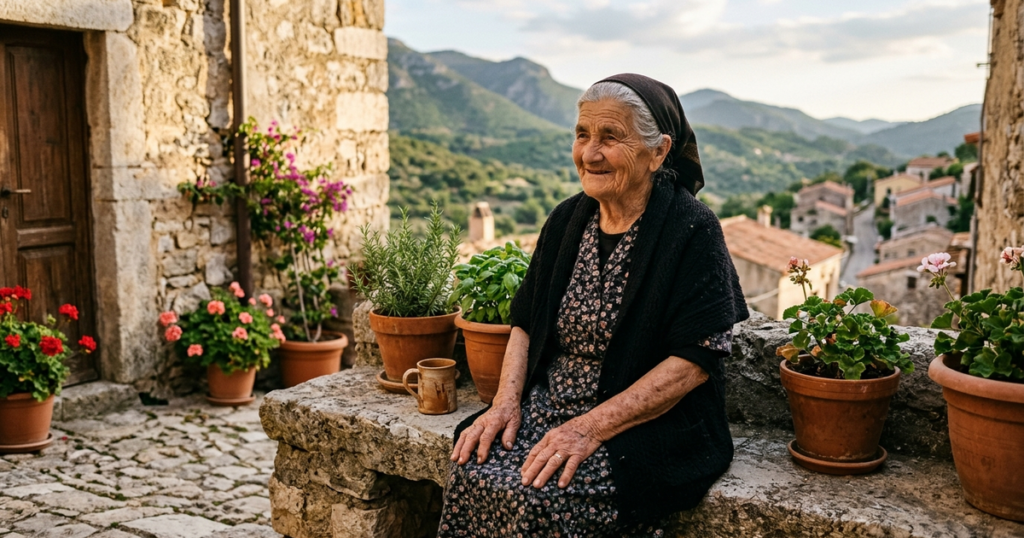
For more than two decades, the rugged mountain villages of Sardinia, Italy, have anchored global longevity research. Designated in 1999 as the world’s first “Blue Zone”—a region where populations experience exceptional healthspan—the central-eastern Sardinian highlands drew worldwide attention for an unusual demographic feature: an equal 1:1 ratio between male and female centenarians, contrasting with the four-to-one female skew typical in other developed countries.
Now, a demographic study in Frontiers in Aging reveals a surprising new chapter in Mediterranean longevity. In the mountain municipality of Bolotana, located in central Sardinia’s Marghine range, researchers identified an unprecedented cluster of late-life survival driven predominantly by women.
According to sex-specific partial period life tables constructed by biodemographers, a woman in Bolotana reaching age 70 has an estimated 13.83% probability of reaching age 100. This conditional survival rate is nearly four times higher than national averages in Italy (3.59%) and the United States (3.55%), establishing Bolotana as a premier candidate Blue Zone.
The Demographic Discovery: A 13.8% Conditional Surge to Age 100
The investigation, “A new blue zone? Exceptional late-life survival in Bolotana, Sardinia,” was led by Dr. Giovanni Mario Pes alongside biodemographer S. Jay Olshansky, biogerontologist Steven N. Austad, and Dan Buettner. Analyzing municipal cohorts from 2021 through 2025, the team evaluated whether this centenarian concentration reflected genuine biological resilience rather than statistical noise.
In biodemography, conditional survival (S70→100) measures the likelihood that someone reaching age 70 survives to 100. In mainland Italy, this probability for women is 3.59%; in the United States, CDC/NCHS life tables place it at 3.55%.
In Bolotana, that probability reaches 13.83%. In addition, remaining life expectancy at age 70 (e70) for local women averages approximately 20.8 years, among the highest values recorded globally and second only to benchmarks in Hong Kong.
Rigorous Age Verification and Archival Confirmation
Because extreme longevity claims can stem from clerical errors or pension fraud, the authors conducted archival validation. The investigators cross-referenced civil records (the anagrafe) with Roman Catholic parish baptismal and funeral registers from the Diocese of Alghero-Bosa dating back over a century. By reconstructing unbroken family trees, the team confirmed that every recorded centenarian was biologically verified, refuting clerical inaccuracies.
Why Bolotana Differs: Female Longevity vs. the Original Blue Zone
Bolotana presents an intriguing contrast to the original Sardinian Blue Zone documented by Poulain, Pes, and colleagues in Experimental Gerontology (2004). That historical zone, situated in Ogliastra and Nuoro, featured parity between male and female centenarians, fueled by cardiovascular resilience among lifelong mountain shepherds.
In Bolotana, men enjoy favorable longevity typical of the Sardinian highlands, but women demonstrate an unparalleled late-life survival advantage. Why does this mountain community cultivate such female endurance?
Because Bolotana has roughly 2,500 residents, demographic metrics can naturally fluctuate across cohorts—a pattern scientists term “waxing and waning.” The authors therefore classified Bolotana as a candidate Blue Zone rather than a permanent designation, calling for continued longitudinal observation.
The Bolotana Lifestyle Equation: Movement, Nutrition, and Social Fabric
Genetic surveys suggest that inherited biology accounts for only 20% to 25% of human lifespan variation; daily habits and environmental context drive the remaining 75% to 80%. In Bolotana, researchers point to three primary mechanisms:
1. Lifelong Non-Exercise Physical Activity (NEAT)
Bolotana rests on the steep slopes of the Marghine range. Rather than gym workouts, residents accumulate continuous Non-Exercise Activity Thermogenesis (NEAT). Elderly women maintain daily routines of climbing steep inclines, tending terraced gardens, and managing household chores. This sustained, low-intensity exertion delivers the metabolic perks of Zone 2 training, supporting mitochondrial health into advanced age.
2. The Mountain Pastoral Diet
As documented by Pes and colleagues in Maturitas, the traditional mountain diet is deeply plant-centered:
- Legumes and Garden Greens: Broad beans (fava beans) and chickpeas supply dietary protein and fiber, paired with wild greens rich in polyphenols.
- Sourdough Whole Grains: Traditional flatbreads (such as pane carasau), made from durum wheat and fermented with wild lactobacilli, produce a modest glycemic response and nourish gut flora.
- Polyphenol-Rich Olive Oil: Cold-pressed extra virgin olive oil delivers monounsaturated oleic acid and squalene.
- Grass-Fed Sheep Dairy: Modest portions of aged pecorino cheese from pasture-grazed sheep provide bioavailable calcium, omega-3s, and conjugated linoleic acid (CLA).
- Minimal Red Meat and Sugar: Meat was historically limited to holidays, while ultra-processed foods were absent during formative decades.
3. Familism and the “Mot de Bibere”
In Bolotana, elders remain central to multi-generational households. Older women care for grandchildren and guide family decisions. This social fabric cultivates what Sardinians term mot de bibere—a compelling reason to live. Public health data from the World Health Organization connects strong social integration with lower chronic stress and improved cardiovascular health.
Comparative Survival Data Across Populations
The table below summarizes conditional survival metrics and centenarian demographics across analyzed cohorts:
| Region / Cohort | Remaining Life Expectancy at 70 (e70) | Conditional Survival: Age 70 to 100 (S70→100) | Centenarian Sex Ratio (Women : Men) | Primary Data Source |
|---|---|---|---|---|
| Bolotana, Sardinia (Women) | ~20.8 years | 13.83% | Predominantly Female (~3.5:1) | Frontiers in Aging (2026) |
| Mainland Italy (Women) | ~16.5 years | 3.59% | ~4.2 : 1 | ISTAT / Frontiers (2026) |
| United States (Women) | ~16.2 years | 3.55% | ~4.5 : 1 | CDC / NCHS Life Tables |
| Original Sardinian Blue Zone | ~17.5 years | ~8.00% | ~1 : 1 Parity | Poulain et al., Exp Gerontol (2004) |
Source: Adapted from Pes GM, Austad SN, Buettner D, et al. Frontiers in Aging (2026); Poulain M, et al. Experimental Gerontology (2004); and CDC/NCHS Life Table Reports.
Scientific Caveats: Association vs. Causation
Distinguishing between population associations and individual causation is essential. While traditional lifestyle habits correlate strongly with longevity in this cohort, observational studies cannot prove that adopting isolated factors guarantees extended lifespan.
Key methodological boundaries include:
- Small Population Cohorts: With 2,500 residents, minor mortality shifts can influence period life tables. Continued multi-year tracking is required.
- Survivor Selection: Centenarians alive today survived childhood hardships and historical epidemics, representing a resilient genetic subgroup.
- Dietary Transitions: As ultra-processed foods reach rural communities, researchers caution that these longevity advantages could diminish in younger generations if traditional habits fade.
Translating Blue Zone Principles into Daily Habits
You do not need to live in Sardinia to benefit from these longevity insights. Everyday preventive habits include:
- Incorporate Daily Functional Movement: Build baseline activity through walking, stair climbing, and post-meal strolls rather than relying solely on gym sessions.
- Center Your Diet on Beans and Greens: Emphasize a plant-forward plate rich in legumes, leafy greens, whole grains, and extra virgin olive oil while minimizing ultra-processed foods.
- Nurture Intergenerational Community: Cultivate meaningful social connections, family meals, and community purpose, which protect against loneliness and chronic stress.
Related Reading
- Blue Zones Diet: What the Longest-Lived People Eat
- Mediterranean Diet and Longevity: What the Science Shows
- Zone 2 Training: Benefits for Metabolism and Longevity
Sources and Further Reading
- Pes GM, Austad SN, Buettner D, Pedde S, Romerio V, Beltrán-Sánchez H, Olshansky SJ. A new blue zone? Exceptional late-life survival in Bolotana, Sardinia. Frontiers in Aging, October 2026; 7:1951042.
- Poulain M, Pes GM, Grasland C, Carru C, Ferrucci L, Baggio G, Franceschi C, Deiana L. Identification of a geographic area characterized by extreme longevity in the Sardinia island: the AKEA study. Experimental Gerontology, 2004; 39(9):1423-1429.
- Pes GM, Dore MP, Tsofliou F, Poulain M. Diet and longevity in the Blue Zones: A set-and-forget issue?. Maturitas, 2022; 164:11-15.
- National Institute on Aging. What Do We Know About Healthy Aging?. National Institutes of Health, April 2026.
- World Health Organization. Ageing and Health Fact Sheet. World Health Organization, October 2024.
Disclosure: This content is for informational purposes only and is not medical advice. Always consult a qualified healthcare provider before making changes to your health regimen.