
Japanese Food for Kids: Healthy Dishes, Bento Ideas and Safe Prep by Age
Japanese home cooking (rice, soup, fish, tofu, vegetables) adapts well to children. This Healthy Foods for Kids guide covers healthy Japanese dishes for kids, bento lunch ideas and snacks, with safe prep for each age. For the adult traditions and evidence, see Japanese healing foods.
Why Japanese food can work for kids
Mayo Clinic recommends nutrient-dense foods for children, including seafood, eggs, soy products, a variety of vegetables and fruits, and whole grains, while limiting added sugar and salt. (Mayo Clinic) Fatty fish such as salmon provide the omega-3s EPA and DHA. (NIH ODS)
Top 10 Japanese foods for kids
| Food | Why and how for kids |
|---|---|
| Rice | offer a variety of grains; CDC advises not relying on rice cereal alone for babies (arsenic) (CDC) |
| Tofu | soft protein; soy is a common allergen (AAP / HealthyChildren.org) |
| Salmon | omega-3s; remove every bone (NIH ODS) |
| Tamagoyaki (egg) | early allergen; cook through, no added sugar for under-2s (AAP / HealthyChildren.org) |
| Edamame | fiber and protein; split or mash for under-4s (CDC) |
| Soba or udon noodles | cut short for toddlers; wheat or buckwheat allergens (AAP / HealthyChildren.org) |
| Sweet potato | cook soft and mash (CDC) |
| Broccoli and spinach | calcium and iron from vegetables (NIH ODS) |
| Nori (seaweed) | iodine-rich; small amounts (NIH ODS) |
| Plain yogurt | calcium; no added sugar (NIH ODS) |
Ages and stages
| Stage | Ideas |
|---|---|
| Toddler (1 to 3) | Soft rice with flaked boneless salmon, silken tofu cubes, mashed sweet potato, soft-cooked vegetables, well-cooked egg |
| School-age (4 to 12) | Bento with onigiri, tamagoyaki, edamame, cucumber and fruit; soba with vegetables |
| Teen (13+) | Cook-together donburi bowls with fish or tofu, vegetables and brown rice |
Choking-safe prep by age
Choking is a leading cause of death for infants and young children, and the AAP advises keeping high-risk foods from children until age 4 or older, depending on development. Round, firm foods such as hot dogs or grapes can be served if completely chopped into tiny pieces, and food for young children should be cut into pieces no larger than one-half inch. (AAP / HealthyChildren.org)
| Age | What to know |
|---|---|
| 6 to 12 months | Start solids at about 6 months (not before 4 months). Begin with smooth, mashed or pureed foods, then thicker and lumpier textures as skills develop. Cook hard vegetables and fruit until soft enough to mash with a fork. (CDC) |
| 1 to 3 years | Cut grapes, cherries, berries and cherry tomatoes into small pieces; cut hot dogs, sausage and string cheese into short thin strips; avoid whole nuts and seeds, chunks or spoonfuls of nut butter, popcorn, hard raw vegetables and fruit pieces, whole beans, and hard or gummy candy. (CDC) (CDC) |
| 4 to 8 years | Many children can handle more textures from about age 4, depending on development and maturity. Keep the rules: sit to eat, no running or lying down with food, and supervise. (AAP / HealthyChildren.org) |
| 9 years and up (school-age and teens) | Choking risk falls, but older siblings often hand risky foods or small objects to younger children, so keep an eye on mixed-age tables. (AAP / HealthyChildren.org) |
Flags for this cuisine: Mochi and sticky rice cakes (avoid for young children; CDC advises avoiding small, sticky or hard foods), whole edamame and beans (split or mash), fish bones, long slippery noodles (cut short), and hard or gummy candy. Soy, wheat, egg, fish, shellfish and sesame are common allergens in Japanese dishes. (CDC) (AAP / HealthyChildren.org)
Allergens: early peanut and egg introduction
Most food allergies are caused by cow’s milk, eggs, peanuts, soy, wheat, tree nuts, fish, shellfish and sesame. (AAP / HealthyChildren.org) The AAP says that once a baby tolerates a few first foods and is not at increased risk, highly allergenic foods such as egg, nut products, dairy, wheat, sesame, soy, fish and shellfish can be introduced, and that peanut-containing products should ideally be introduced to these babies as early as 4 to 6 months. Start with small tastes, then keep the food in the diet routinely in infant-safe forms, such as thinned peanut butter or well-cooked egg. (AAP / HealthyChildren.org)
NIAID’s 2017 guidelines for preventing peanut allergy grew out of the LEAP study, and later research found that giving infants other allergy-causing foods such as milk and egg may also help prevent food allergy. (NIH / NIAID) (NIH / NIAID) If your baby has severe eczema or an egg allergy, talk with your child’s doctor about when and how to introduce peanut foods safely. (CDC)
Honey, added sugar and salt
- No honey before 12 months. Honey can cause infant botulism, a severe food poisoning. Do not add honey to a baby’s food, water, formula or pacifier, and skip honey-glazed dishes for babies. Honey is safe from age 1. (CDC) (AAP / HealthyChildren.org)
- No added sugar under 2. Children younger than 24 months should not have added sugars. (CDC) The Dietary Guidelines for Americans, as summarized by CDC, recommends that children younger than 11 have no added sugar. (CDC)
- Drinks: water and plain milk are the best choices. No juice under 1 year; if you offer 100% juice later, the AAP suggests no more than 4 ounces a day at ages 2 to 3 and 4 to 6 ounces at ages 4 to 5. Whole fruit is always preferred. (AAP / HealthyChildren.org)
- Salt: avoid feeding high-salt foods to young children, such as some canned foods, processed meats and some packaged toddler snacks. (CDC) Salty condiments add sodium fast: one tablespoon of soy sauce can have more than 800 mg of sodium. (Mayo Clinic) Limit salty condiments such as soy sauce, ketchup and dressings, and season with herbs, spices and citrus instead. (Mayo Clinic)
- Fish: avoid high-mercury fish such as king mackerel, marlin, orange roughy, shark, swordfish, Gulf tilefish and bigeye tuna; many other fish are lower in mercury and support a healthy diet. (CDC)
Japanese food for kids’ lunch: bento ideas
- Small onigiri (rice ball) with flaked salmon, plus cucumber sticks (cooked soft for toddlers) and fruit
- Tamagoyaki slices, steamed broccoli and mandarin segments
- Soba noodle salad with shredded chicken and vegetables, light on sauce
- Tofu and vegetable rice with a side of plain yogurt
Use reduced-sodium soy sauce sparingly; one tablespoon of regular soy sauce can have more than 800 mg of sodium. (Mayo Clinic) Related: calcium-rich foods, ginger tofu stir-fry and children’s blood pressure screening.
Nearby cuisines: Japanese healing foods · Chinese foods for kids · Indian foods for kids · American foods for kids · Korean foods for kids · Thai foods for kids
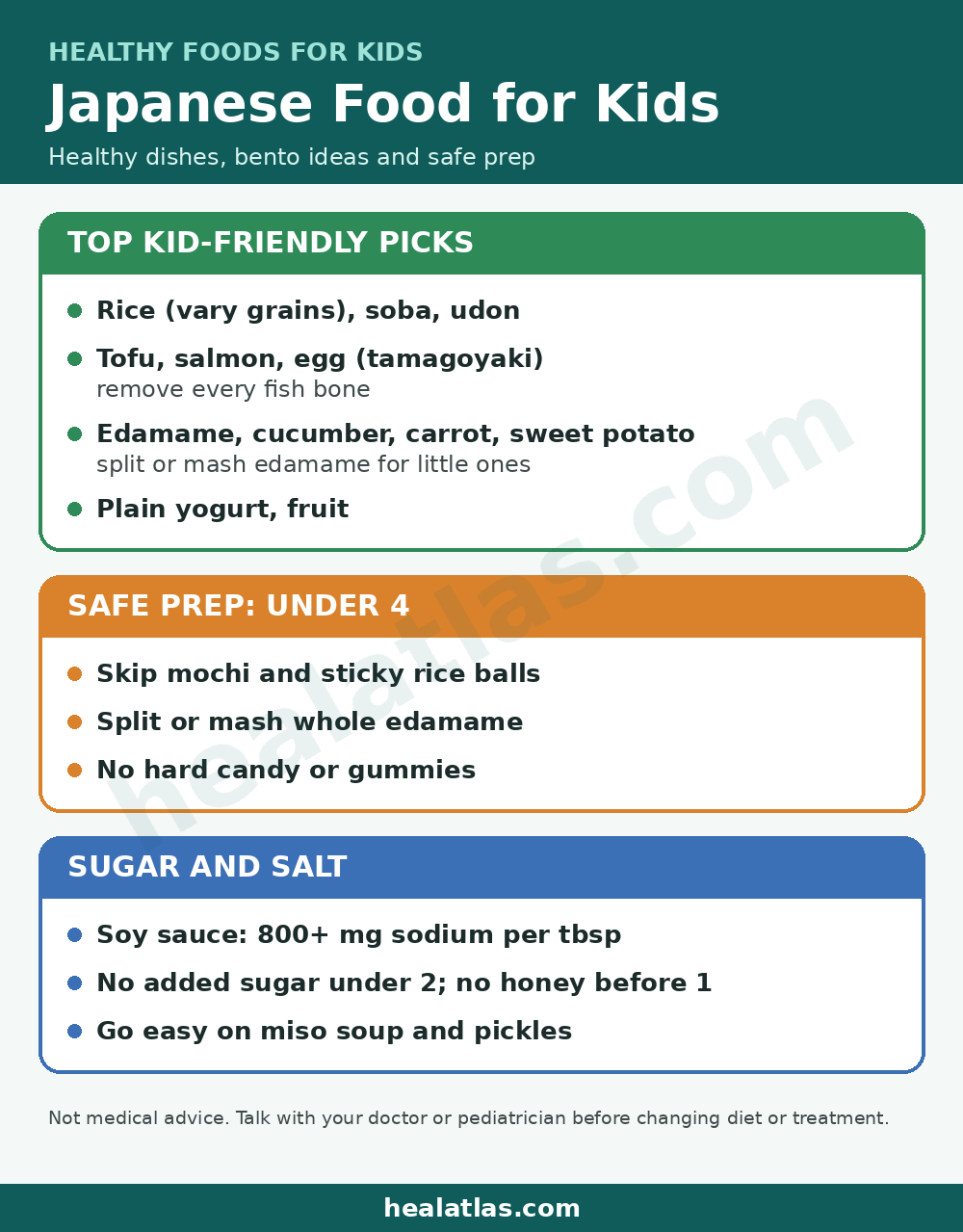
Infographic
Related on HealAtlas: Healthy Foods for Kids hub · Japanese healing foods · Children’s blood pressure screening · Calcium-rich foods · Infant allergy, egg and peanut research
FAQ
What Japanese foods should kids try?
Good starters are rice, tofu, boneless salmon, tamagoyaki (egg), edamame (split for little ones), soba or udon cut short, and soft-cooked vegetables. These fit Mayo Clinic’s advice to choose seafood, eggs, soy products, vegetables and whole grains. (Mayo Clinic)
Is mochi safe for children?
Mochi is sticky and hard to chew. CDC advises avoiding small, sticky or hard foods for young children, and the AAP advises keeping high-risk foods away until age 4 or older depending on development. (CDC) (AAP / HealthyChildren.org)
Is rice safe for babies?
Rice can be part of a varied diet. CDC advises offering a variety of infant cereals such as oat, barley and multigrain rather than only rice cereal, because feeding only rice cereal can increase arsenic exposure. (CDC)
When can my baby have peanut and egg?
The AAP says peanut-containing foods can ideally be introduced as early as 4 to 6 months for babies who tolerate first foods and are not at increased risk, alongside other allergens such as egg, in infant-safe forms. If your baby has severe eczema or an egg allergy, ask your child’s doctor first. (AAP / HealthyChildren.org) (CDC)
Is honey safe for babies?
No. Do not give honey to children younger than 12 months because it can cause infant botulism. Honey is safe from age 1. (CDC) (AAP / HealthyChildren.org)
Can toddlers have soy sauce or fish sauce?
Soy sauce and fish sauce are very salty and may add a lot of sodium: USDA data list about 1,410 mg of sodium per tablespoon of fish sauce (18 g; about 7,850 mg per 100 g; FDC ID 174531), and CDC advises avoiding high-salt foods for young children. Leave soy sauce, fish sauce and other salty condiments out of baby portions and use only a few drops for older kids. (USDA FoodData Central) (CDC)
Sources
- CDC. Choking Hazards (Infant and Toddler Nutrition). https://www.cdc.gov/infant-toddler-nutrition/foods-and-drinks/choking-hazards.html (accessed Oct 25, 2026)
- HealthyChildren.org (AAP). Choking Prevention for Babies & Children. https://www.healthychildren.org/English/health-issues/injuries-emergencies/Pages/Choking-Prevention.aspx (accessed Oct 25, 2026)
- CDC. Foods and Drinks to Avoid or Limit (Infant and Toddler Nutrition). https://www.cdc.gov/infant-toddler-nutrition/foods-and-drinks/foods-and-drinks-to-avoid-or-limit.html (accessed Oct 25, 2026)
- CDC. When, What, and How to Introduce Solid Foods. https://www.cdc.gov/infant-toddler-nutrition/foods-and-drinks/when-what-and-how-to-introduce-solid-foods.html (accessed Oct 25, 2026)
- HealthyChildren.org (AAP). When to Introduce Egg, Peanut Butter & Other Common Food Allergens to a Baby. https://www.healthychildren.org/English/healthy-living/nutrition/Pages/when-to-introduce-egg-peanut-butter-and-other-common-food-allergens-to-your-baby-food-allergy-prevention-tips.aspx (accessed Oct 25, 2026)
- HealthyChildren.org (AAP). Food Allergies in Children. https://www.healthychildren.org/English/healthy-living/nutrition/Pages/Food-Allergies-in-Children.aspx (accessed Oct 25, 2026)
- NIAID (NIH). Food Allergy Causes and Prevention. https://www.niaid.nih.gov/diseases-conditions/food-allergy-causes-prevention (accessed Oct 25, 2026)
- NIAID (NIH). Guidelines for Clinicians and Patients for Diagnosis and Management of Food Allergy. https://www.niaid.nih.gov/diseases-conditions/guidelines-clinicians-and-patients-food-allergy (accessed Oct 25, 2026)
- HealthyChildren.org (AAP). Botulism. https://www.healthychildren.org/English/health-issues/conditions/infections/Pages/Botulism.aspx (accessed Oct 25, 2026)
- HealthyChildren.org (AAP). Recommended Drinks for Children Age 5 & Younger. https://www.healthychildren.org/English/healthy-living/nutrition/Pages/Recommended-Drinks-for-Young-Children-Ages-0-5.aspx (accessed Oct 25, 2026)
- CDC. Get the Facts: Added Sugars. https://www.cdc.gov/nutrition/php/data-research/added-sugars.html (accessed Oct 25, 2026)
- Mayo Clinic. Nutrition for kids: Guidelines for a healthy diet. https://www.mayoclinic.org/healthy-lifestyle/childrens-health/in-depth/nutrition-for-kids/art-20049335 (accessed Oct 25, 2026)
- USDA FoodData Central. Sauce, fish, ready-to-serve, SR Legacy FDC ID 174531 (7,850 mg sodium per 100 g; 1 tablespoon = 18 g). https://fdc.nal.usda.gov/food-search/?query=fish%20sauce (accessed Oct 26, 2026)
- Mayo Clinic. Sodium: How to tame your salt habit. https://www.mayoclinic.org/healthy-lifestyle/nutrition-and-healthy-eating/in-depth/sodium/art-20045479 (accessed Oct 25, 2026)
- NIH Office of Dietary Supplements. Calcium: Fact Sheet for Consumers. https://ods.od.nih.gov/factsheets/Calcium-Consumer/ (accessed Oct 25, 2026)
- NIH Office of Dietary Supplements. Omega-3 Fatty Acids: Fact Sheet for Consumers. https://ods.od.nih.gov/factsheets/Omega3FattyAcids-Consumer/ (accessed Oct 25, 2026)
- NIH Office of Dietary Supplements. Iodine: Fact Sheet for Consumers. https://ods.od.nih.gov/factsheets/Iodine-Consumer/ (accessed Oct 25, 2026)