
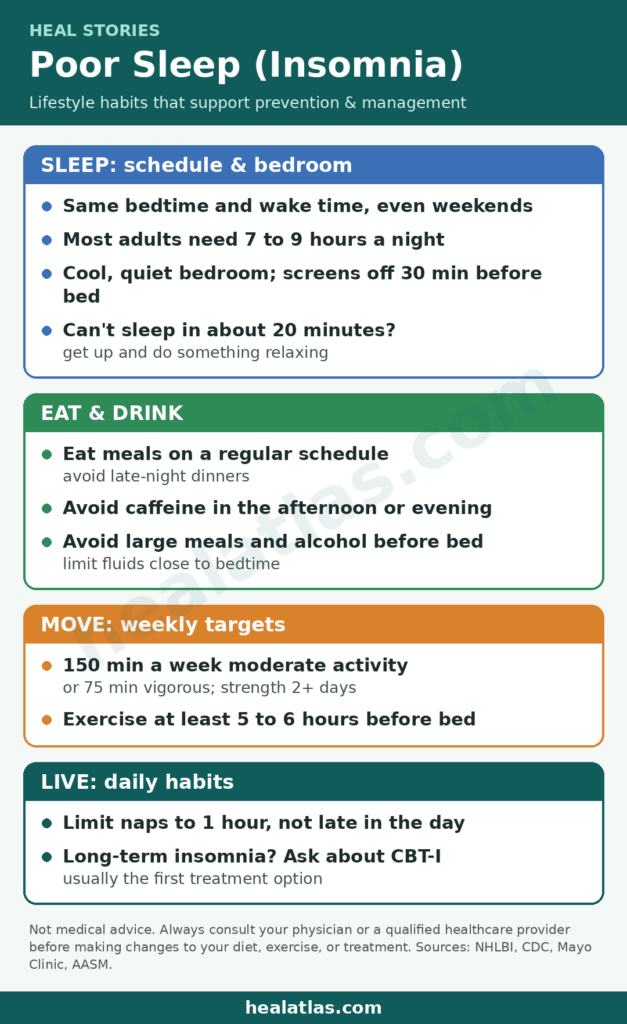
Nearly everyone has an occasional sleepless night, and ongoing poor sleep can be addressed. (Mayo Clinic) This Heal Stories guide pulls together what trusted health organizations say about everyday habits that support prevention and management of insomnia, alongside the care plan you build with your healthcare provider.
What it is
Insomnia is a common sleep disorder. With insomnia, you may have trouble falling asleep, staying asleep, or getting good quality sleep, even if you have the time and the right environment to sleep well. Short-term insomnia may be caused by stress or changes in your schedule or environment and can last for a few days or weeks. Chronic insomnia occurs 3 or more nights a week, lasts more than 3 months, and cannot be fully explained by another health problem. (NHLBI)
Most adults need 7 to 9 hours of sleep a night. (Mayo Clinic) The CDC recommends 7 or more hours for adults ages 18 to 60. (CDC) Chronic insomnia raises your risk of high blood pressure, coronary heart disease, diabetes, and cancer. (NHLBI)
Your chances of insomnia rise as you get older, and it is more common in women than in men. Shift or night work, travel across time zones, irregular routines, long daytime naps, too little physical activity, caffeine, nicotine, alcohol, screens close to bedtime, and stress all raise the risk. (NHLBI)
Signs that mean see a doctor now
- If you are in crisis or having thoughts of suicide, call or text 988 right away. (NIMH) Thoughts of suicide may occur with chronic insomnia. (NHLBI)
- See your doctor if insomnia makes it hard for you to do daily activities. Your doctor will look for the cause and may suggest testing at a sleep center if a sleep disorder is suspected. (Mayo Clinic)
- Sleep disorders such as sleep apnea, which causes you to stop breathing at times during the night, and restless legs syndrome can disrupt sleep. (Mayo Clinic) Talk to your healthcare provider if you regularly have problems sleeping or notice signs of a sleep disorder. (CDC)
- If you are being treated, tell your doctor about any new or worsening symptoms or side effects from your medicines. (NHLBI)
Prevention
Good sleep habits can help prevent insomnia. (Mayo Clinic)
- Keep a regular schedule: go to bed and get up at the same time every day, including weekends. (Mayo Clinic) (CDC)
- Stay active. Regular activity can lead to a good night’s sleep. (Mayo Clinic)
- Limit naps to no more than one hour and avoid napping late in the day. (Mayo Clinic)
- Make your bedroom sleep friendly: quiet, relaxing, and cool; turn off electronic devices at least 30 minutes before bedtime. (CDC)
- Use your bed only for sleep and sex, and create a relaxing bedtime ritual, such as a warm bath, reading, or soft music. (Mayo Clinic)
- If you can’t fall asleep within about 20 minutes, leave the bedroom and do something relaxing, then go back to bed when you’re tired. (Mayo Clinic)
For long-term insomnia, cognitive behavioral therapy for insomnia (CBT-I), a 6- to 8-week treatment plan, is usually recommended as the first treatment option. (NHLBI) The American Academy of Sleep Medicine strongly recommends multicomponent CBT-I for chronic insomnia in adults and suggests not using sleep hygiene alone as a single treatment. (AASM guideline)
Food practices
What and when you eat and drink can affect sleep. NHLBI advises eating meals on a regular schedule and avoiding late-night dinners. (NHLBI)
Foods to favor
- Meals on a regular schedule (NHLBI)
- Heart-healthy foods: vegetables, fruits, whole grains, fat-free or low-fat dairy, fish, lean meats, beans, nuts, and seeds. NHLBI recommends healthy sleep habits in addition to a heart-healthy lifestyle. (NHLBI) (NHLBI)
- A light snack before bedtime is OK if you’re hungry (Mayo Clinic)
Foods to limit
- Caffeine in the afternoon or evening. Coffee, tea, cola, and other caffeinated drinks are stimulants. (CDC) (Mayo Clinic)
- Alcohol before bedtime. It may make you feel sleepy at first, but it can disrupt sleep later in the night. (Mayo Clinic)
- Heavy or large meals within a couple of hours of bedtime (Mayo Clinic)
- Lots of fluids close to bedtime, which can wake you to use the bathroom (NHLBI)
- Nicotine, another stimulant that can disrupt sleep (Mayo Clinic)
Many people take melatonin supplements, but research has not proven that melatonin is an effective treatment for insomnia; talk to your provider before using dietary supplements. (NHLBI)
A sample day of meals
An example day built from the guidance above. Needs vary; your provider can tailor it. (NHLBI)
| Meal | Example |
|---|---|
| Breakfast | Oatmeal with fruit and low-fat yogurt; morning coffee or tea if you drink it |
| Lunch | Salad with beans or grilled chicken and whole-grain bread |
| Snack | Fruit and a small handful of nuts; caffeine-free drinks from the afternoon on |
| Dinner | At a regular, not late, time: baked salmon, brown rice, and vegetables |
| Evening | A light snack only if hungry; limit fluids close to bedtime; no alcohol before bed |
Exercise and lifestyle habits
Regular physical activity can promote better sleep. (Mayo Clinic) A meta-analysis of 66 studies found regular exercise had small benefits for total sleep time and sleep efficiency, small-to-medium benefits for how long it takes to fall asleep, and moderate benefits for sleep quality. (PubMed review)
| Habit | How often | How intense |
|---|---|---|
| Moderate aerobic activity, such as brisk walking | At least 150 minutes a week, e.g. 30 minutes a day, 5 days a week | Moderate intensity |
| Or vigorous aerobic activity, such as jogging or running | 75 minutes a week, or an equivalent mix | Vigorous intensity |
| Muscle strengthening (all major muscle groups) | 2 or more days a week | — |
| Exercise timing | During the daytime, at least 5 to 6 hours before going to bed | — |
| Sleep schedule | Same bedtime and wake time daily; set aside no more than 8 hours in bed | — |
| Naps | No more than 1 hour, not late in the day | — |
| Wind-down and stress management (reading, soothing music, a hot bath, meditation, yoga) | Nightly | Relaxing |
Sources for the table: (CDC) (NHLBI) (Mayo Clinic)
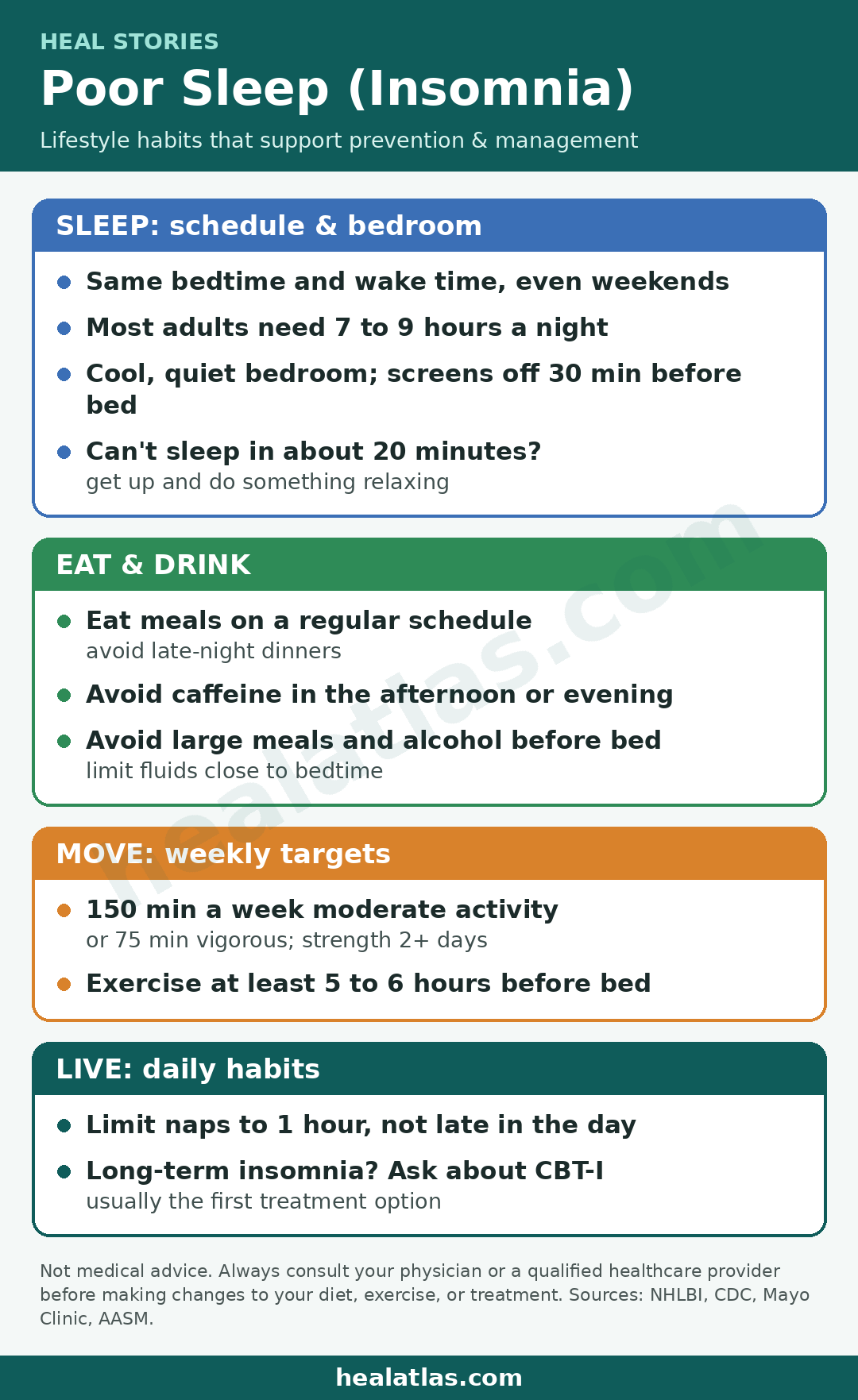
Infographic
Related on HealAtlas: Insomnia and stroke risk: what a 1.3M-person review found · Caffeine and deep sleep: how 100 mg disrupts slow waves · NSDR and yoga nidra: how 20 minutes resets brain and sleep
FAQ
What is the recommended first treatment for chronic insomnia?
Cognitive behavioral therapy for insomnia (CBT-I), a 6- to 8-week plan, is usually recommended as the first treatment for long-term insomnia. The American Academy of Sleep Medicine strongly recommends multicomponent CBT-I for adults with chronic insomnia. (NHLBI) (AASM guideline)
How much sleep do adults need?
The CDC recommends 7 or more hours for adults ages 18 to 60, 7 to 9 hours for ages 61 to 64, and 7 to 8 hours for adults 65 and older. (CDC)
Does exercise help with sleep?
Regular physical activity can promote better sleep, and a meta-analysis found regular exercise had moderate benefits for sleep quality. NHLBI suggests exercising during the daytime, at least 5 to 6 hours before going to bed. (Mayo Clinic) (PubMed review) (NHLBI)
Should I take melatonin or sleep medicines?
Research has not proven that melatonin is an effective treatment for insomnia, and you should talk to your provider before using supplements. Talk to your doctor about the benefits and side effects of insomnia medicines, and tell them about any side effects. (NHLBI) (NHLBI)
How do caffeine and alcohol affect sleep?
Caffeine is a stimulant whose effects take hours to wear off, so avoid it in the afternoon or evening. Alcohol might make you feel sleepy at first, but it can disrupt sleep later in the night. (Mayo Clinic) (CDC)
When should I see a doctor about poor sleep?
See your doctor if insomnia makes it hard to do daily activities or you regularly have problems sleeping. If you are in crisis or having thoughts of suicide, call or text 988 right away. (Mayo Clinic) (CDC) (NIMH)
Sources
- CDC. Adult Activity: An Overview. https://www.cdc.gov/physical-activity-basics/guidelines/adults.html (accessed Oct 25, 2026)
- NHLBI (NIH). What Is Insomnia? https://www.nhlbi.nih.gov/health/insomnia (accessed Oct 25, 2026)
- NHLBI (NIH). Insomnia – Causes and Risk Factors. https://www.nhlbi.nih.gov/health/insomnia/causes (accessed Oct 25, 2026)
- NHLBI (NIH). Insomnia – Treatment. https://www.nhlbi.nih.gov/health/insomnia/treatment (accessed Oct 25, 2026)
- NHLBI (NIH). Living With Insomnia. https://www.nhlbi.nih.gov/health/insomnia/living-with (accessed Oct 25, 2026)
- Mayo Clinic. Insomnia – Symptoms and causes. https://www.mayoclinic.org/diseases-conditions/insomnia/symptoms-causes/syc-20355167 (accessed Oct 25, 2026)
- Mayo Clinic. Sleep tips: 6 steps to better sleep. https://www.mayoclinic.org/healthy-lifestyle/adult-health/in-depth/sleep/art-20048379 (accessed Oct 25, 2026)
- CDC. About Sleep. https://www.cdc.gov/sleep/about/index.html (accessed Oct 25, 2026)
- NIMH (NIH). Suicide Prevention. https://www.nimh.nih.gov/health/topics/suicide-prevention (accessed Oct 25, 2026)
- NHLBI (NIH). Choose Heart-Healthy Foods. https://www.nhlbi.nih.gov/health/heart-healthy-living/healthy-foods (accessed Oct 25, 2026)
- Edinger JD, et al. Behavioral and psychological treatments for chronic insomnia disorder in adults: an American Academy of Sleep Medicine clinical practice guideline. J Clin Sleep Med. 2021. PMID 33164742. https://pubmed.ncbi.nlm.nih.gov/33164742/ (accessed Oct 25, 2026)
- Kredlow MA, et al. The effects of physical activity on sleep: a meta-analytic review. J Behav Med. 2015. PMID 25596964. https://pubmed.ncbi.nlm.nih.gov/25596964/ (accessed Oct 25, 2026)