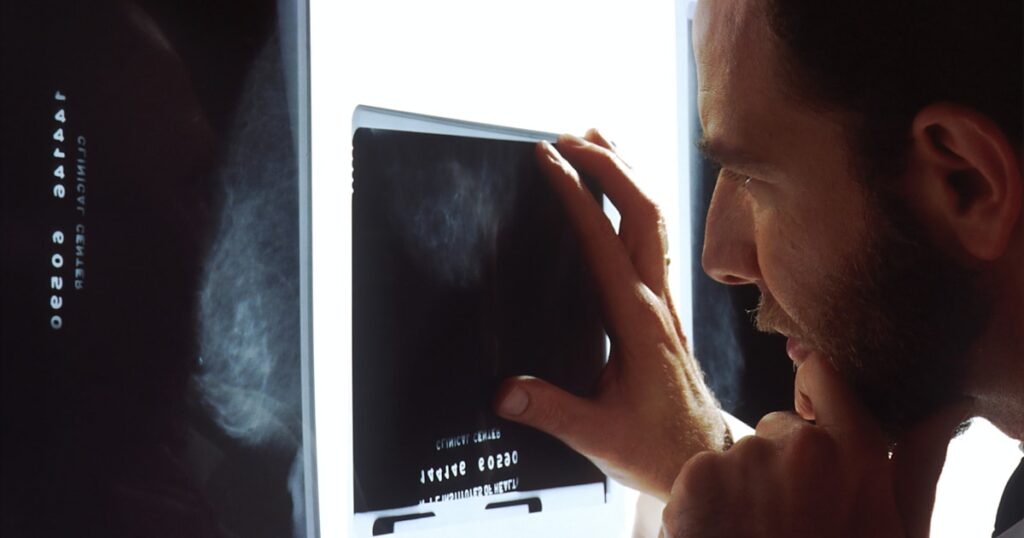
Artificial intelligence may be able to see what radiologists can’t — not yet. A new analysis published in the journal Radiology reports that commercial AI systems, when re-run against years of stored mammograms, flagged suspicious changes in roughly 1 in 5 breast cancer cases up to six years before the women involved received a formal diagnosis. The finding sharpens a growing question for screening programs worldwide: how soon, and how confidently, can software begin to change when and how breast cancer is found?
What the new study found
Researchers led by Fredrik Strand, MD, PhD, of Karolinska University Hospital in Stockholm, drew on Sweden’s Validation of Artificial Intelligence for Breast Imaging database to examine 88,963 mammograms from more than 31,000 women. Within that group, 12,072 went on to develop breast cancer over the study window (2008–2019). The team retrospectively ran three commercially available, FDA-cleared AI computer-aided detection systems against the historical images to ask a simple question: how early could the algorithms have flagged a cancer that was eventually diagnosed by standard care?
At a 90% specificity threshold — a level chosen to keep false positives low — the AI systems identified:
- 19.7% of eventual cancers six years before diagnosis
- 25.2% four years before diagnosis
- 39.3% two years before diagnosis
“Our study shows that, for many patients, cancer signs detectable by AI appear several years before human radiologists find the signs suspicious enough to lead to clinical work-up,” Strand said in a statement accompanying the paper. In other words, the algorithms were not necessarily seeing the tumor itself — they were learning to recognize subtle, pre-clinical tissue patterns that statistically tracked toward later disease.
How AI sees what radiologists can’t — yet
Modern mammography AI is trained on millions of labeled images and learns features that are not always intuitive to the human eye: texture, asymmetry between breasts, density gradients, and the architecture of fibroglandular tissue. These are inputs that radiologists also use, but algorithms can quantify them at a scale and consistency people cannot match across a 10-hour reading day.
The Karolinska result echoes earlier work. The MASAI trial, a prospective Swedish study published in The Lancet Oncology in 2023, found that AI-supported reading detected about 20% more cancers than the standard double-read approach, without raising the recall rate. A separate large study from researchers at MIT and Massachusetts General Hospital published in Science Translational Medicine showed that an algorithm called Mirai could predict five-year breast cancer risk more accurately than traditional risk models that rely on family history and hormonal factors.
Three commercial systems, one direction
Notably, the new Karolinska paper tested three different commercial AI products. All three showed an early-warning signal, suggesting the effect is not unique to a single vendor’s algorithm and that the underlying biology — cancers that develop slowly, leaving subtle traces in tissue — is at least partially learnable from imaging alone.
What this could mean for screening
Breast cancer remains the most common cancer in women worldwide. The World Health Organization estimates that 2.3 million women were diagnosed in 2022, and 670,000 died from the disease. The U.S. Preventive Services Task Force in 2024 lowered the recommended starting age for routine mammography from 50 to 40 for women at average risk, citing rising incidence in younger adults.
Against that backdrop, even modest gains in early detection matter. The American Cancer Society reports that five-year survival is 99% when breast cancer is found at a localized stage, compared with 31% once it has spread to distant organs. Tools that nudge detection earlier — even by months — can change which treatments are available and how disruptive they are.
Researchers also see a different role for these systems: risk-tiered screening. Instead of recommending every woman the same schedule, AI scores from a current mammogram might one day help identify who should be screened more often, who could be referred for supplemental MRI, and who could safely lengthen their interval. That kind of personalization is already being piloted in Sweden, the UK, and parts of the Netherlands.
The limits behind the headline
The Karolinska results are striking but should be read with care. The analysis was retrospective, meaning the algorithms looked back at images whose outcomes were already known. Prospective trials — where AI guides real-time decisions for women who don’t yet have a diagnosis — are the gold standard, and only a handful are underway.
A 19.7% detection rate six years out also means roughly 4 in 5 eventual cancers were not flagged at that point. That is not a failure — cancers grow at different speeds, and some genuinely are not visible six years before they become clinically detectable. But it does mean an AI “all clear” is not yet a guarantee of cancer-free years ahead.
There are equity questions, too. Most large mammography AI datasets skew toward European populations, and performance can degrade in women with denser breast tissue, in younger patients, and in some racial and ethnic groups underrepresented in training data. Research published in JAMA Network Open in 2023 found measurable performance gaps for Black and Asian American women across several leading algorithms — a gap the field is actively working to close.
What to do with this information today
For now, AI mammography sits alongside, not in place of, human radiologists in most clinics. If you are eligible for breast cancer screening, current guidance from major medical bodies still applies:
- Talk with your healthcare provider about when to start screening based on your personal and family history.
- Know your breast density — dense tissue can both raise risk and make cancers harder to spot.
- Ask whether your imaging center uses AI-assisted reading. It does not change what you do, but it is a reasonable question to understand your care.
- Stay current with follow-up appointments; early-detection technology only helps if you show up for screenings.
The bigger story is the trajectory. Studies like the Karolinska analysis suggest the question is shifting from whether AI can read a mammogram to how health systems should use what it finds, especially when the algorithm is looking years into a person’s future. The answer will take more trials, careful regulation, and continued attention to who benefits — and who is still being missed.
Disclosure: This content is for informational purposes only and is not medical advice. Always consult a qualified healthcare provider before making changes to your health regimen.