
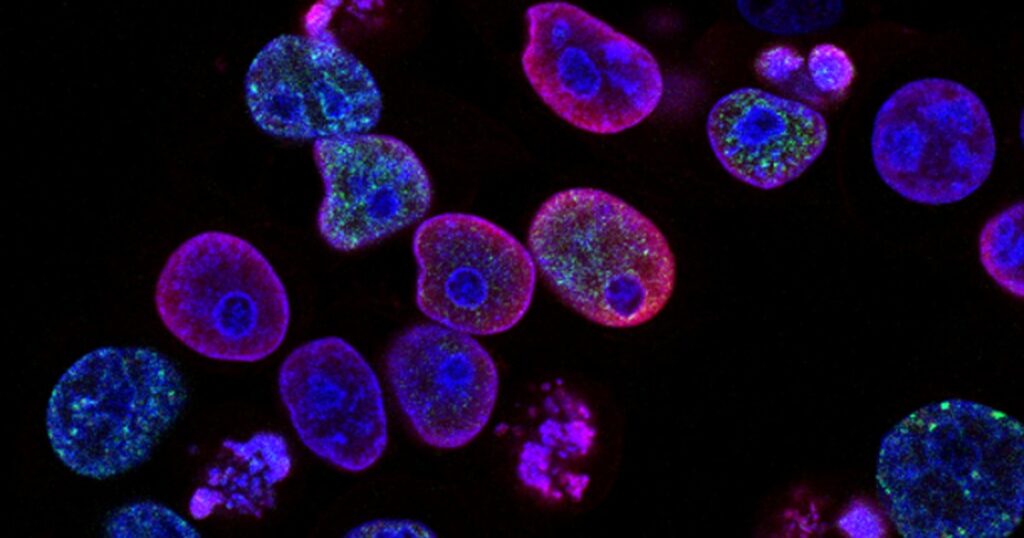
A new artificial intelligence tool funded by the National Institutes of Health (NIH) can predict how long cancer patients are likely to survive — not by analyzing whole tumors, but by examining the genetic behavior of individual cells within them. The model, called scSurvival, marks a significant advance in precision oncology and could eventually transform how oncologists assess patient risk and plan treatment.
The research was conducted at Oregon Health & Science University (OHSU) and published in April 2026 in Cancer Discovery, a peer-reviewed journal of the American Association for Cancer Research (DOI: 10.1158/2159-8290.CD-25-0965).
What Is scSurvival?
scSurvival is a machine learning algorithm designed to work with single-cell RNA sequencing (scRNA-seq) data — a technology that reads the genetic activity of individual cells within a tumor. While scRNA-seq has existed for years, using it reliably to predict patient survival had remained a major challenge. scSurvival is engineered specifically to bridge that gap.
The key innovation lies in how the model handles cellular diversity. Rather than averaging gene expression across an entire tumor — which can mask critical signals from minority cell populations — scSurvival assigns each individual cell a survival-related weight. Those weights are then aggregated to generate a patient-level risk score that preserves the nuances of tumor composition instead of flattening them.
Why Single-Cell Analysis Changes Everything
Tumors are not uniform structures. They contain dozens of distinct cell types — cancer cells, immune cells, stromal cells, and more — each behaving differently and potentially responding to treatment in unique ways. Traditional bulk tumor analysis mixes all these cells together, producing a blurred average that can obscure the signals most relevant to prognosis.
“Single-cell resolution lets us see what is actually happening inside a tumor at a granular level,” said Zheng Xia, Ph.D., associate professor of biomedical engineering at OHSU and the study’s corresponding author. “scSurvival translates that granular data into something clinically actionable.”
Research suggests that a tumor’s immune cell composition — particularly the presence of T cells, natural killer cells, and tumor-infiltrating lymphocytes — is strongly associated with how well patients respond to immunotherapy and how long they survive. The single-cell approach makes these signals visible in ways that bulk analysis cannot.
What the Research Found
The OHSU team tested scSurvival on clinical data from more than 150 cancer patients, training the model on datasets drawn from hundreds of additional cases. In both melanoma and liver cancer (hepatocellular carcinoma), the model outperformed traditional survival prediction methods.
In melanoma patients, scSurvival identified specific immune cell populations linked to stronger responses to checkpoint inhibitor immunotherapy — a class of drugs that helps the immune system recognize and attack cancer cells. Being able to predict immunotherapy response before treatment begins could spare patients from ineffective therapies and direct them toward options more likely to succeed.
In liver cancer, the tool flagged cell populations associated with higher or lower survival risk, providing prognostic detail that standard tumor profiling had missed. Studies indicate this kind of cellular-level information could add a meaningful new layer to how oncologists evaluate difficult-to-stage cancers.
How It Compares to Current Methods
Today, cancer prognosis relies on a combination of tumor staging, imaging, biomarker panels, and pathology reports. These approaches are valuable but inherently limited — they describe the tumor at a population level, not at the resolution of individual cells.
Researchers envision scSurvival as a complement to existing diagnostics, not a replacement. Rather than overturning current workflows, the model would add a precision layer, particularly for patients with ambiguous staging or those being evaluated for immunotherapy eligibility.
Anthony Letai, M.D., Ph.D., director of the National Cancer Institute (NCI), has emphasized that linking cellular-level biological data to clinical outcomes represents a critical frontier in oncology. “Understanding tumor biology at this resolution is essential for developing the next generation of targeted therapies,” he has noted in NCI communications.
What This Could Mean for Patients
The potential implications extend well beyond prognosis. If scSurvival can reliably identify which cell populations drive survival outcomes, it may also help researchers:
- Design immunotherapies targeting specific cell types linked to poor outcomes
- Identify patients most likely to benefit from checkpoint inhibitors before treatment starts
- Monitor tumor changes over time to detect early resistance to therapy
- Uncover new therapeutic targets in cancers with limited treatment options
For patients, this kind of precision could translate into fewer cycles of ineffective chemotherapy, faster access to the right treatment, and ultimately better outcomes. Consult with an oncologist about whether single-cell genomic profiling may be appropriate for your care.
The Road to Clinical Practice
Like most research breakthroughs, scSurvival’s path from laboratory to routine clinical use will take time. Single-cell RNA sequencing remains expensive and requires specialized laboratory infrastructure, limiting its availability in community hospital settings. Researchers also need to validate the model across larger and more diverse patient cohorts, and across additional cancer types beyond melanoma and liver cancer.
However, the trajectory of genomic sequencing costs — which have fallen dramatically over the past two decades — suggests that single-cell analysis may become widely accessible within the next decade. As costs drop and AI models like scSurvival are refined and independently validated, the technology could move from academic research centers into clinical workflows faster than many expect.
AI and the Future of Oncology
scSurvival is one of many AI tools being developed to improve cancer diagnosis, treatment selection, and survival prediction. Research suggests that machine learning models trained on biological data — from genomics and proteomics to medical imaging — can detect patterns at a scale and resolution that was previously impossible.
What distinguishes scSurvival is its focus on the single-cell level, which many researchers consider the most information-rich layer of tumor biology. As the technology matures, tools like this may form the foundation of a new era in cancer care — one in which treatment decisions are guided not just by tumor type and stage, but by the precise cellular landscape of each patient’s individual tumor.
The NIH-funded study was published in Cancer Discovery in April 2026 and represents an important proof of concept in the broader effort to make cancer medicine more personalized and more effective.
Disclosure: This content is for informational purposes only and is not medical advice. Always consult a qualified healthcare provider before making changes to your health regimen.