
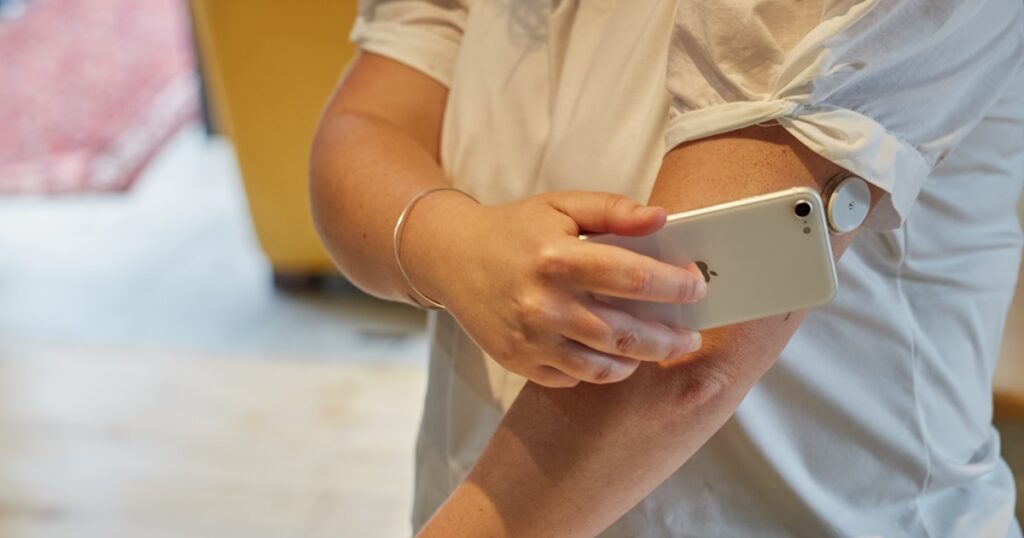
For decades, continuous glucose monitors (CGMs) were a tool reserved for people with diabetes. That changed in 2024, when the FDA cleared Dexcom’s Stelo and Abbott’s Lingo as the first over-the-counter CGMs in the United States. Suddenly, anyone with about $50 a month could wear a coin-sized sensor on their arm and watch their blood sugar rise and fall in real time.
The technology has become a cornerstone of the so-called metabolic health movement, with high-profile founders, athletes, and wellness influencers crediting CGMs for sharper energy, smarter food choices, and better sleep. But the science behind wearing a glucose monitor when you do not have diabetes is more nuanced than the marketing suggests.
What a Continuous Glucose Monitor Actually Measures
A CGM is a small sensor — typically worn on the back of the upper arm — that measures glucose in the fluid surrounding cells just beneath the skin. It samples that level every one to five minutes and streams the data to a smartphone app, producing a 24-hour glucose curve rather than a single fingerstick snapshot.
For people with type 1 and type 2 diabetes, CGMs are well established. A 2017 randomized trial published in JAMA found that adults with type 1 diabetes who used a CGM had significantly better long-term blood sugar control than those using traditional finger sticks. Similar benefits have been reported in adults with type 2 diabetes using insulin.
Why Non-Diabetics Are Wearing Them
Outside diabetes care, CGMs are marketed as a window into metabolic health. The pitch: by watching how specific foods, workouts, and sleep patterns affect glucose, users can fine-tune lifestyle choices that may reduce the long-term risk of type 2 diabetes, cardiovascular disease, and weight gain.
There is a real concept underneath the hype. Glycemic variability — the magnitude of glucose ups and downs across the day — has been studied as a possible marker of cardiometabolic risk. Research published in Diabetes Care has linked higher daily glucose variability to oxidative stress and endothelial dysfunction, even in people whose average glucose levels are normal.
But translating that signal into useful action for a metabolically healthy adult is where the science gets thin.
What the Research Actually Shows
A 2022 review in Nature Reviews Endocrinology concluded that, although CGM data is fascinating, there is currently no consensus on what a “normal” glucose curve looks like in healthy non-diabetic adults, or on which patterns predict future disease. Reference ranges have been built almost entirely around diabetes risk, not optimization.
Several small studies have shown that personalized nutrition guided by CGM data can change eating behavior. A widely cited 2015 study in Cell from researchers at the Weizmann Institute found that glucose responses to identical meals varied dramatically between individuals — some people spiked sharply after bananas but not cookies, and vice versa. A follow-up algorithm using CGM data predicted personalized responses better than generic carb counts.
However, a 2024 randomized trial published in The American Journal of Clinical Nutrition compared non-diabetic adults using a CGM-guided diet to those using standard nutrition advice. After 12 weeks, both groups improved similarly on weight, waist circumference, and fasting glucose. The CGM did not produce additional benefit.
Potential Benefits — and Real Limits
For a healthy adult, the most defensible reasons to try a CGM are educational and behavioral:
- Personalized feedback. Seeing a 60-point post-meal spike from a “healthy” bowl of granola can prompt meaningful changes that vague advice (“eat less sugar”) rarely does.
- Identifying hidden risk. Some people discover frequent post-meal spikes or fasting glucose readings consistent with prediabetes, prompting earlier follow-up with a doctor.
- Reinforcing exercise and sleep habits. CGMs make the metabolic cost of a poor night’s sleep or a sedentary afternoon visible in a way that feels concrete.
The limits are equally real. Healthy people spike after meals — that is normal physiology, not a warning sign. The American Diabetes Association notes that glucose readings up to 140 mg/dL one to two hours after eating fall within the normal range. Treating every transient bump as a “crash” or “blood sugar emergency” can lead to unnecessary food restriction.
A 2023 commentary in JAMA Internal Medicine warned that widespread CGM use in non-diabetics could fuel orthorexia-like behaviors, food anxiety, and an overemphasis on optimization in people who are already healthy. The authors also noted that consumer CGMs can read 10–15 percent higher or lower than venous blood draws, so single readings should be interpreted cautiously.
Who Might Actually Benefit
Most endocrinologists draw a practical line. CGMs may offer meaningful insight for adults with:
- A family history of type 2 diabetes or known prediabetes
- Polycystic ovary syndrome (PCOS) or gestational diabetes history
- Stubborn weight that is not responding to standard nutrition advice
- Symptoms suggesting reactive hypoglycemia
For everyone else, a brief one-month trial under guidance from a registered dietitian or physician may be reasonable, but routine ongoing use is not supported by current evidence. Standard biomarkers — fasting glucose, HbA1c, lipid panel, blood pressure, waist circumference — remain the most clinically validated measures of metabolic health for healthy adults.
The Bottom Line
Continuous glucose monitors are no longer a futuristic device. They are accurate, increasingly affordable, and can deliver real insight to the right person at the right time. But for most healthy adults, a CGM is closer to a sophisticated nutrition coach than a true diagnostic tool — useful for learning, not for diagnosing.
If you are curious, consider trying one for two to four weeks, ideally alongside guidance from a healthcare professional who can help you separate normal glucose curves from genuine red flags. The data is only as valuable as the questions you bring to it.
Disclosure: This content is for informational purposes only and is not medical advice. Always consult a qualified healthcare provider before making changes to your health regimen.