
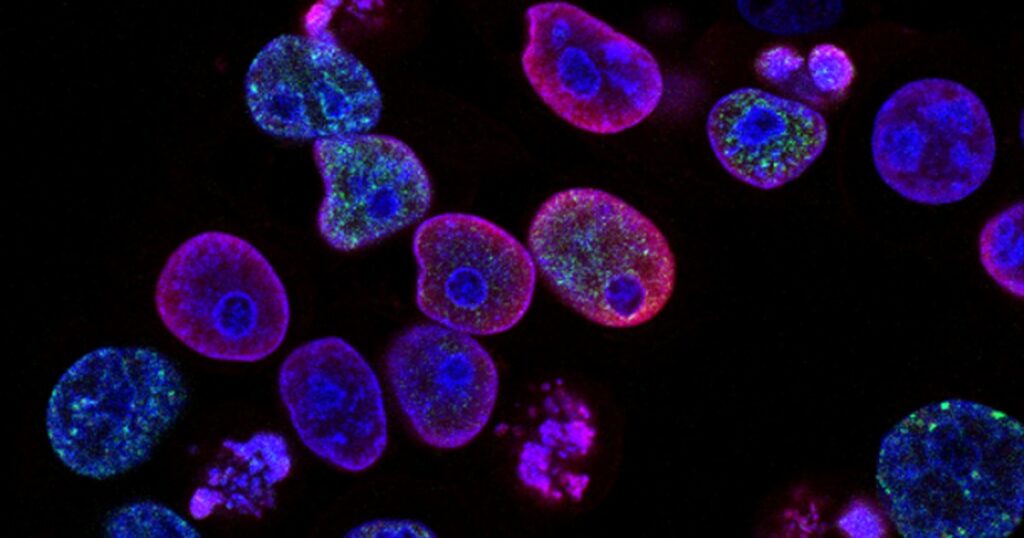
Predicting who will survive cancer — and why — has long been one of oncology’s greatest challenges. Two patients with the same diagnosis can have vastly different outcomes. A tumor visible to the eye may conceal a chaotic internal landscape of thousands of distinct cell types, each influencing how the disease behaves and responds to treatment.
A new artificial intelligence tool, developed with funding from the National Institutes of Health (NIH), may now offer a window into that microscopic landscape. Called scSurvival, the machine learning framework analyzes gene expression data from individual tumor cells to forecast patient survival — with a level of precision that traditional methods have struggled to match. The findings were published in April 2026 in the journal Cancer Discovery.
What Is scSurvival?
scSurvival is a machine learning framework designed to work with single-cell RNA sequencing data — a technology that captures gene activity not in bulk tissue samples, but cell by cell. By reading the molecular identity of each individual cell within a tumor, the system can map the internal diversity of the cancer in extraordinary detail.
Traditional tumor analysis often averages gene expression across thousands of cells simultaneously, which can obscure the contributions of rare but influential cell populations. scSurvival takes a different approach: it assigns a statistical weight to each cell based on how strongly that cell’s gene activity correlates with patient survival, then aggregates those weighted signals to produce an overall survival risk score.
According to the research team led by Zheng Xia, Ph.D., an associate professor at Oregon Health & Science University (OHSU), this granular method “not only tells you who may be at higher risk, but also provides clues as to why” — a distinction with significant implications for treatment planning.
How Single-Cell Analysis Changes the Picture
Tumors are not uniform masses. Even within a single biopsy, scientists have identified dozens of distinct cell subtypes — cancer cells at different stages of development, immune cells attempting to mount a defense, stromal cells that form the tumor’s structural scaffolding, and more. This cellular heterogeneity is increasingly understood to drive differences in how tumors grow, spread, and respond to therapy.
Bulk genomic analysis — the standard approach used in most current clinical tools — blends these signals together, losing the granularity that may determine whether a patient lives or dies. Single-cell sequencing preserves that granularity. scSurvival is designed specifically to exploit it.
In the study, the model was tested on clinical data from more than 150 cancer patients, and outperformed traditional survival prediction methods in accuracy across its target cancer types.
Key Findings: Melanoma and Liver Cancer
The research team applied scSurvival to two of oncology’s most challenging cancers: melanoma and hepatocellular carcinoma (the most common form of liver cancer).
Melanoma and Immunotherapy Response
In melanoma, scSurvival identified specific immune and tumor cell populations associated with better or worse outcomes — including populations linked to immunotherapy response. This is particularly significant because immunotherapy (using drugs that activate the immune system to attack cancer) has transformed melanoma treatment, but predicting which patients will benefit remains difficult. Research suggests that understanding the cellular composition of a tumor before treatment could help guide that decision.
The model’s ability to flag immune cell subtypes associated with treatment responsiveness could, if validated in future clinical trials, help oncologists identify which patients are most likely to benefit from immunotherapy — and which may need alternative strategies.
Liver Cancer and Risk Stratification
In liver cancer, scSurvival demonstrated the ability to stratify patients by survival risk based on the cellular makeup of their tumors. Liver cancer is notoriously difficult to treat partly because it is often diagnosed late, and because patient outcomes vary widely even at similar disease stages. Better risk prediction tools could help clinicians tailor follow-up schedules, prioritize patients for aggressive intervention, or guide enrollment in clinical trials.
Why This Matters for Precision Medicine
The emergence of tools like scSurvival reflects a broader shift in oncology toward precision medicine — the idea that cancer treatment should be tailored to the molecular and cellular characteristics of each patient’s tumor, not just its tissue of origin or stage.
National Cancer Institute director Anthony Letai, M.D., Ph.D., highlighted the significance of the research’s dual output: not just predicting risk, but identifying the cellular mechanisms behind that risk. That mechanistic insight is what could eventually allow oncologists to intervene upstream — before a tumor declares its behavior through clinical progression.
Studies indicate that single-cell approaches are rapidly becoming foundational to next-generation cancer diagnostics. As sequencing costs decline and computational tools like scSurvival mature, researchers anticipate that this type of analysis will become increasingly accessible in real-world clinical settings.
Current Limitations and the Road Ahead
It is important to note that scSurvival is currently a research tool, not a clinically approved diagnostic. The model’s findings were validated on a dataset of over 150 patients — promising, but a relatively small sample for the complexity of cancer biology. The researchers acknowledge that broader validation across diverse patient populations, cancer types, and treatment contexts will be needed before the tool could be integrated into routine clinical workflows.
Additionally, single-cell sequencing remains more expensive and technically demanding than standard pathology or bulk genomic testing, though costs have fallen dramatically over the past decade and continue to decline.
Future research may extend scSurvival’s framework to additional cancer types beyond melanoma and liver cancer. The underlying methodology — weighting individual cells by their relationship to survival — is theoretically applicable to any solid tumor for which single-cell sequencing data can be obtained.
What This Means for Cancer Research
The publication of scSurvival in Cancer Discovery adds to a growing body of evidence that artificial intelligence, when combined with high-resolution biological data, can uncover patterns invisible to conventional analysis. Earlier research in this space has shown AI’s promise in identifying cancer from imaging, predicting treatment resistance, and flagging early-stage tumors in blood tests.
scSurvival’s contribution is distinctive: it operates not on images or clinical records, but on the molecular language of cells themselves — gene expression data that encodes the functional identity of each cell in the tumor. By learning to read that language at scale, the model can, in effect, take a census of the tumor’s internal ecosystem and ask: which populations are associated with danger, and which with resilience?
The answer, researchers suggest, could eventually form the basis for more personalized treatment plans — ones that target not just the average tumor, but the specific cellular cast that makes each patient’s cancer unique.
Disclosure: This content is for informational purposes only and is not medical advice. Always consult a qualified healthcare provider before making changes to your health regimen.