
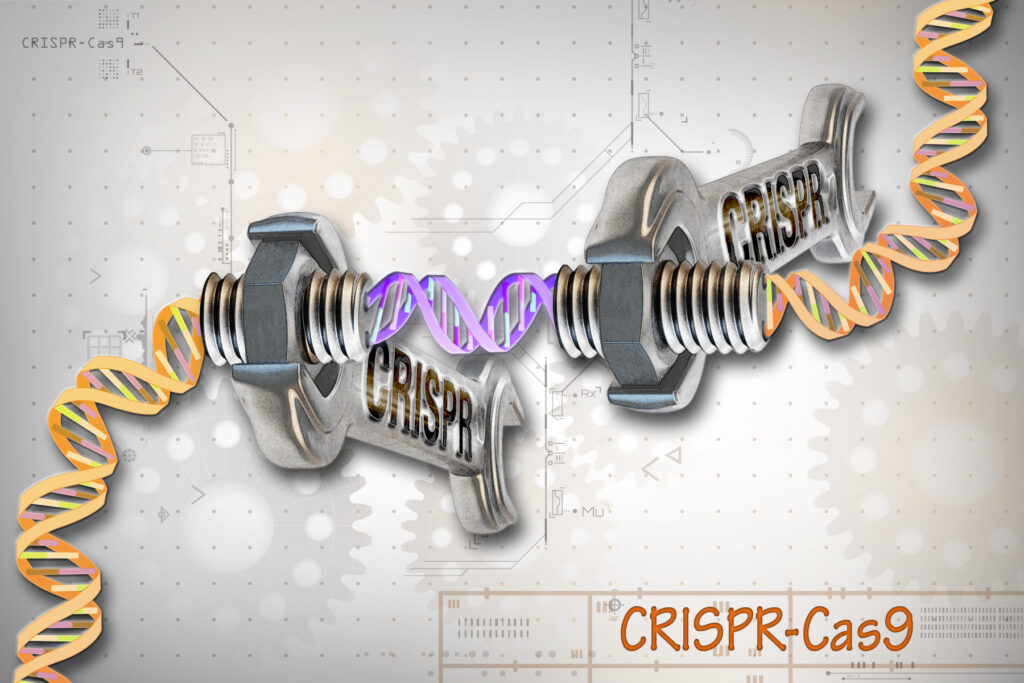
Gene editing has long promised to revolutionize medicine — rewriting the faulty DNA instructions behind cancer, neurological disease, and inherited disorders. But a persistent obstacle has stood in the way: getting the editing machinery into the right cells, inside a living body, without causing harm. A new NIH-funded breakthrough published in Nature Structural & Molecular Biology may have just cleared that hurdle.
The Size Problem With Traditional CRISPR
The CRISPR-Cas9 system — the gene-editing technology that earned its developers the 2020 Nobel Prize — works like molecular scissors, snipping DNA at precise locations. But Cas9 and most of its relatives are large proteins. Delivering them into human cells typically requires viral vectors, the biological “delivery trucks” scientists use to ferry genetic cargo into the body. The most common of these, adeno-associated viruses (AAVs), have a strict cargo size limit: roughly 4,700 base pairs.
Standard Cas9 and other popular CRISPR enzymes are simply too big to fit. This has forced researchers to use unwieldy workarounds — splitting the system across two viral particles or relying on delivery methods that are less precise, less safe, or harder to manufacture at scale.
Enter Al3Cas12f: A Miniaturized Gene Editor
Scientists at the University of Texas at Austin, led by molecular biosciences professor David Taylor, have now engineered a solution. Using cryo-electron microscopy imaging and machine learning analysis, they identified a naturally occurring enzyme called Al3Cas12f — a far smaller member of the CRISPR protein family. They then re-engineered it into an improved variant, Al3Cas12f RKK, that fits comfortably inside a single AAV particle.
The results were striking. Previous versions of this miniaturized enzyme achieved gene-editing efficiency below 10% — too low to be medically useful. The newly engineered Al3Cas12f RKK variant pushed that figure to over 80% across multiple genomic targets, and as high as 90% in certain genome regions, according to the study published in April 2026.
“It comes preassembled and ready to go shortly after its pieces are produced,” Taylor noted, highlighting one of the key practical advantages of the new system.
Which Diseases Could Benefit?
The implications span some of the most devastating conditions in modern medicine:
Cancer and Leukemia
Many cancers are driven by specific genetic mutations or by the body’s failure to suppress abnormal cell growth. Precise gene editing inside tumor cells — or inside immune cells engineered to fight cancer — could enable therapies that target cancer’s root causes rather than just its symptoms. The research team highlighted both solid tumors and blood cancers like leukemia as potential application areas.
ALS (Amyotrophic Lateral Sclerosis)
ALS, also called Lou Gehrig’s disease, is a fatal neurodegenerative condition affecting motor neurons. Certain inherited forms are caused by mutations in specific genes, such as SOD1. Research suggests that silencing or correcting these mutations via gene editing could slow or halt disease progression. Delivering CRISPR machinery across the blood-brain barrier has been one of the field’s most formidable challenges — and compact, AAV-compatible enzymes like Al3Cas12f RKK represent a meaningful step forward.
Atherosclerosis and Heart Disease
Atherosclerosis — the hardening and narrowing of arteries — is driven in part by genetic factors, including elevated LDL cholesterol levels tied to variants in the PCSK9 gene. Studies indicate that silencing PCSK9 via gene editing could offer a one-time, long-lasting reduction in cardiovascular risk. The miniaturized CRISPR system could make liver-targeted delivery for this purpose far more feasible.
How Machine Learning Made the Difference
One of the more remarkable aspects of this breakthrough is how it was discovered. The UT Austin team used cryo-electron microscopy — a technique that photographs molecular structures at near-atomic resolution — combined with machine learning algorithms to analyze the three-dimensional structure of Al3Cas12f. This allowed researchers to identify precisely which parts of the enzyme could be modified to boost its performance without sacrificing its compact size.
This fusion of structural biology and artificial intelligence is increasingly central to drug discovery and molecular medicine. It represents a shift from trial-and-error to computationally guided design — a trend that experts believe will accelerate biotechnology development significantly over the next decade.
What Comes Next
The research team’s immediate next step is packaging Al3Cas12f RKK into actual adeno-associated virus vectors and testing its performance in living biological systems. This will help scientists understand how the enzyme behaves when delivered through the body’s tissues, how long its effects last, and whether the immune system mounts any unwanted responses.
Clinical translation — the path from promising lab result to approved human therapy — typically takes years and involves rigorous safety and efficacy trials. Still, the significance of achieving 80–90% editing efficiency at this size class should not be understated. Many previous miniaturized CRISPR attempts stalled precisely because their editing efficiency was too low for therapeutic use. Al3Cas12f RKK appears to have crossed that threshold.
The research was funded by the National Institute of General Medical Sciences (NIGMS), part of the National Institutes of Health, and the study appeared in Nature Structural & Molecular Biology (DOI: 10.1038/s41594-026-01788-6).
Why This Matters Beyond the Lab
For patients living with ALS, inherited cancers, or severe cardiovascular disease, the promise of gene editing has often felt tantalizingly out of reach. Proof-of-concept studies have demonstrated that rewriting faulty DNA is possible — but the delivery problem has repeatedly delayed real-world application. This breakthrough directly addresses that bottleneck.
It also illustrates a broader pattern in biomedical research: the most important advances often come not from discovering a new mechanism, but from solving a fundamental engineering challenge. In this case, simply making a powerful tool small enough to use.
Consult your healthcare provider for personalized guidance on any genetic conditions or treatment options relevant to your health.
Disclosure: This content is for informational purposes only and is not medical advice. Always consult a qualified healthcare provider before making changes to your health regimen.